Eléctrico Interactivo
¿Qué es un neutro abierto? Síntomas, peligros y una demostración en vivo
Un neutro abierto puede elevar la mitad de los circuitos de una casa muy por encima de 120 V. Vea qué indica en un probador de contactos, los síntomas, qué hacer y una demostración en vivo.

Contenido
- ¿Qué es un neutro abierto?
- Open neutral symptoms and the warning signs of a loose neutral
- Cómo funciona un servicio de fase partida de 120/240 V
- Qué pasa cuando el neutro se abre
- Open the neutral yourself in our simulator
- Qué causa un neutro abierto y dónde falla
- Qué hacer si sospechas un neutro abierto
- Investigating an open neutral for attorneys, insurers and adjusters
- Preguntas frecuentes
If the neutral feeding a house breaks, half the circuits can run far above 120 V while the rest sag. That’s an open neutral. It can damage many appliances at once. The failing connection can overheat, and current can end up on the water pipes. A plug-in tester that reads “open neutral” at one outlet usually means a fault on just that circuit, which we cover below.
¿Términos desconocidos? Consulte el Glosario de ingeniería
If you think you have an open neutral, call your electric utility or a licensed electrician now. Don’t open the meter base or take the panel cover off, and stay away from anything that gives you a tingle.
Ve directo a los síntomas, qué hacer, el simulador en vivo o la investigación de un siniestro.
¿Qué es un neutro abierto?
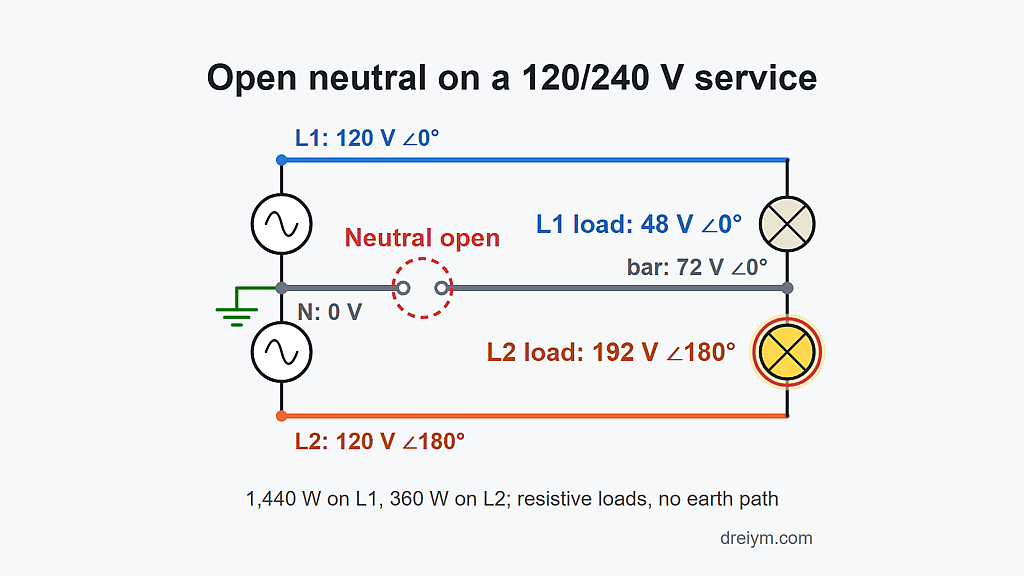
An open neutral is a break in the neutral wire somewhere between the utility transformer and your main panel. On a 120/240 V service, the neutral is what holds each half of the house at 120 V. Without it, the 120 V loads on the two legs end up in series across 240 V, and one half of the house runs high while the other runs low.
You’ll also hear electricians call it a lost neutral, a broken neutral or a floating neutral. A portable generator’s “floating neutral” is something else. A loose neutral is the same fault at an earlier stage: the connection still touches, just not very well.
Qué significa “neutro abierto” en un probador de contactos
A plug-in tester showing “open neutral” at one outlet means that branch circuit’s neutral is broken. The break could be at the receptacle, a splice upstream or back at the panel. Usually only that circuit is affected. The exception is a multiwire branch circuit, where two circuits share one neutral (2023 NEC 210.4). A break in that neutral does to both circuits what an open service neutral does to the house. Even when it’s just one circuit, a failing connection still heats up, so stop using the circuit and call a licensed electrician. Our guide to conexiones eléctricas flojas explains why. A tester checks wiring, not voltage, so a normal reading doesn’t rule out a problem with the service neutral.
Open neutral symptoms and the warning signs of a loose neutral
Loose neutral symptoms come and go as the connection makes and breaks contact. Once the neutral breaks completely, they stop coming and going, though they still change as appliances turn on and off. What to watch for:
- Lights getting brighter in some rooms and dimmer in others, especially when a microwave, heater or washer kicks on or off.
- Several electronics or appliances failing at once. Surge strips may fail or smell hot too.
- Electronics resetting, a UPS switching to battery, or motors that hum and struggle.
- A tingle when you touch a faucet, sink, tub or the frame of an appliance.
- Chisporroteo, zumbido u olor a quemado en el medidor o en el tablero.
- Una acometida aérea que cuelga más de lo normal, o daños después de una tormenta, la caída de una rama o el choque de un vehículo.
- Your neighbors on the same transformer are seeing the same thing.
Breakers rarely trip, because the loads themselves limit the current. That’s why an open neutral can go on for days. If half the house goes dead instead, you’re usually looking at a lost hot leg (see the FAQ).
Cómo funciona un servicio de fase partida de 120/240 V
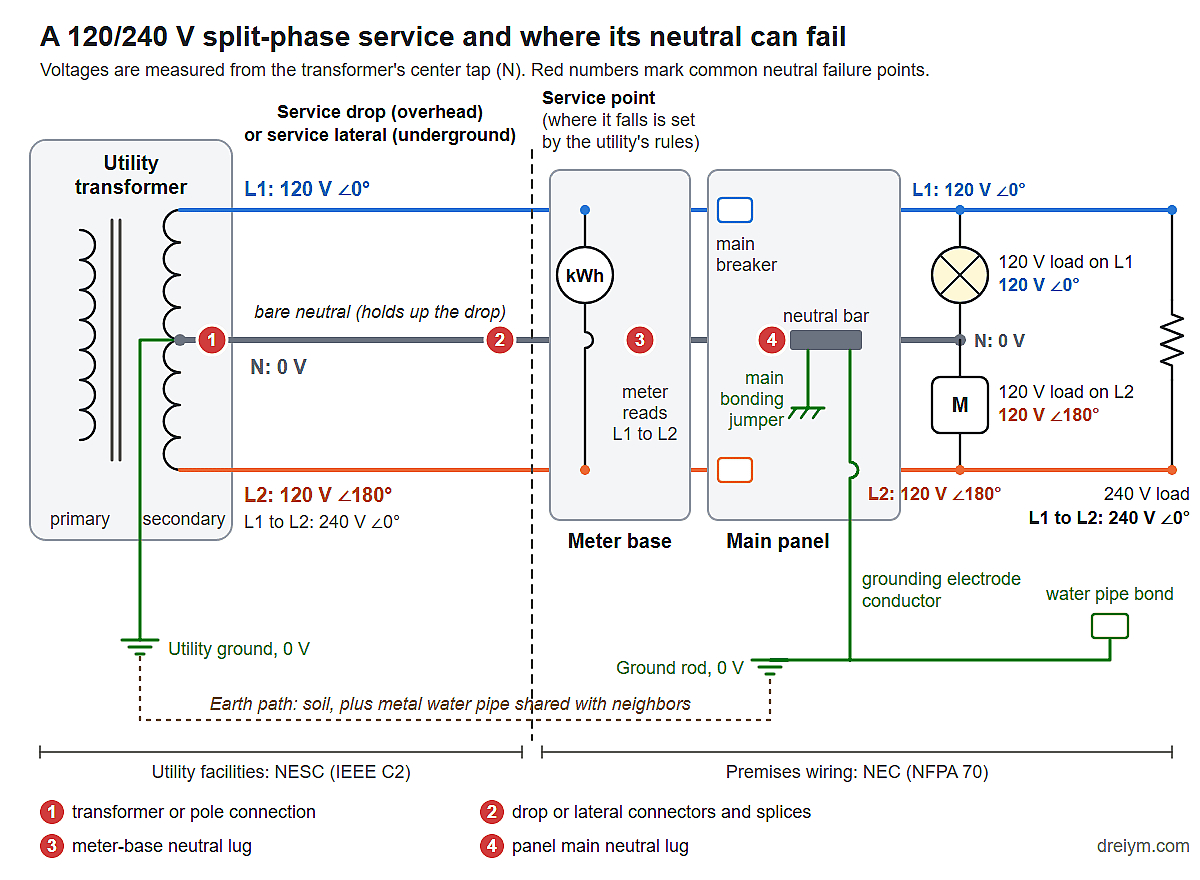
The utility transformer, on a pole or in a pad-mounted box, has a secondary winding tapped at its center. That center tap is the neutral (N). The ends of the winding are the hot legs, L1 and L2, and each measures 120 V to the neutral. They’re half a cycle apart (0° and 180°), so you measure 240 V from L1 to L2.
Lights, receptacles and most appliances run from one leg to the neutral at 120 V. Water heaters, air conditioners and EV chargers go across L1 and L2 at 240 V. Ranges and dryers use both: 240 V for heat, and 120 V for controls, lamps and motors. Many apartments have 120/208 V service instead, where an open neutral works the same way with different numbers.
¿El neutro conduce corriente?
Yes. On a branch circuit, the neutral carries all of that circuit’s current. On the service it carries the difference between the 120 V currents on the two legs, not their sum, so with 12 A on L1 and 3 A on L2 it carries 9 A. It also ties the house neutral to the transformer’s center tap, so each leg stays near 120 V.
¿El neutro es lo mismo que la tierra?
No. The neutral carries current in normal operation, while the equipment grounding conductors (the bare or green wires) are only meant to carry current during a fault. Inside the house the two are joined in just one place, at the service. That’s also where the neutral connects to the ground rod and the bonded metal water pipe (2023 NEC 250.24 and 250.104(A)(1)).
Qué pasa cuando el neutro se abre
With the neutral broken, current flows from L1 through the L1 loads, across the neutral bar and through the L2 loads to L2. The two groups are now in series across 240 V and split it in proportion to their resistance:
V(L1) = 240 V × R1 ÷ (R1 + R2)
V(L2) = 240 V × R2 ÷ (R1 + R2).
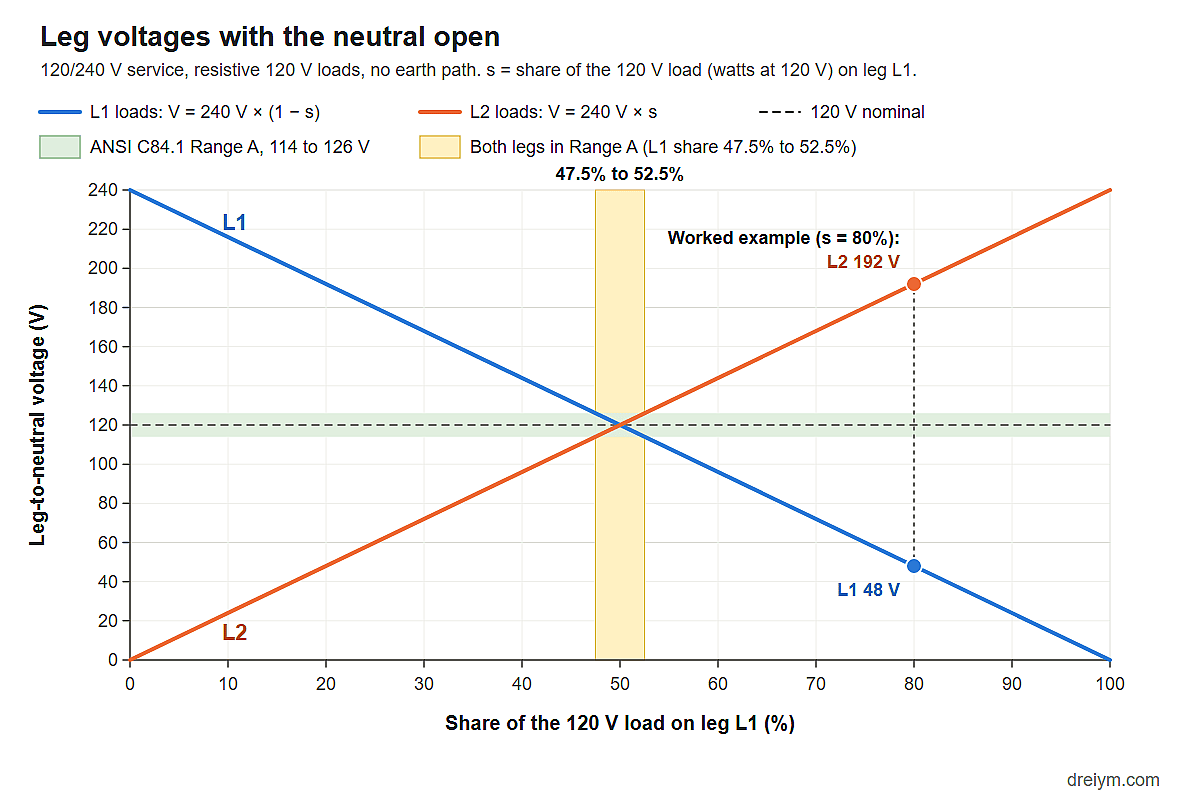
The leg with less load has the higher resistance, so it takes the bigger share and rises above 120 V, while the heavily loaded leg sags. Using rated watts at 120 V instead, V(L1) = 240 V × P2 ÷ (P1 + P2).
Un ejemplo resuelto
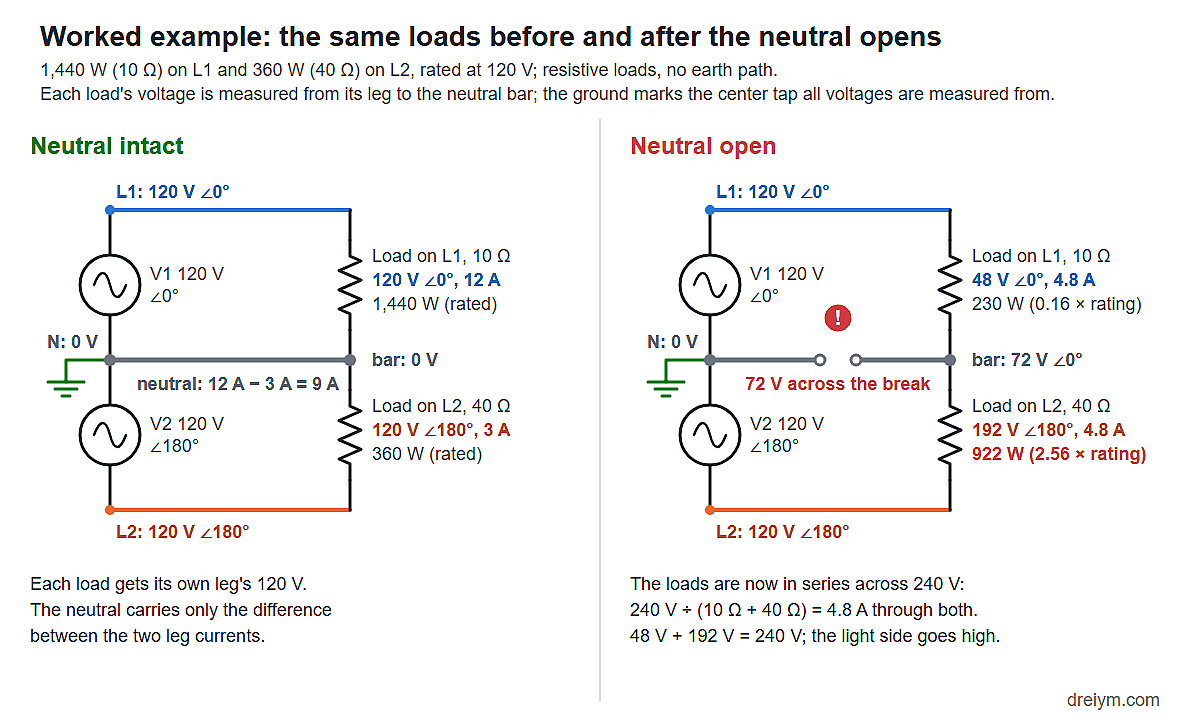
Here’s the example from our simulator: 1,440 W on L1 (10 Ω) and 360 W on L2 (40 Ω), both rated at 120 V.
| Magnitud | Neutro intacto | Neutro abierto |
|---|---|---|
| Carga en L1, 1,440 W nominales | 120 V, 12 A | 48 V, 4.8 A, 230 W |
| Carga en L2, 360 W nominales | 120 V, 3 A | 192 V, 4.8 A, 922 W |
| Neutro | 9 A | 0 A, 72 V en el punto de ruptura |
| Entre L1 y L2 | 240 V | 240 V |
With the neutral open, the same 4.8 A flows through both loads (240 V ÷ 50 Ω). Power goes up with the square of the voltage, so the 360 W load, now at 192 V, dissipates 922 W. That’s 2.56 times its rating.
How much ANSI C84.1 lets the voltage vary from 120 V
ANSI C84.1 (Table 1) puts Range A for a 120/240 V service at 114 to 126 V per leg. Range B, 110 to 127 V, is only tolerated for limited periods. Now suppose the neutral is fully open with no earth path, and use Range A as a yardstick for the loads. Both legs stay inside it only if the load split falls between 47.5% and 52.5%. An ordinary household imbalance puts at least one leg outside that band, often far outside.
When some current returns through the earth
Real open neutrals are often milder than the worked example. Some current gets back through the ground rod and soil, and through water pipes shared with neighbors. Bonded cable TV shields carry some too (2023 NEC Chapter 8). With one 25 Ω ground rod, our example comes out at about 65 V and 175 V, and about 2 A flows in the grounding electrode conductor. A metal water main can cut the swing to a few volts, but it may carry several amperes doing it.
The NEC doesn’t rely on the earth to clear faults. In its words, “The earth shall not be considered as an effective ground-fault current path” (2023 NEC 250.4(A)(5)). An open neutral pushes current through the earth anyway. The grounded metal in the house ends up tens of volts above the utility’s neutral, about 55 V in our example. That’s how someone at a faucet or a cut pipe can get shocked. See our articles on puesta a tierra y unión equipotencial y el tierra Ufer.
Open the neutral yourself in our simulator
The simulator below models the same service, with a heavy load on L1 and a light load on L2. In the “Open neutral explained” panel, switch the Neutral between Intact and Open, then change the loads and tick “Earth path” to see how the voltages move. It’s a teaching model built from ideal resistors, not a diagnostic tool. Real electronics and motors can behave worse, and LED lamps may not show the brightening. There are more examples in our simulador de circuitos en línea.
Servicio relacionado
Informes periciales para abogados, aseguradoras y propietarios. Aceptamos contrataciones solo como consultor.
Qué causa un neutro abierto y dónde falla
The numbered points on the service drawing above are where neutrals usually fail:
- The transformer or pole, at the neutral connection or one of the secondary splices.
- The drop or lateral, at the connectors on the house or an overhead splice. Underground, a neutral nicked during digging can corrode through.
- The meter base, where the neutral lug can work loose or oxidize. The neutral usually bypasses the meter itself.
- The main panel, at the main neutral lug or the neutral bar, especially with aluminum conductors that weren’t torqued to specification.
The usual causes are under-tightened connections, corrosion, storms, trees, vehicle strikes and plain age. On the house side, so are connectors that aren’t identified for aluminum (2023 NEC 110.14). A joint that’s gone resistive heats up and oxidizes further. With our example loads, a 1 Ω neutral joint dissipates about 64 W, enough to damage the connection before it opens.
Who is responsible, the utility or the owner?
El Código Nacional de Seguridad Eléctrica (NESC, IEEE C2) abarca las instalaciones de la compañía eléctrica hasta el punto de acometida (Regla 011B). El Código Eléctrico Nacional (NEC, NFPA 70) defines the service point in Article 100 and covers the premises wiring past it. Each utility’s rules say where that point is. Usually the utility owns the transformer, drop and meter, and the owner owns the meter base and panel, though underground laterals vary. Each side repairs its own equipment. Who pays for damage is a separate question that depends on where and why the neutral failed, and on tariff and policy terms.
Qué hacer si sospechas un neutro abierto
- Call the utility’s outage or emergency line first, since many of these failures are on the utility’s equipment.
- Then call a licensed electrician for the house side, and follow their advice about the main breaker.
- If anyone has felt a tingle, keep people and pets away from the plumbing fixtures. If anything smokes, sparks or feels hot, get out and call 911. Treat a sagging or fallen drop as energized.
- Stop using anything that has failed, and don’t count on surge strips to protect the rest. Sustained overvoltage can destroy them.
- Hang on to whatever failed. Photograph it where it is, and ask the crews to keep the parts they replace.
Don’t open the meter base, take off the panel cover or touch the service conductors, and don’t disconnect a ground wire or a metal water pipe either. The main lugs stay live even with the main breaker off. The grounding system may also be carrying neutral current, possibly from a neighbor’s service. Your main breaker does nothing to stop that.
Qué revisarán la compañía eléctrica y tu electricista
The utility’s crew will measure each leg to neutral, check its drop or lateral and the transformer connections, and repair its side. The utility may also disconnect a hazardous customer-side fault until it’s fixed.
Your electrician will measure each leg to neutral at the panel while putting a known 120 V load on one leg. If the neutral is bad, one leg goes up as the other goes down. They’ll also compare the current on the grounding electrode conductor and water-pipe bond with the current on the service neutral, and tighten the terminals to the manufacturer’s torque (2023 NEC 110.14(D)).
Investigating an open neutral for attorneys, insurers and adjusters
When several appliances fail together, or a fire starts at a service connection, the questions become forensic. The first is whether it was an open neutral at all. It could have been un rayo o un pico de voltaje de la compañía eléctrica, a primary-to-secondary contact or a lost hot leg. A neighbor’s open neutral or a shared branch-circuit neutral can look much the same. If it was the neutral, where, why and when did it fail? Whose equipment was it, and did it cause the claimed damage?
Preserva la evidencia antes de la reparación
The repair usually destroys the evidence, because crews replace the failed connector the same day. Send preservation requests as soon as a claim looks possible; counsel can advise on the duty to preserve. Ask the utility to hold the removed connectors, the drop or lateral section and the meter, along with its trouble tickets, work orders, photographs and meter data. Ask the electrician to keep any lugs they remove, and keep every damaged appliance. We document the scene as we find it, without disturbing connections. We keep a chain of custody and give all interested parties notice. As-found torque readings, disassembly and destructive tests wait until there’s an examination every party can attend. We follow ASTM E1188 and ASTM E860 and, for fires, NFPA 921.
Qué analizamos
- Why the connection let go: mechanical overload from a tree or ice load, wind-vibration fatigue, corrosion or heating at a high-resistance joint. Microscopy and, where needed, lab work (SEM/EDS, X-ray or CT of compression connectors) tell them apart, with the parts checked against exemplars and the maker’s specification.
- We map each damaged item to its breaker, its leg and what was running at the time. An open neutral should show up as overvoltage damage to 120 V equipment on the lighter-loaded leg and low-voltage effects (motors, compressors) on the heavier one. Purely 240 V loads such as water-heater elements are spared, though range and dryer controls run at 120 V and can fail. Because the high leg can change as loads cycle, we check damage on both legs against the timeline. Lightning and utility surges look different: they tend to hit both legs, 240 V equipment and anything with a cable, antenna or phone connection.
- Signs of current on the earth path, such as heated coax, arcing at pipe joints or an overheated grounding conductor.
- We also go through the records: trouble tickets, complaints, and meter interval and event data for the address and its transformer neighbors, plus storm, inspection and vegetation records and permits. Where the NESC is adopted, defects not promptly corrected must be recorded until they are (Rule 214A4 overhead, Rule 313A underground).
One caution about meter data: a standard residential meter measures the 240 V between the legs. That stays normal during an open neutral, so normal meter voltages don’t rule one out. Responsibility depends on where and why the failure happened, the codes then in force, and the tariff and policy terms.
Nuestro ingenieros eléctricos forenses investigan fallas de neutro abierto, daños a aparatos e incendios en conexiones del servicio para abogados, aseguradoras y ajustadores. Para contratarnos en un siniestro, puedes enviar un encargo forense o solicitar el CV de un perito y su tabla de honorarios.
Preguntas frecuentes
¿Un neutro abierto es peligroso?
Yes. It can push 120 V equipment far past its rating and overheat the failing connection, and it can put current on the water pipes. Treat it as a shock and fire hazard.
¿Un neutro abierto puede causar un incendio?
It can. A failing neutral joint gets hotter as its resistance rises, and the overvoltage on the high leg can overheat equipment and surge strips. If there’s smoke, sparks or heat, call 911.
¿Por qué la mitad de mi casa no tiene luz?
That’s usually a lost hot leg, not a lost neutral. The 120 V circuits on that leg go dead or run very dim, and 240 V appliances won’t work properly. Call the utility or an electrician.
¿El seguro cubre los daños causados por un neutro abierto?
That depends on the policy, and on where and why the neutral failed. Keep the damaged items and any parts that were replaced, and see investigación de un neutro abierto de más arriba.
Codes cited: the 2023 NEC, the 2023 NESC and ANSI C84.1-2020. Your jurisdiction may have adopted a different edition.