Selected Projects
Follow-Up Cathodic Protection Survey of Five Buried Gas Piping Systems at a Multi-Unit Power Station, El Paso (2025)
We typically respond within one business day.
Project at a glanceDE-PRJ-8825
- Practice
- Corrosion and CP
- Location
- El Paso, TX
- Service
- CP survey, rectifier adjustment
- Client
- Confidential
Follow-Up Cathodic Protection Survey of Five Buried Gas Piping Systems at a Multi-Unit Power Station, El Paso (2025)
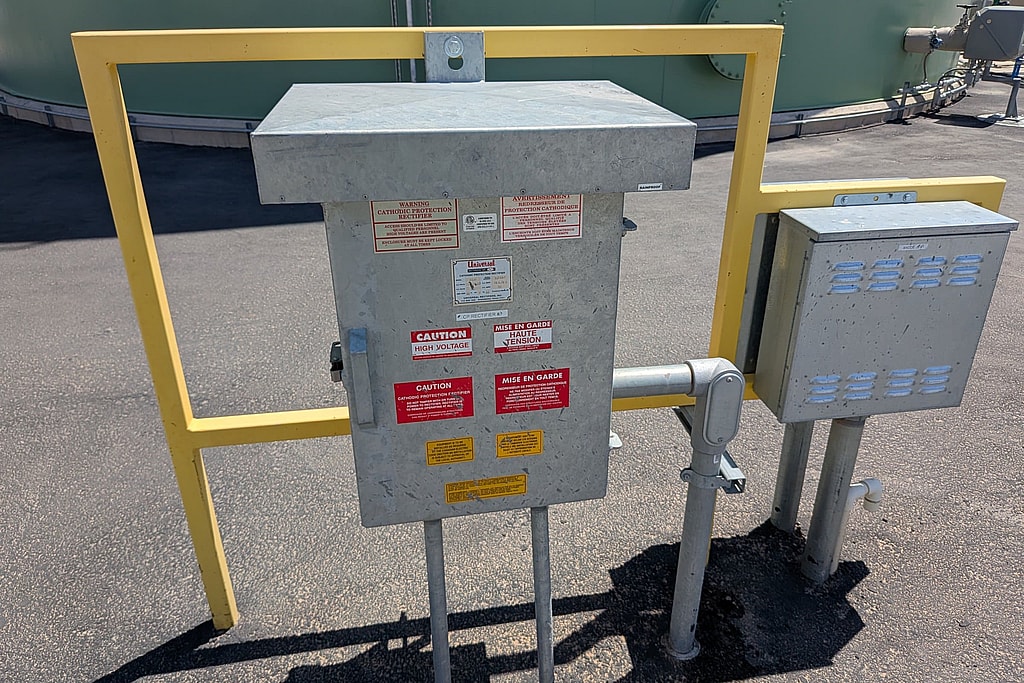
In May 2025 we went back to the El Paso power station where, in 2018, a 10-inch gas line had needed about ten times the current it should have. Seven years and several repairs later, the station has five buried gas piping systems with their own rectifiers, and they told five different stories.
The 10-inch line, fixed by isolation
The line that had worried us in 2018 runs from the supplier meter station to a compressor skid. After the isolation repairs recommended in earlier surveys were made in 2024, it was protected: -1.00 to -1.15 V instant off at all three test points. Its rectifier had been turned up since our previous visit, for reasons nobody could tell us, from about 2 A to more than 20 A. Downstream of the compressor skid, a newer rectifier protecting the line into the same unit was on its highest coarse tap, and the piping read -1.10 to -1.27 V off, so we turned it down to about 26 V and 7.5 A to cut the risk of interference and stretch the life of its anodes. The carbon dioxide, instrument air and demineralized water risers at that unit had flange kits, but many no longer isolated.
The older units
The two 12-inch lines to the oldest units were still underprotected, at -0.32 to -0.55 V off. New flange kits installed in 2024 had cleared one segment, but another stayed shorted, which puts the contact somewhere below pavement, likely from decades of work around buried grounding. Two segments are shorted at the blending station, where the risers have no flange kits. We advised against adding kits there for now: as long as the buried short remains, the grounded structures drain stray current away from the pipe and slow its corrosion. The two lines to a fourth unit were in the same position, -0.52 to -0.61 V off, with two segments shorted below grade. Finding those shorts would mean exploratory fault locating through pavement, which may not tell a short from a coating defect.
The newest unit
The yard piping of the station newest unit, gas, instrument air, drain and ammonia, is protected by two rectifiers, each with a semi-deep anode well, and six negative bond boxes that double as test points. With the rectifiers delivering only 0.06 and 0.12 A, all eleven test points read -0.87 to -1.10 V off. A system that needs that little current is a sign of excellent coating.
Related work
The first visit to this station is described in the 2018 baseline survey. The method is explained under interrupted potential surveys.
Corrosion and CP
More projects in this practice
Wink and Sarita, TX
AC Interference Data Logging on Texas Pipelines
AC interference testing
Wickett, TX
ACVG Coating Survey of Two Gathering Lines, Wickett
ACVG survey
Eastland area, TX
Annual CP Survey and Ground Patrol of a Gas Line, Eastland Area
CP survey, ground patrol
Get your project started
We typically respond within one business day.