Selected Projects
Soil Resistivity Survey Along a 62-Mile Pipeline Route, Lake Charles Area (2026)
We typically respond within one business day.
Project at a glanceDE-PRJ-8787
- Practice
- Corrosion and CP
- Location
- Lake Charles, LA
- Service
- Soil resistivity
- Client
- Confidential
Soil Resistivity Survey Along a 62-Mile Pipeline Route, Lake Charles Area (2026)
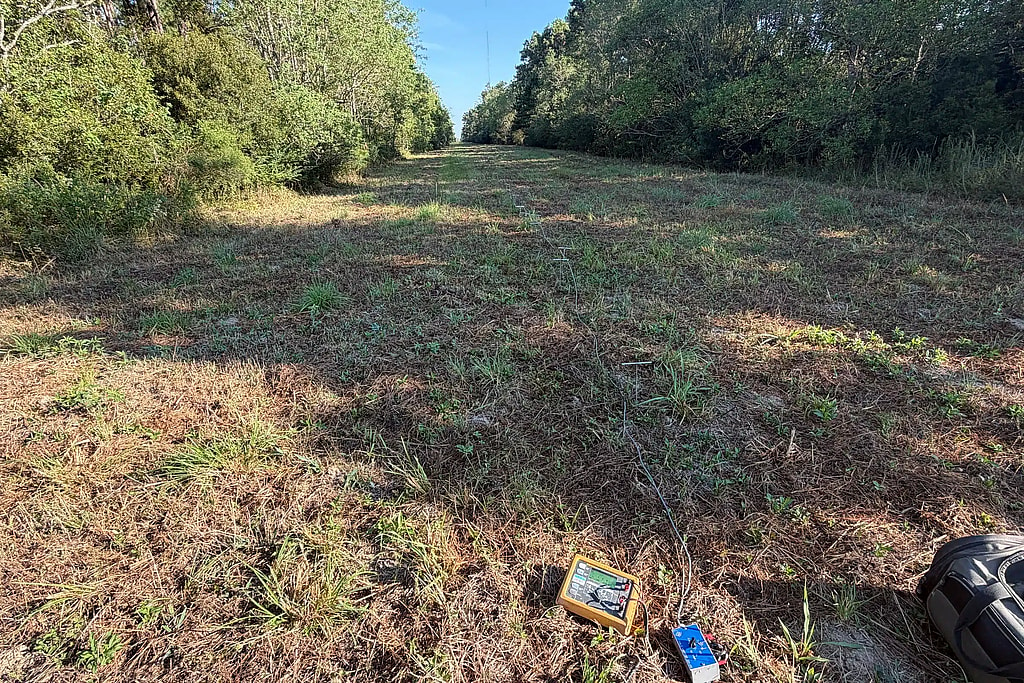
In September 2026 we measured soil resistivity along the route of a planned pipeline of about 62 miles near Lake Charles, Louisiana. Client details are confidential.
Why measure before the pipe goes in
Soil resistivity is the first input to a cathodic protection design. Low resistivity means corrosive soil and a lower resistance path for CP current. It sets how much current the line will need, where anode beds can go and how far protection will spread. Measuring along the route before construction lets the designer place the CP system where the soil calls for it, instead of guessing from a few borings.
The fieldwork
The plan called for 14 test locations along the alignment. Three could not be reached, so we tested 11. Over three days we ran the Wenner four-electrode method of ASTM G57 at each site with a Fluke 1625-2 and a cable harness, at pin spacings of 2.5, 5, 7.5, 10, 15 and 20 feet. Where space allowed, the pin layout was turned 45 or 90 degrees and measured again to confirm the first set. From the average resistivities we calculated layer resistivities with the Barnes method, because averaging can hide a corrosive layer under a drier one.
What the route looks like
The sites fall into two groups. The upland sites, in grassy fields and pipeline easements, varied widely, from more than 11,000 ohm-cm near the surface at one site to a few hundred ohm-cm at others, generally dropping with depth. The wetland sites, with low grass near the surrounding water level, averaged roughly 90 to 200 ohm-cm, and some calculated layers were below 100 ohm-cm. On a scale where anything under 500 ohm-cm is severely corrosive, the route as a whole classifies as severely corrosive to ferrous metal.
What else matters
Resistivity is the main field indicator, but it is not the only one. pH, chemical content, soil type, aeration, anaerobic conditions and drainage also affect corrosion, and they are usually measured in the laboratory on samples taken during geotechnical drilling. Reading those results alongside the resistivity profile gives the CP designer a complete picture.
Soil testing for pipelines
The testing is described on our page for soil corrosivity analysis. Other work in the state is listed on our page for Louisiana.
Corrosion and CP
More projects in this practice
Wink and Sarita, TX
AC Interference Data Logging on Texas Pipelines
AC interference testing
Wickett, TX
ACVG Coating Survey of Two Gathering Lines, Wickett
ACVG survey
Eastland area, TX
Annual CP Survey and Ground Patrol of a Gas Line, Eastland Area
CP survey, ground patrol
Get your project started
We typically respond within one business day.