Selected Projects
Stray-Current Investigation at a Multi-Building Complex, Oklahoma City (2023)
We typically respond within one business day.
Project at a glanceDE-PRJ-8116
- Practice
- Corrosion and CP
- Location
- Oklahoma City, OK
- Service
- Interference testing
- Client
- Confidential
Stray-Current Investigation at a Multi-Building Complex, Oklahoma City (2023)
The job was a stray-current investigation at a multi-building complex in Oklahoma City. Our corrosion team did the work in 2023. Client details are confidential.
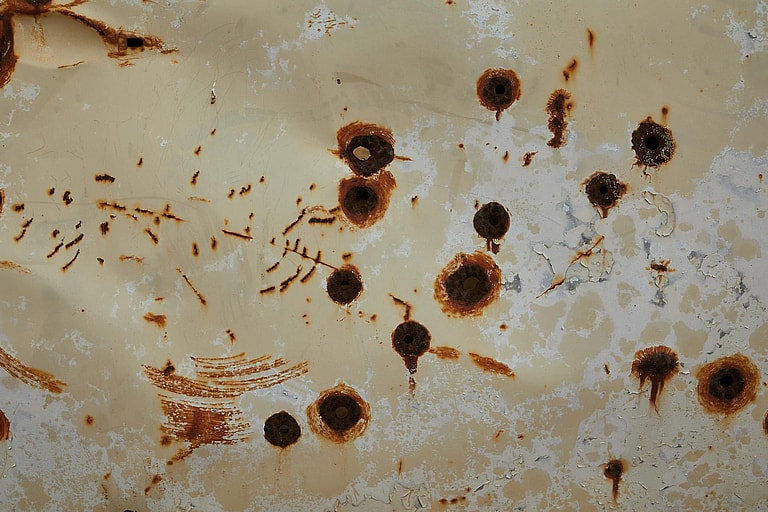
Pitting corrosion. Where stray current discharges, metal is lost at concentrated points instead of evenly across the surface.
What ties the buildings together
Electrically, a multi-building complex is one large connected system. Water lines, gas piping, electrical conduit, structural steel and grounding conductors all tie the buildings to each other, often in ways the record drawings no longer show. So when corrosion turns up where it shouldn’t, or the electrical readings don’t add up, the question is whether current is flowing on paths it was never designed to use. Nobody can see or hear stray current, and its effects often aren’t found until metal has already been lost. Answering the question takes systematic measurement in the field.
Where stray current comes from, and why the exit point corrodes
Stray current is electrical current that leaves its intended circuit and finds another way back, through soil, water or a metal structure that happens to offer a convenient route. In a building complex, the possible sources include shared grounding networks that bond many systems together, DC equipment like rectifiers and welding operations, electrified rail transit, and interactions with utility systems, including cathodic protection rectifiers on buried pipelines nearby. What happens to the metal depends on which way the current crosses its surface. Where direct current enters a metal structure, it shifts that surface in the protective, cathodic direction, and the metal isn’t harmed. Trouble starts where the current leaves the metal and passes back into the soil or water around it. That exit surface becomes anodic, and the metal there dissolves in proportion to the current discharged. Because the discharge concentrates at a few points, stray-current corrosion tends to be localized and aggressive, and it eats into the wall thickness at those points first.
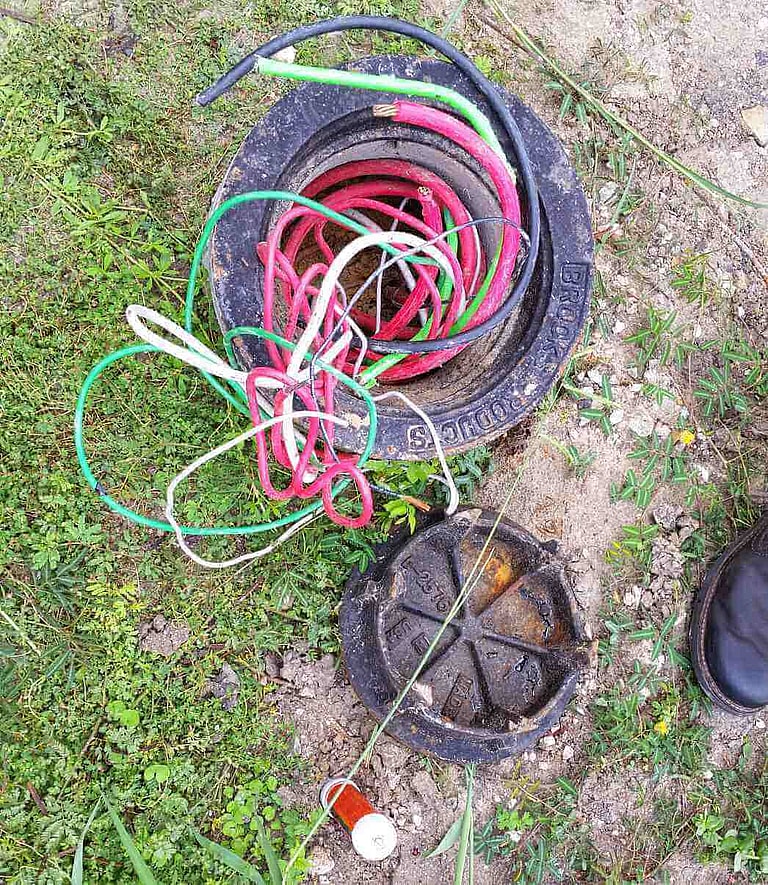
Insulated conductors coiled in an in-ground box. A mitigation bond is a metallic connection between the affected structure and the interference source. It’s brought to an accessible box like this one so the current it carries can be measured and adjusted.
Fixing interference and checking that the fix holds
Finding the source only gets you partway. Mitigation depends on what the current is doing and where it wants to go, and the options are well established. The most common is a mitigation bond, which is a deliberate metallic connection, often made through a resistor sized from the test data. The bond gives the current a designed path back toward its source, so it doesn’t discharge off the affected structure into the soil. Where the current is smaller, a galvanic drain can do the same job by sacrificing an anode in place of the structure. Isolation joints in the right locations can break the unintended path outright. Or additional cathodic protection can hold an affected area cathodic, so it collects current instead of discharging it.
Any one of these changes the electrical picture for everyone connected to it, so interference work is usually a cooperative job. If the source belongs to another party, such as a pipeline operator’s rectifier or a transit system, the mitigation is worked out with them and verified jointly. Readings are taken on both structures before and after, so fixing one problem doesn’t start another somewhere else.
Then the fix has to be monitored, because a bond can fail like any other component. A resistor drifts, a connection corrodes or a lead gets cut during construction, and the interference comes back without anyone noticing. Bonds and drains get test stations and are checked on the same cycle as the rest of the protection system. They’re documented too, so the next person who investigates the complex finds a record of what’s there. We do this work for facility owners as part of our interference testing services.
On site in Oklahoma City
Work like this comes down to measurement. That means structure-to-electrolyte potentials at representative locations, current readings on bonds and grounding conductors, and data logged over time, so swings in the readings can be lined up with the operating cycles of the suspected sources. On this job, the fieldwork fell to our AMPP® (NACE) certified cathodic protection personnel, and licensed Professional Engineers oversaw the investigation. We also looked at how the buildings and their buried metal systems were connected, since a complex behaves as one electrical network whether or not anyone designed it that way. Our findings and recommendations went to the client in an engineering report.
If you suspect stray current at your facility
Stray current doesn’t give much warning. It takes metal from concentrated spots until a buried line perforates or an embedded structural element loses section, and by then the repairs are far more disruptive than an early investigation would have been. If you’re seeing localized corrosion nobody can explain, or your facility shares soil and grounding with pipelines, rail systems or heavy DC equipment, structured interference testing by certified personnel can settle the question. For more on the mechanism, our article on how stray current corrosion damages critical infrastructure covers where these currents come from and what they do to the assets that carry them.
Corrosion and CP
Related projects
Houston, TX
Corrosion Assessment of a 60-Inch Raw Water Line, Houston
Condition assessment, CIS, interference testing
Wink and Sarita, TX
AC Interference Data Logging on Texas Pipelines
AC interference testing
Tulsa, OK
Tulsa CP Construction-Phase Services
Construction phase
More work in: Oklahoma
Get your project started
We typically respond within one business day.