Selected Projects
Arc Flash Studies for One Manufacturer in Mississippi, Arizona, Washington and Texas (2023-2026)
We typically respond within one business day.
Project at a glanceDE-PRJ-8775
- Practice
- Electrical power
- Location
- Hattiesburg, MS, plus AZ, WA and TX
- Service
- Arc flash, labels
- Client
- Confidential
Arc Flash Studies for One Manufacturer in Mississippi, Arizona, Washington and Texas (2023-2026)
Since 2023 we have studied arc flash hazards at four plants of one manufacturer, in Hattiesburg, Mississippi; Tolleson, Arizona; Fife, Washington; and Houston, Texas. Client details are confidential.
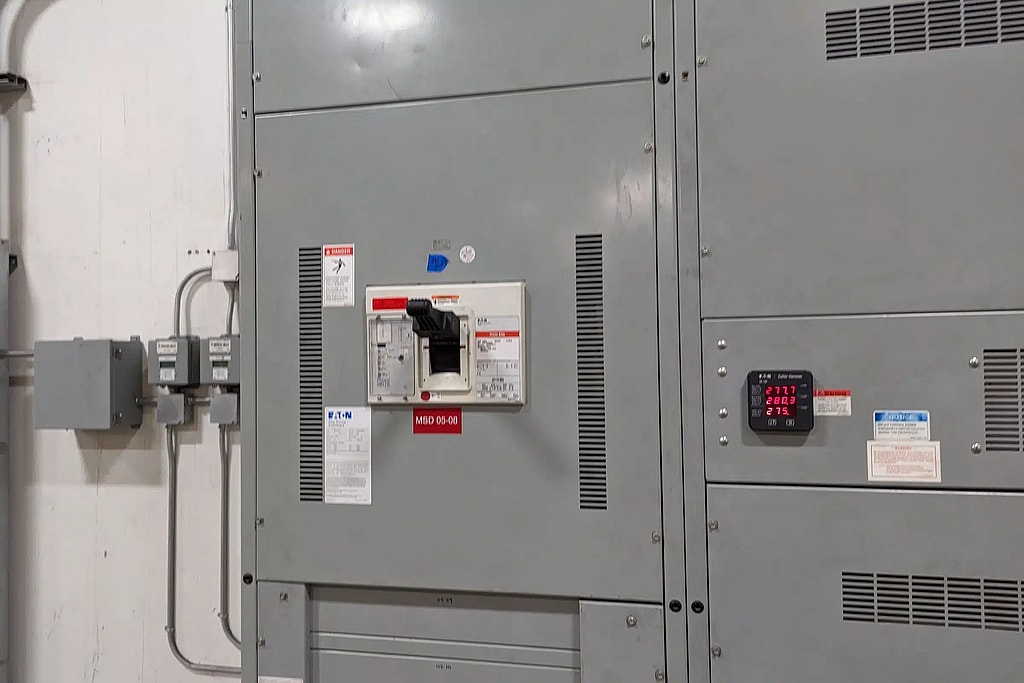
Four plants, one approach
A company with plants in several states wants the same deliverable everywhere: models built the same way, labels in the same format and results that a corporate safety program can compare. Each plant has its own electrical system and its own utility, so each got its own model, but the method, the report layout and the label database are common to all four. Earlier studies of these plants, from 2016 and 2021, had been done in a different software package. Our studies were built in ETAP.
The size of the models
The models are large because the plants are. The Hattiesburg model has 539 buses, 40 transformers and 58 induction motors, with eight 12.47 kV source buses. The Tolleson model has 375 buses, 39 transformers and 33 induction motors, fed from a 69 kV source. The Houston model has 227 buses, 24 transformers and 16 induction motors. Each motor contributes current to a nearby fault, so they are modeled one by one instead of being lumped together.
Where the energy comes from
The Fife study, issued in October 2023, shows why the protective devices matter as much as the fault current. Bus duct fed from the 4,000 A main switchboards sees high bolted fault current, but the switchboard main breakers clear an arc in under two cycles, so the incident energy at those buses stayed near 1 cal/cm². Buses with no fast device upstream were calculated at the full 2 second arcing time and came out as high as about 25 cal/cm², even though their fault current was far lower. Results like these point to where faster protection would help most.
Labels that track the plant
Every label is generated from a database exported from the model. Each record carries the arc flash boundary, the incident energy and working distance, the PPE description, the limited and restricted approach boundaries and the glove class, along with the upstream protective device. When equipment changes, the model is updated and the labels are reissued from it. The Hattiesburg model was updated in November 2025, and 541 labels were issued from the updated model in July 2026.
A study program across state lines
Licensed Professional Engineers oversee the studies, which are PE-stamped where required. What a study includes is described on the page for our arc flash study services. Work outside Texas is described on our page for work nationwide.
Electrical power
More projects in this practice
Norman, OK
Airport Grounding Testing, Norman
Ground testing
Temple, Grand Prairie and Humble, TX
Arc Flash Studies at Manufacturing Plants in Temple, Grand Prairie and Humble
Arc flash, coordination
Austin, Houston and Pasadena, TX
Arc Flash Studies for Offices, Laboratories and a Grid Control Room
Arc flash, small facilities
Get your project started
We typically respond within one business day.