Selected Projects
Baseline Cathodic Protection Surveys of Fuel Gas Lines and a Water Tank at Two Power Stations, El Paso (2018)
We typically respond within one business day.
Project at a glanceDE-PRJ-8790
- Practice
- Corrosion and CP
- Location
- El Paso, TX
- Service
- CP surveys, rectifiers
- Client
- Confidential
Baseline Cathodic Protection Surveys of Fuel Gas Lines and a Water Tank at Two Power Stations, El Paso (2018)
In the week of April 30, 2018 our corrosion engineers surveyed the cathodic protection at three power stations in El Paso. The survey at the first station led to the impressed current work described in a separate write-up. This page covers the other two, where the questions were about older systems nobody had tested in years.
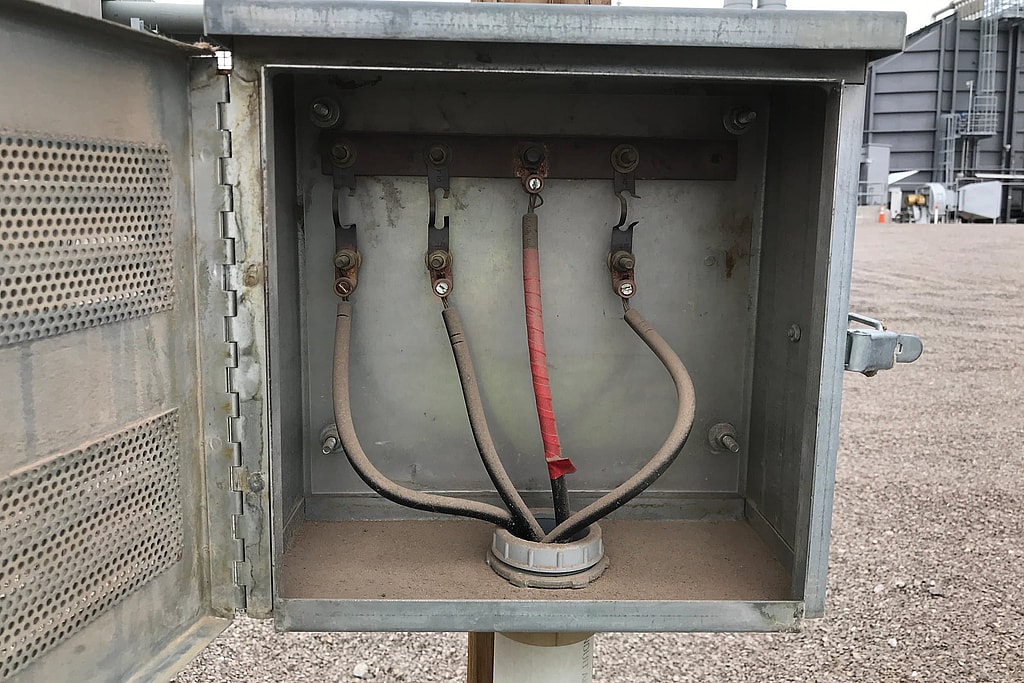
A gas line that wanted ten times its current
At the second station, a 10-inch fuel gas line of about 3,200 feet feeds a combined cycle unit built in 2009. Its pole-mounted 30 V, 12 A rectifier was found at 2.32 V and 0.6 A, and the two anode junction boxes beside it held 20 anode leads, probably in a deep well. Notes left in the rectifier cabinet from start-up in April 2009 showed the line had been protected with only 0.18 A. We raised the output in two steps to about 10.4 V and 10.6 A, close to the rating, and the two far test points still read about -0.68 V and -0.61 V instant off, short of the -0.85 V criterion. Assuming a 5% coating defect after nine years and 2 mA per square foot, the line should need about 1 A. Needing ten times that means the line is shorted to other plant metal, its coating has largely failed, or both. Nineteen of the 20 anodes were still working, so the groundbed was not the problem.
The two 12-inch lines feeding the older units at the same station were shorted to the plant grounding. Their CP system had not been installed correctly and was switched off. It needed its AC wiring redone to code, correct fuses, five burned anode leads checked, the anode test station replaced with a junction box, the vent pipe moved out of a parking lot, and five insulating flange kits to isolate the lines.
A shorted line near the supplier station
The third station has run since 1929, and its newest unit, from 2013, is fed by a 6-inch line coated with fusion bonded epoxy. A leak on that line had been repaired the week before we arrived. During our walk of the route on May 1 there was a strong smell of gas, so we located and marked the buried line to help the plant crew find a second leak. The line was shorted to plant grounding somewhere below grade. That makes it a low resistance return path for stray current from the supplier CP system, which fits the recent failures clustered near the supplier meter station. A bigger rectifier would only add stray current, so isolation came first.
The older 10-inch line at the same station was isolated at both ends, and a 1996 rectifier needed only a tap change: the instant off potentials moved 43 and 50 mV more negative within half an hour. The raw water storage tank appeared adequately protected, pending its record drawings.
Related work
We went back to the second station in 2025, and that visit is described in the 2025 follow-up survey. The work that followed at the first station is described in the impressed current cathodic protection project. The survey method is explained under interrupted potential surveys.
Corrosion and CP
More projects in this practice
Wink and Sarita, TX
AC Interference Data Logging on Texas Pipelines
AC interference testing
Wickett, TX
ACVG Coating Survey of Two Gathering Lines, Wickett
ACVG survey
Eastland area, TX
Annual CP Survey and Ground Patrol of a Gas Line, Eastland Area
CP survey, ground patrol
Get your project started
We typically respond within one business day.