Selected Projects
Galvanic Cathodic Protection Designs for the Steel Canopy Piers of Two Federal Facilities, Brownsville Area (2017)
We typically respond within one business day.
Project at a glanceDE-PRJ-8797
- Practice
- Corrosion and CP
- Location
- Brownsville area, TX
- Service
- CP design, soil testing
- Client
- Confidential
Galvanic Cathodic Protection Designs for the Steel Canopy Piers of Two Federal Facilities, Brownsville Area (2017)
Two federal facilities in the Brownsville area have large steel canopies over outdoor work areas and covered walkways, held up by I-beam piers set in concrete foundations. After decades in the ground with no corrosion control, the owner wanted the buried part of those piers protected, and in 2017 we tested the soil and designed a galvanic system for each site.
Two canopies, two soils
The larger canopy covers about 25,700 square feet on roughly 25 piers; the smaller one covers about 16,200 square feet on 23. We ran Wenner four-pin soil resistivity tests (ASTM G57) at five points around each canopy, with pin spacings from 2.5 to 20 feet, and worked out layer values with the Barnes method. Under the larger canopy, the lowest layer in the 2.5 to 10 foot range where the piers sit was 46 ohm-cm and the layer average was 564 ohm-cm, in line with the silty clay mapped there. Under the smaller one the lowest layer was 466 ohm-cm and the average 1,242 ohm-cm, in fine sandy loam over silt loam. Both soils are highly corrosive to steel.
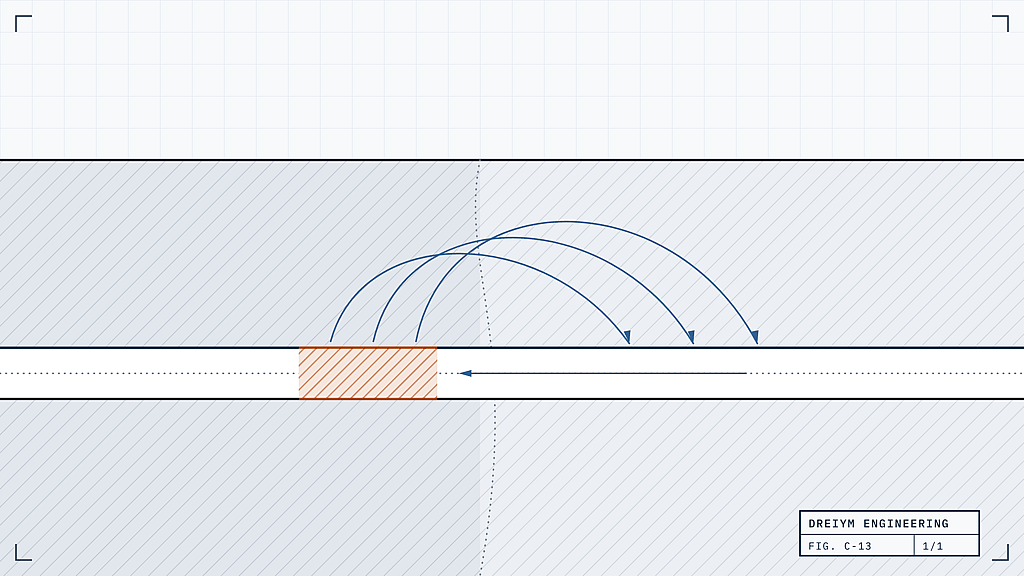
Measuring what the piers need
No record drawings of the buried steel were available, so any calculated current demand rested on assumptions about the rebar, the piers and the copper grounding. We measured it as well. At each site a dozen short steel pins served as a temporary groundbed, fed from a portable generator and rectifier. After about an hour of polarization the crew interrupted the current on an 8 second on, 2 second off cycle and read the piers again. The larger canopy shifted 58 mV on average, about 20 mA of current per millivolt; the smaller shifted 64 mV, about 40 mA per millivolt. For target shifts of about 250 mV and 200 mV, that pointed to about 5 A and 8 A of protective current.
Zinc or magnesium
The owner had specified sacrificial anodes, which suit low resistivity soil and the modest current demand of steel in concrete. We sized both zinc and magnesium for a 15-year life with an 85 percent utilization factor. Zinc would have taken about 40 anodes of 60 pounds at the larger site. Magnesium, with its higher driving voltage, needed less material and a smaller footprint: four groundbeds of nine 48-pound anodes there, and four of eleven 60-pound anodes at the smaller site. At the smaller site the anodes had to be set 5 feet apart to spare the pavement, so we checked the groundbed resistance with that spacing taken into account. Each bed connects to the structure through an at-grade test station.
A sacrificial system of this kind runs at under 2 V, so it adds no shock hazard for the people who use the canopies. The report was also plain about its limits: cathodic protection slows future corrosion, but it cannot restore steel that has already been lost.
Related services
The soil work behind these designs is described under soil corrosivity analysis. Anode sizing for buried structures is part of cathodic protection design.
Corrosion and CP
More projects in this practice
Wink and Sarita, TX
AC Interference Data Logging on Texas Pipelines
AC interference testing
Wickett, TX
ACVG Coating Survey of Two Gathering Lines, Wickett
ACVG survey
Eastland area, TX
Annual CP Survey and Ground Patrol of a Gas Line, Eastland Area
CP survey, ground patrol
Get your project started
We typically respond within one business day.