Selected Projects
Arc Flash Studies for Office, Laboratory and Grid Control Buildings, Austin, Houston and Pasadena (2020-2022)
We typically respond within one business day.
Project at a glanceDE-PRJ-8803
- Practice
- Electrical power
- Location
- Austin, Houston and Pasadena, TX
- Service
- Arc flash, small facilities
- Client
- Confidential
Arc Flash Studies for Office, Laboratory and Grid Control Buildings, Austin, Houston and Pasadena (2020-2022)
Arc flash rules do not stop at plant gates. Between 2020 and 2022 we studied five smaller buildings: an Austin office that houses grid control systems, two laboratory buildings, a federal laboratory and a communications site in Houston.
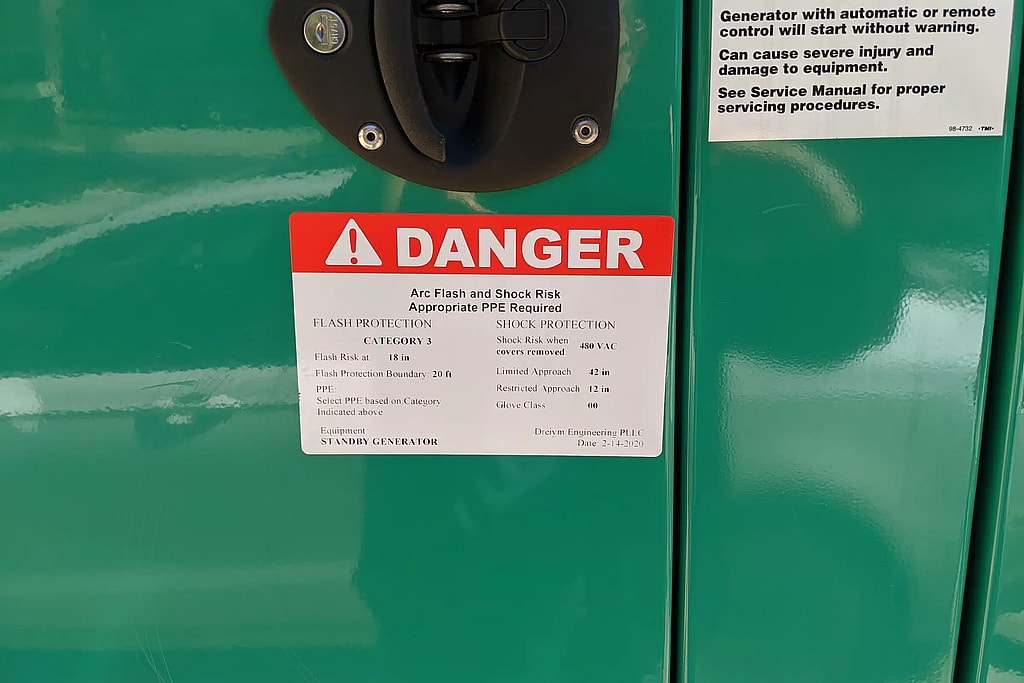
Small systems, two sources
The Austin office has office space and grid control equipment, fed through electrical panels with a standby diesel generator and automatic transfer switches behind them. A building like that can be energized from either source, so the study has to cover both. The Houston office of a subsea technology company was the simplest job of the group: offices, a laboratory, shipping and storage, all served by three electrical panels. The Pasadena complex mixes offices, a laboratory, hazardous material storage and general storage, with a standby generator, transfer switches, panels and disconnects at 480 V and 208/120 V.
Larger services
The federal laboratory in Houston takes one utility feed at 34.5 kV, stepped down by a 1,000 kVA transformer, and is protected by fuses and circuit breakers with no protective relays. We modeled it in ETAP 20.5.0 and calculated incident energy to IEEE 1584-2018 and NFPA 70E-2018. The communications site, also in Houston, takes two utility feeds at 12.47 kV through several transformers, again with fuses and breakers only. At both, the electrical contractor on site supplied the one-lines, the utility data and the walkdown data.
What each study found
None of the five turned up a critical item, and none needed a setting change to make the installation safe. That is a common result for a building whose equipment is new or lightly loaded. The value of the study is then in the labels and in the record it leaves for the next change. Each report asks that breaker settings be confirmed in the field against the settings document, under engineering supervision, so that no setting exceeds the ampacity of the circuit it protects.
What goes on the label
Each label gives the arc flash boundary, the incident energy at the working distance, the voltage a worker tests for zero energy, the minimum class of insulating gloves and the limited and restricted approach boundaries. The Pasadena report also includes a table of glove classes, so the crew can match the class on the label to the gloves they carry.
Related services
Studies for buildings with a generator and transfer switches are described on our page for arc flash study services. Fault current calculations are explained under short circuit analysis.
Electrical power
More projects in this practice
Norman, OK
Airport Grounding Testing, Norman
Ground testing
Temple, Grand Prairie and Humble, TX
Arc Flash Studies at Manufacturing Plants in Temple, Grand Prairie and Humble
Arc flash, coordination
Hattiesburg, MS, plus AZ, WA and TX
Arc Flash Studies for Four Plants in Four States
Arc flash, labels
Get your project started
We typically respond within one business day.