Selected Projects
Corrosion Survey of Fire Protection Piping and Water Tanks After a Leak at a Glass Plant, Wichita Falls (2024)
We typically respond within one business day.
Project at a glanceDE-PRJ-8813
- Practice
- Corrosion and CP
- Location
- Wichita Falls, TX
- Service
- CP survey, continuity testing
- Client
- Confidential
Corrosion Survey of Fire Protection Piping and Water Tanks After a Leak at a Glass Plant, Wichita Falls (2024)
A leak on the fire protection main at a glass plant in Wichita Falls raised a simple question in July 2024: was the buried piping under cathodic protection at all? The plant had two rectifiers that everyone believed served the fire system.
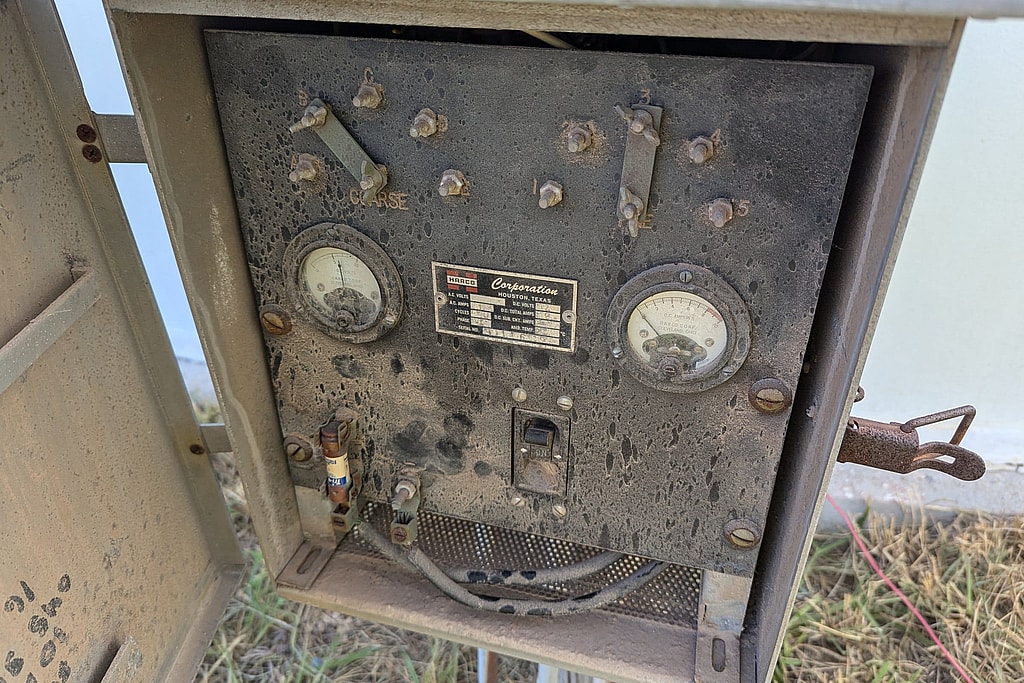
What the rectifiers were for
We visited on August 1. Both rectifiers, rated 12 V and 8 A, were energized and reading about 5.4 and 6.5 V, but neither was putting out any current. A temporary load test showed the units themselves still worked; further troubleshooting showed their anode beds were used up. No drawings were inside either cabinet, and their location pointed to the two at-grade water storage tanks, not the fire system. Native potentials at four points around each tank, between -381 and -465 mV, confirmed the tank bottoms were getting no protection.
The fire main
To test the fire protection piping we started from the hydrants and a valve, the only places to reach the pipe. With a pipe locator transmitter on one hydrant, the signal followed only one spool of about 20 feet before it was lost. Pipe-to-soil readings at two hydrants 20 feet apart, taken from the same electrode position, differed by 64 mV, and at a valve and hydrant elsewhere by more than 350 mV. Photos from the leak repair showed ductile iron pipe, and the results meant its joints had never been bonded. The piping had no cathodic protection and was not electrically continuous.
What we recommended
For the tanks, find out first whether they sit on a nonconductive liner, because that decides where new anodes can go, and replace the anode systems. The rectifiers were working but old. For the fire main, in a plant reportedly built in the 1970s, CP is possible but may not be practical. One option is to expose every joint, bond it and protect the system as a unit; the other is to dig about every 15 feet and put sacrificial anodes on each pipe spool, accepting that a few would be missed. We also pointed out buried natural gas, and possibly oxygen and nitrogen, piping that was outside our scope but may need a look.
Related services
Surveys like this start with cathodic protection potential surveys. Options for old buried piping are weighed as part of integrity assessments of piping and tanks.
Corrosion and CP
More projects in this practice
Wink and Sarita, TX
AC Interference Data Logging on Texas Pipelines
AC interference testing
Wickett, TX
ACVG Coating Survey of Two Gathering Lines, Wickett
ACVG survey
Eastland area, TX
Annual CP Survey and Ground Patrol of a Gas Line, Eastland Area
CP survey, ground patrol
Get your project started
We typically respond within one business day.