Selected Projects
Coating Holiday Testing and CP Start-Up on a New Gas Line, and a Chilled Water CP Survey, at a Semiconductor Plant, Austin (2023-2025)
We typically respond within one business day.
Project at a glanceDE-PRJ-8819
- Practice
- Corrosion and CP
- Location
- Austin, TX
- Service
- Holiday testing, CP start-up, CP survey
- Client
- Confidential
Coating Holiday Testing and CP Start-Up on a New Gas Line, and a Chilled Water CP Survey, at a Semiconductor Plant, Austin (2023-2025)
A semiconductor plant in Austin added a 10-inch gas line, about 2,000 feet of carbon steel coated with fusion bonded epoxy, as part of an incoming utility package in 2023. For this semiconductor plant CP work, we checked the gas line coating for holidays before backfill, put its cathodic protection in service, and came back in 2025 to test it again along with the older chilled water piping.
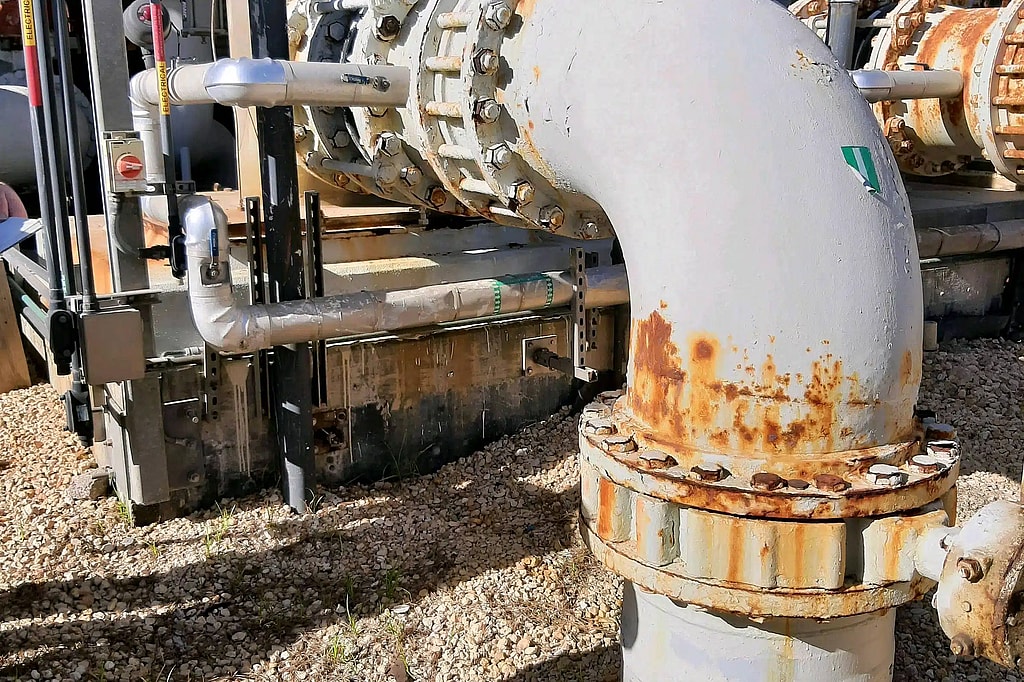
Six visits with a holiday detector
From September to December 2023 we tested the coating each time the contractor had a new run of pipe ready, following NACE SP0490. Cameras were not allowed inside the plant. Each session began with a deliberate pinhole, about 0.03 inches across, made with an awl, and the detector voltage was raised until it found that pinhole: 2.4 to 2.6 kV on the 14 to 16 mil coating, above the 2.1 kV minimum, and 3.5 kV on a section of about 320 feet that was bored under pavement with an extra 30 mils of coating. The first 850 feet had 22 holidays, and the next 125 feet had 54, mostly small scrapes, pinholes and joint wraps that did not fully cover the weld. Pipe sitting on supports beside the trench was tested piece by piece, and its welded joints were tested again once the pieces were joined. Over the six visits more than a hundred holidays were marked, repaired by the contractor and tested again until the detector stayed quiet.
Start-up
In November we made the test lead connections by exothermic welding at three test stations and set the magnesium anodes, two 32-pound anodes at each of two anode stations. On December 7, with most of the line backfilled, we read native potentials, tested the insulating flange kits at both ends, connected the anodes and ran an interrupted survey with GPS-synchronized interrupters at each anode station. Instant off potentials were -909 to -945 mV against native readings of about -660 to -680 mV. Part of the line runs near overhead transmission lines, so we also read AC potentials; all were under 1 V.
2025: the gas line and the chilled water
In March 2025 the gas line read -1,030 to -1,130 mV instant off and its flange kits still worked. One test station had its leads pulled out of the terminal board, probably during backfill, which left its anodes disconnected, but the line met criteria anyway, and we asked for the station to be repaired.
The chilled water system was another matter. Two 60-inch headers, supply and return, each about 360 feet long, have sacrificial anodes in an unknown layout; an earlier survey by others suggested 24 anodes of 60 pounds. At six anode test stations the pipe read only -310 to -465 mV off, and most anodes gave little or no current. None of the 17 risers at the cooling tower was isolated. On the return risers the hardware threads into the valve body, so a flange kit cannot go there. Some supply risers could be isolated at the flange nearest the pump, while others are shorted through instrumentation. The 60-inch risers at the central utility building seemed to have flange kits, but grounded instrumentation tubing, welded support brackets embedded in concrete and bare pipe that may touch reinforcing steel kept them shorted.
Steel in soil is more active than copper grounding or steel in concrete, so most of the anode current was going to the plant ground rather than the pipe. Isolating the headers would mean major piping changes with no guarantee of success. We laid out two options for a new system, both needing excavation, probably by hydro-vac: more sacrificial anodes, which would likely give only partial protection, or impressed current, with the output to overcome the shorts but needing more field work and permanent AC power.
Related services
The December visit is an example of start-up and commissioning. The 2025 testing falls under cathodic protection potential surveys.
Corrosion and CP
More projects in this practice
Wink and Sarita, TX
AC Interference Data Logging on Texas Pipelines
AC interference testing
Wickett, TX
ACVG Coating Survey of Two Gathering Lines, Wickett
ACVG survey
Eastland area, TX
Annual CP Survey and Ground Patrol of a Gas Line, Eastland Area
CP survey, ground patrol
Get your project started
We typically respond within one business day.