Selected Projects
Galvanic CP Design for the Yard Piping of Two Water Pump Stations, and Witnessed Start-Up Testing at One of Them, San Antonio (2018-2024)
We typically respond within one business day.
Project at a glanceDE-PRJ-8821
- Practice
- Corrosion and CP
- Location
- San Antonio, TX
- Service
- CP design, test witnessing
- Client
- Confidential
Galvanic CP Design for the Yard Piping of Two Water Pump Stations, and Witnessed Start-Up Testing at One of Them, San Antonio (2018-2024)
Two water pump stations in San Antonio got new steel yard piping as part of a utility improvement program. As a subconsultant to the prime design firm, our corrosion engineer prepared the cathodic protection design for both stations in 2018 and an updated set for the rebid in March 2020. Years later, at one of the stations, we were asked to witness the start-up testing.
The design
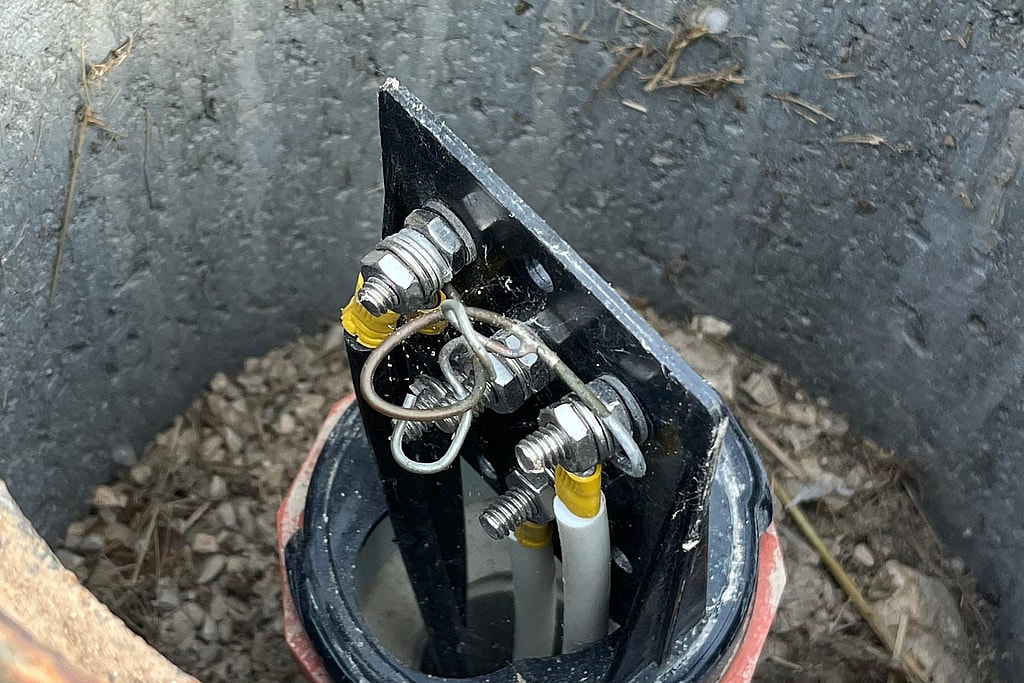
The drawings cover the yard piping quadrant by quadrant, with details at the booster pump pad, the surge tank pad and the flow control valve, plus test station, bonding and isolation details. At one station the main run is 48-inch welded steel: eight anode test stations along it, each with ten 32-pound magnesium anodes, three more stations with four anodes each on a second run, and six anodes on a short third run. Insulating test stations sit wherever the new pipe meets existing 48-, 54-, 60- and 66-inch pipe, so the new piping can be protected on its own and checked later. Non-welded joints are bonded, and the isolation details cover flange kits, insulating flanged coupling adapters and gaskets.
Taking over the witnessing
The project specifications required a corrosion engineer to witness the CP testing. Another engineer had done so during construction and, in May 2023, reported non-conforming anode lead splices and incomplete or missing test stations. When that engineer was no longer available, the CP subcontractor asked us to take over. On September 27, 2023, after being told all issues were fixed, we watched the crew open every test station and install GPS-synchronized interrupters on every anode station. Several deficiencies remained, and instant off potentials ran from about -370 to -980 mV.
November 2024
By the second visit on November 1, 2024 those items had been resolved. The crew measured the voltage across each anode shunt, then ran the interrupted survey again: instant off potentials from -304 to -571 mV. Those numbers look low against the -850 mV criterion, but the metering station grounding on the east end is connected to the protected piping, and copper grounding there makes up most of the exposed metal in the circuit. The native readings from before construction no longer applied, and the true depolarized potential is likely near -200 mV or more positive, so the readings show at least 100 mV of polarization. The new piping was isolated from the existing plant piping and adequately protected. AC potentials on it were under 2 V, but utility staff reported high AC on the piping at the west tie-in, and we noted that the new piping west of the station may need more testing.
Related work
Larger transmission lines in the same city are described in the transmission line CP design project. The testing method is covered under start-up and commissioning.
Corrosion and CP
More projects in this practice
Wink and Sarita, TX
AC Interference Data Logging on Texas Pipelines
AC interference testing
Wickett, TX
ACVG Coating Survey of Two Gathering Lines, Wickett
ACVG survey
Eastland area, TX
Annual CP Survey and Ground Patrol of a Gas Line, Eastland Area
CP survey, ground patrol
Get your project started
We typically respond within one business day.