Selected Projects
Corrosion Rate Testing of Steel Piles for a Solar Farm, Northwest of Austin (2019)
We typically respond within one business day.
Project at a glanceDE-PRJ-8786
- Practice
- Corrosion and CP
- Location
- Central Texas
- Service
- Corrosion rate testing
- Client
- Confidential
Corrosion Rate Testing of Steel Piles for a Solar Farm, Northwest of Austin (2019)
In 2019 our pile corrosion testing measured how fast bare steel piles corrode in the soil of a planned solar farm about 20 miles northwest of Austin, Texas. Client details are confidential.
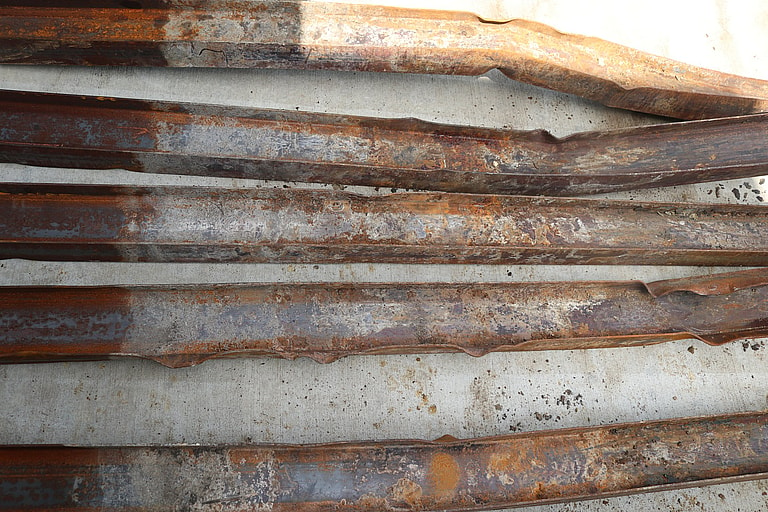
Test piles after six months in the ground. The heaviest corrosion was in the top 4 feet, where the soil holds the most oxygen.
From theory to measurement
A geotechnical study had already found the soils corrosive to ferrous metal and given theoretical corrosion rates for the buried parts of the steel supports. The lead designer wanted measured data before settling the structural design, and the geotechnical firm brought us in to plan and run field corrosion rate testing. In March 2019 we reviewed the design documents and wrote a test plan that would simulate the installed piles.
Ten test piles
Ten bare steel wide-flange test piles, each 11 feet long, were driven about 8 feet into the native soil at locations scattered across the planned footprint, so the results would represent the whole site. The production piles were to carry a 3-mil galvanized coating, but bare steel was used on purpose. Zinc is consumed quickly in corrosive soil, and bare steel shows the steady-state rate that follows. The piles went in on March 28 and came out on September 26, 2019, a six-month exposure.
Probes for a second reading
In April 2019 we also installed an electrical resistance probe 1 to 2 feet deep at each pile location. Each probe has two identical carbon steel elements, one exposed to the soil and one sealed inside the probe body. A meter at an above-grade connection reads the difference in their resistance and turns it into an effective corrosion rate. The probes stayed in for five months, giving an independent rate at every location.
What the lab found
The piles were cleaned, reweighed and examined in October 2019. As expected, the heaviest damage was in the top 0 to 4 feet, where the soil holds the most oxygen. Measurable weight loss showed up at six of the ten piles. Across the probes, the average corrosion rate was 1.34 mils per year and the maximum was 3.05 mils per year. Wall thickness testing did not give meaningful results over a test this short, because the loss was small and fairly uniform. Six months is a short test for a slow process, and longer exposure always gives better numbers.
What it meant for the design
The measured rates supported the finding that the site soils are highly corrosive to steel. We passed the results to the structural engineering team for the pile design, and noted that cathodic protection is a common way to extend the life of buried structural members and may be warranted here. How corrosion risk is assessed before construction is described on our page for soil corrosivity analysis.
Corrosion and CP
More projects in this practice
Wink and Sarita, TX
AC Interference Data Logging on Texas Pipelines
AC interference testing
Wickett, TX
ACVG Coating Survey of Two Gathering Lines, Wickett
ACVG survey
Eastland area, TX
Annual CP Survey and Ground Patrol of a Gas Line, Eastland Area
CP survey, ground patrol
Get your project started
We typically respond within one business day.