Selected Projects
Galvanic Cathodic Protection Designs for Four New Water Lines, Fort Worth Area and Mansfield (2024-2025)
We typically respond within one business day.
Project at a glanceDE-PRJ-8109
- Practice
- Corrosion and CP
- Location
- Fort Worth and Mansfield, TX
- Service
- CP design
- Client
- Confidential
Galvanic Cathodic Protection Designs for Four New Water Lines, Fort Worth Area and Mansfield (2024-2025)
In 2024 and 2025 our corrosion engineer prepared a galvanic waterline CP design for each of four new water lines. Three are on City of Fort Worth water projects, for the civil engineer of record, and one is in Mansfield, for the utility contractor building it.
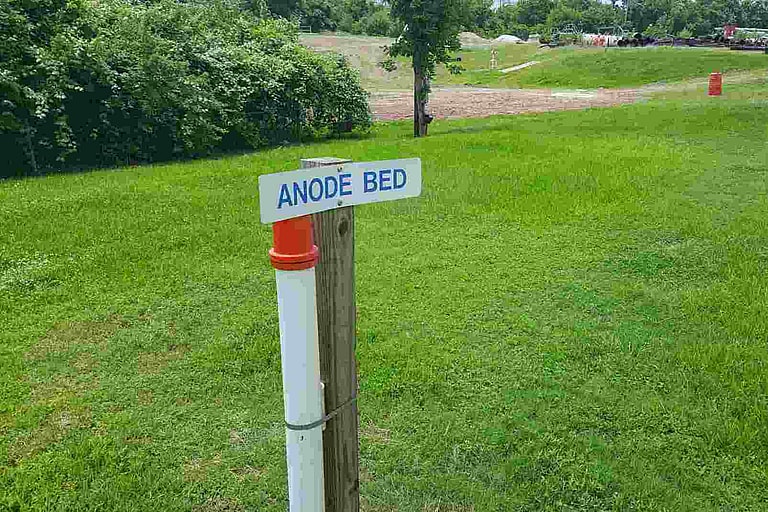
An anode junction box test station. The anode stations in these designs bring the anode leads to a terminal panel at grade, so the current can be read later.
A schedule for each pipe in the bid
The Fort Worth lines were designed before the pipe material was settled, so each drawing set carries a test station schedule for every option still in the bid. On a 24-inch line of roughly 3,700 feet, issued in May 2024, the ductile iron option has nine test stations: six cased-crossing stations at three 42-inch steel casings, two anode stations with eight 60-pound magnesium anodes each, and one potential station. The concrete cylinder pipe option needs four anode stations of ten anodes each, 40 anodes against 16.
A 36-inch off-site line of about 2,800 feet, issued in April 2025, runs beside an existing 36-inch main and has three options. Ductile iron and welded steel share one layout: an insulating joint test station at the tie-in to the existing line, three anode stations of six anodes and three potential stations, most of them in the median. The concrete cylinder option raises each anode station to eleven anodes, 33 in all.
The third Fort Worth set, issued in July 2024, is a 16-inch ductile iron line of about 4,700 feet with two cased-crossing stations on a 30-inch casing, two anode stations of eight anodes and one potential station. It also covers a 30-inch steel sewer casing at a railroad crossing, with one anode station of two anodes beside a manhole.
Built from the city details
All three Fort Worth sets use the city standard details for potential, flange insulation and cased-crossing test stations, magnesium anode stations, permanent reference electrodes, bonding across flanges, valves, bell and spigot joints and mechanical couplings, the bonded joint for lined cylinder pipe, isolation flanges and brazed connections. The general notes are the same on each: anode beds and at-grade parts may move up to 15 feet for site conditions if the as-built drawings record it, test stations go as close over the pipe as practical, every non-welded joint is bonded unless it is meant to insulate, and a corrosion engineer inspects and tests the installation and sends all readings to the city with a letter report.
Mansfield
The Mansfield line is 24-inch ductile iron, roughly 1,800 feet long. Its four test stations are a potential station at each end and two anode stations of ten 60-pound anodes, each with a utility marker. The civil drawings showed every pipe connecting to the line, existing and new, as PVC, so no isolation was needed; the notes ask the contractor to check in the field and to isolate any metallic connection. A revision in May 2025 extended the alignment.
Related services
The design approach is described under cathodic protection design. The casing work that followed on the 16-inch project is part of the cased crossing designs.
Corrosion and CP
Related projects
Upper Texas Coast
Flood Gate CP Anode Vent Review, Upper Texas Coast
CP consulting
El Paso, TX
Power Station Impressed Current CP, El Paso
CP design, installation
Brownsville area, TX
Canopy Pier CP Designs at Two Federal Facilities, Brownsville Area
CP design, soil testing
More work in: Texas, Cathodic Protection in Dallas-Fort Worth
Get your project started
We typically respond within one business day.