Selected Projects
Soil Corrosivity Study, Galvanic CP Design and Commissioning for a 24-Inch Ductile Iron Water Line, McKinney (2020)
We typically respond within one business day.
Project at a glanceDE-PRJ-8816
- Practice
- Corrosion and CP
- Location
- McKinney, TX
- Service
- Soil corrosivity, CP design, commissioning
- Client
- Confidential
Soil Corrosivity Study, Galvanic CP Design and Commissioning for a 24-Inch Ductile Iron Water Line, McKinney (2020)
For a new 24-inch water line of about 2,500 feet in McKinney, we did the whole corrosion job in 2020: the soil study in June, the design the same month, and start-up testing in September.
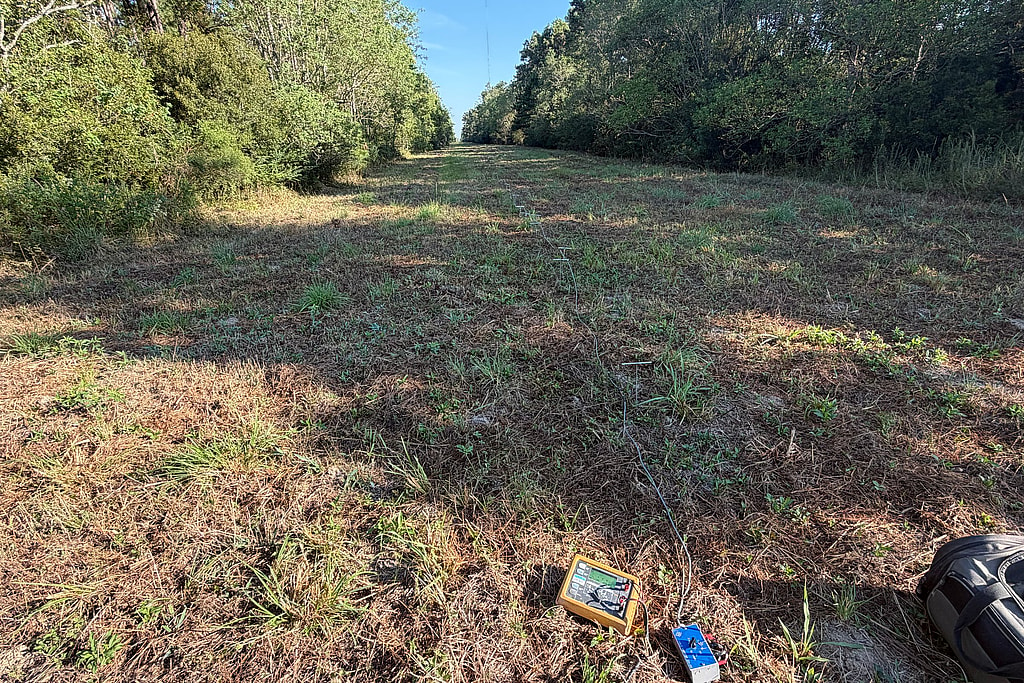
The soil
We ran Wenner four-pin tests (ASTM G57) at four locations along the alignment on June 11, with pin spacings from 2.5 to 20 feet. In the 5 to 10 foot layers, where the pipe would sit, resistivity averaged 954 ohm-cm, with a low of 515. The soil survey maps the area as silty clay, with expected resistivity of 500 to 1,500 ohm-cm, which matched. We classed the soil as highly corrosive to ductile iron.
The design
The line was designed for ductile iron in polyethylene encasement (AWWA C105). We called for insulating joints with test stations where it met other piping (NACE SP0286), bonding of every bell and spigot joint, test stations no more than 1,600 feet apart and at insulating joints, anode beds and casings, coated fittings and dielectric sleeves through concrete. Protection came from magnesium anodes: two anode test stations with 12 anodes of 60 pounds each. Two gas lines of other utilities crossed the route at about 60 degrees with at least 8 feet of vertical separation, so we judged interference risk negligible.
Start-up
At our first visit on September 4 the pipe was backfilled. Lead-to-lead resistances were all within 0.3 ohm, so the test leads had survived backfill, and the steel casing at the crossing was isolated from the carrier pipe. Two problems showed up. The insulating flange kit at the tie-in to an existing main was not working, so unprotected old pipe was dragging the new line down and wasting its anodes. And each anode station had been built with 7 anodes instead of 12. At the other end a test station was not needed, because the line tied into PVC.
The contractor fixed both. On September 29, two weeks after the last anodes were connected, every test station read more negative than -1,000 mV with the anodes disconnected, against a baseline of about -730 to -790 mV, meeting the -850 mV criterion. The only oddity left was reversed wire colors in the casing test station, which we recorded for future testers.
Related services
The first step is described under soil corrosivity analysis. The September visits are an example of start-up and commissioning.
Corrosion and CP
More projects in this practice
Wink and Sarita, TX
AC Interference Data Logging on Texas Pipelines
AC interference testing
Wickett, TX
ACVG Coating Survey of Two Gathering Lines, Wickett
ACVG survey
Eastland area, TX
Annual CP Survey and Ground Patrol of a Gas Line, Eastland Area
CP survey, ground patrol
Get your project started
We typically respond within one business day.