Selected Projects
Galvanic Cathodic Protection Design for Twelve Flume Crossings on a Raw Water Canal System, Southeast Texas (2022)
We typically respond within one business day.
Project at a glanceDE-PRJ-8800
- Practice
- Corrosion and CP
- Location
- Southeast Texas
- Service
- CP design, galvanic anodes
- Client
- Confidential
Galvanic Cathodic Protection Design for Twelve Flume Crossings on a Raw Water Canal System, Southeast Texas (2022)
Where a canal meets a bayou or a marsh, the water often crosses in large steel pipes carried on piles. For a raw water canal system in Southeast Texas, we designed galvanic cathodic protection for twelve of these flume crossings in 2022.
Twelve sites, no two alike
The owner provided record drawings for each flume, from replacements and expansions built between 2006 and 2020, and we tabulated every structure before designing anything. Eleven of the flumes carry the water in steel pipe, from a single 96-inch line to five parallel 60-inch pipes, in runs of about 140 to 560 feet. The supports differ as much as the pipes. Most sites stand on steel H-piles, from 4 to 32 per flume, three stand on concrete piles or columns, and four include steel sheet pile walls. The twelfth flume is itself concrete, carried on eight steel H-piles with a sheet pile section.
The design
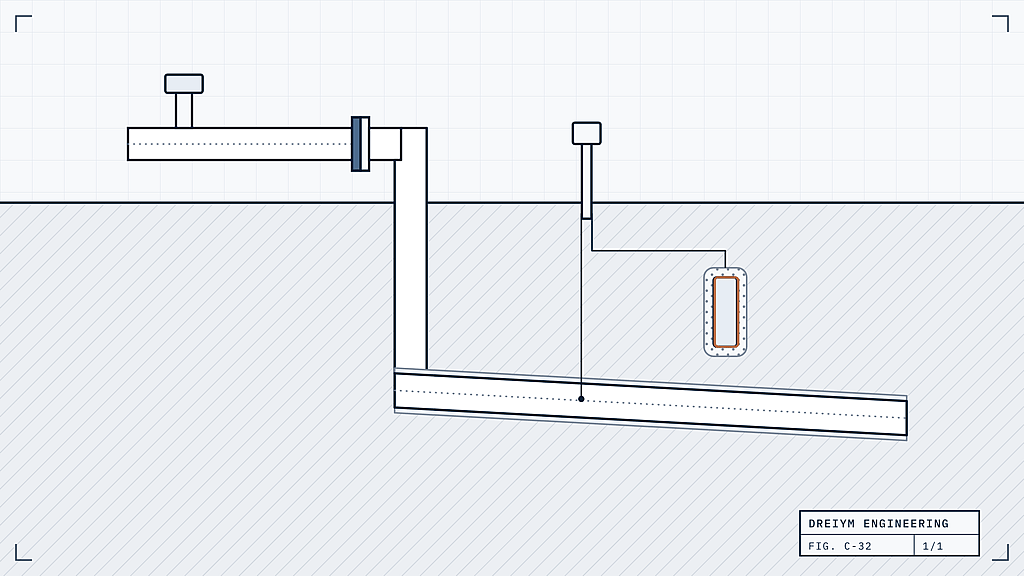
Galvanic anodes need no power, which matters at crossings out in the marsh far from any service. The trade-off is a fixed output, so the number of anodes has to match the steel each groundbed serves. The design uses 60-pound magnesium anodes in one to four groundbeds per site, with between 2 and 27 anodes in a bed. Seven sites got four beds, four got two, and one got a single bed.
Each site has its own layout sheet, with coordinates, and its own line in the CP schedule listing the pipes, the piles, the number of groundbeds and the anodes in each. The detail sheets cover the anode configuration and alloy, buried splices, connections to the pipes and to the support structures, the wire weld procedure, and the anode test stations through which each bed connects, so that every bed can be tested once it is installed. After two review rounds with the owner, we issued the drawings for construction in April 2022 and a revised set in May 2022.
Related services
Designs like this one start with our cathodic protection design work. Once anodes are in the ground, the next step is start-up and commissioning.
Corrosion and CP
More projects in this practice
Wink and Sarita, TX
AC Interference Data Logging on Texas Pipelines
AC interference testing
Wickett, TX
ACVG Coating Survey of Two Gathering Lines, Wickett
ACVG survey
Eastland area, TX
Annual CP Survey and Ground Patrol of a Gas Line, Eastland Area
CP survey, ground patrol
Get your project started
We typically respond within one business day.