Selected Projects
Soil Corrosivity Study and Corrosion Control Recommendations for the Buried Piping of a New Industrial Gas Plant, Taylor (2023)
We typically respond within one business day.
Project at a glanceDE-PRJ-8820
- Practice
- Corrosion and CP
- Location
- Taylor, TX
- Service
- Soil corrosivity study
- Client
- Confidential
Soil Corrosivity Study and Corrosion Control Recommendations for the Buried Piping of a New Industrial Gas Plant, Taylor (2023)
When we arrived at a new industrial gas plant in Taylor on August 7, 2023, to measure soil resistivity for a soil corrosivity memo, most of what we were meant to protect was already in the ground. That changed how the study was done, but not what the plant needed from it.
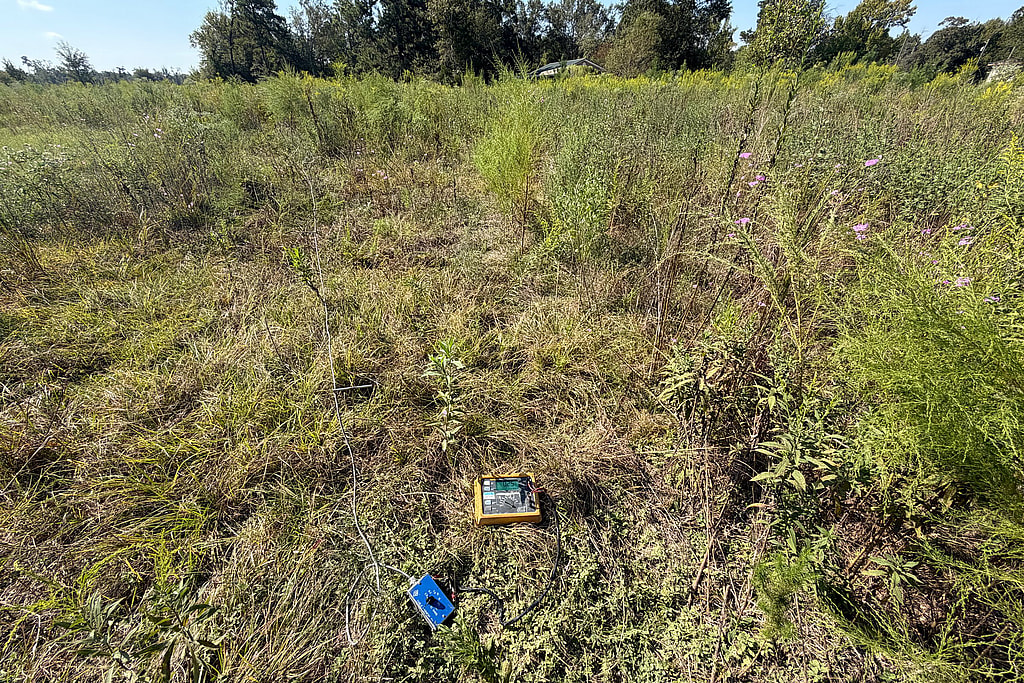
When a site is too built up to test
A Wenner four-pin test sends current through the soil between steel pins and reads the voltage it makes. Buried pipe, foundations and grounding near the pins carry part of that current and spoil the reading. With the underground work largely finished, we walked the pipe routes and turned to the geotechnical study instead. Its laboratory results put the soil at pipe depth between 500 and 5,000 ohm-cm, and its 21 borings, 45 to 100 feet deep, found mostly clay at and above pipe depth. Clays hold water, drain poorly and let little air in. We classed the soil as highly corrosive to ferrous metal, mainly because of its low resistivity.
What is buried
From the construction documents we listed four systems at risk. The fire water piping is mostly non-metallic, but short steel sections lead up to the hydrants, and the hydrant assemblies and valves are steel. The process wastewater piping is mostly carbon steel, and the gravity oily water and cooling water piping are all carbon steel.
The recommendations
The plan was short. Isolate the buried pipe from aboveground piping with insulating joints per NACE SP0286; the installation documents already called for them, and the design phase would confirm every location. The footprint is small and most systems run no more than a few thousand feet, so pipe risers can serve as test and anode connection points, and separate test stations may not be needed. No new piping crosses or runs alongside the foreign line near the site. Coat the pipe, fittings and bolts, and use dielectric sleeves or seals where pipe passes through concrete. Protect the buried steel with sacrificial anodes, sized in the design phase, which also keeps the risk of interference with other structures low.
Related services
Studies like this one are described under soil corrosivity analysis. The next step is cathodic protection design.
Corrosion and CP
More projects in this practice
Wink and Sarita, TX
AC Interference Data Logging on Texas Pipelines
AC interference testing
Wickett, TX
ACVG Coating Survey of Two Gathering Lines, Wickett
ACVG survey
Eastland area, TX
Annual CP Survey and Ground Patrol of a Gas Line, Eastland Area
CP survey, ground patrol
Get your project started
We typically respond within one business day.