See the Hidden Dangers: Infrared Technology for Electrical Safety
Electrical thermography finds hot joints in live equipment during an infrared safety scan. What a scan can miss and how often NFPA 70B calls for one.

Contents
A loose or corroded connection can run hot for a long time before it burns up or starts an arc. An infrared electrical safety inspection looks for that heat with a thermal camera while the equipment stays in service. But a scan at light load, or with the covers on, can miss the problem it was meant to find.
A field example from our work: Chemical Plant Infrared and Grounding Work, Pasadena
Need a scan of your own equipment? See our infrared electrical inspection services for switchgear, panelboards, motor control centers and transformers.
What the Camera Sees
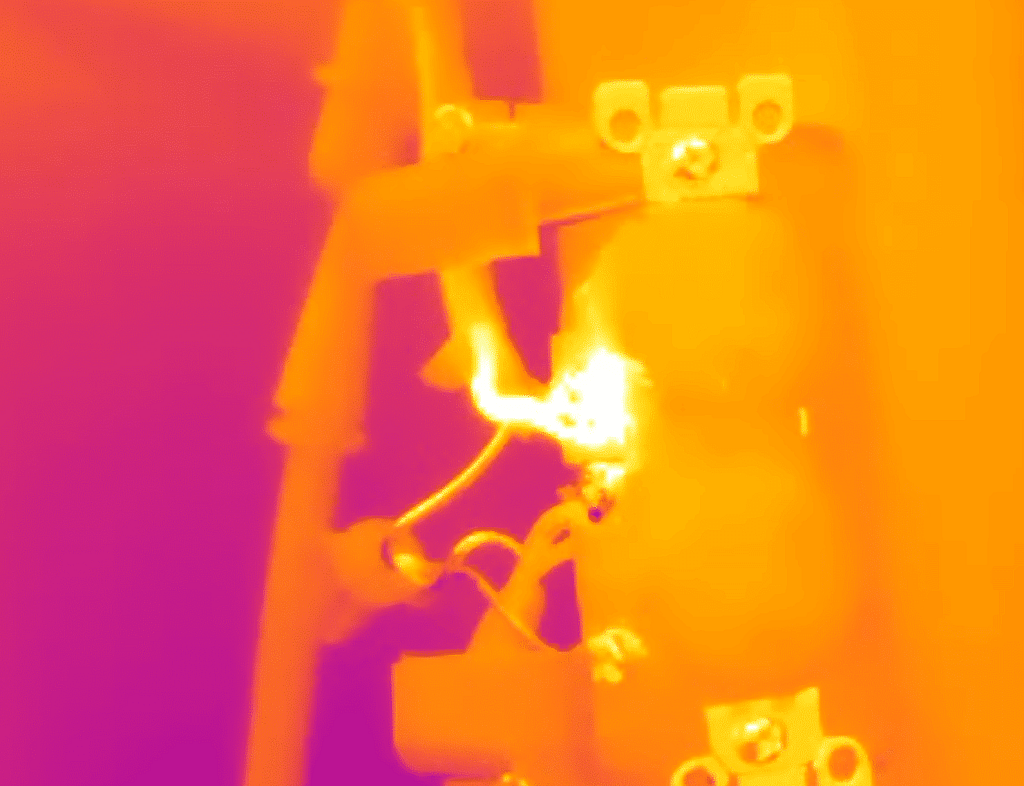
Infrared thermography works because every surface gives off infrared energy, and hotter surfaces give off more. The camera reads that energy and turns it into a picture of surface temperature, called a thermal image or thermogram. On a panel, a bad connection shows up as a bright spot its neighbors don’t have.
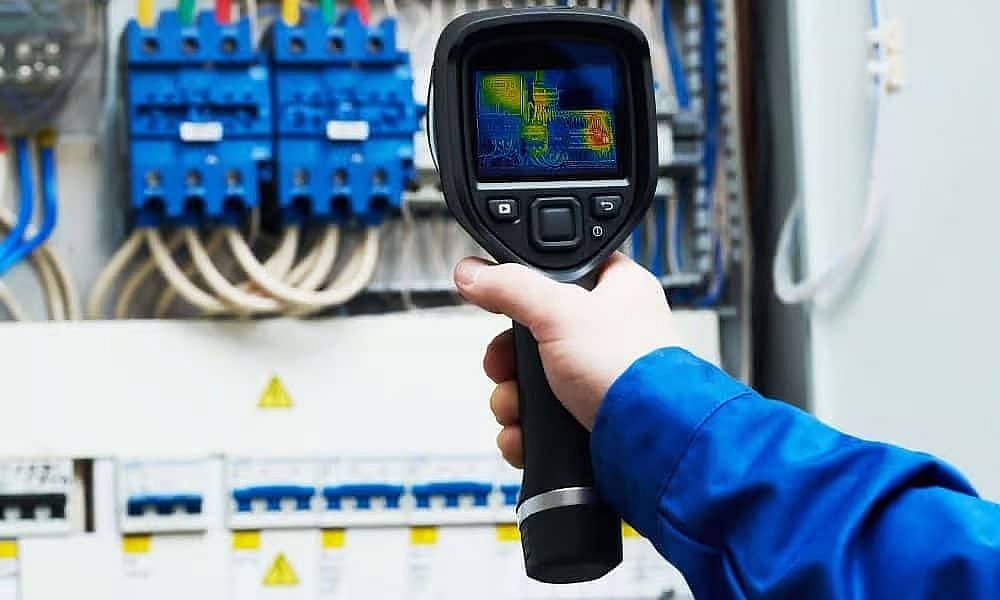
The camera has two blind spots that matter in electrical work. It only sees surfaces in its line of sight, so it can’t see through a closed door or a dead-front. Either the covers come off, or the equipment gets infrared windows. Shiny metal also fools it. Clean copper and aluminum bus reflect infrared much like a mirror. A thermographer reads the insulation or a painted surface next to the joint instead.
Why a Bad Connection Runs Hot
A connection that has worked loose, corroded, or was never torqued properly has more resistance than it should. Current through that extra resistance turns into heat. The heat speeds up oxidation, which raises the resistance further. Every heating and cooling cycle can also loosen the joint a bit more. Left alone, that loop can end in charred insulation, a failed device, an arc flash or a fire.
Caught early, the connection can usually be fixed during a planned outage instead of an emergency one.
What a Scan Finds, and What It Misses
A typical survey covers switchgear, panelboards, motor control centers, disconnects, transformers, bus duct, motors and generators. The usual findings are loose or corroded lugs, fuse clips that have lost tension, breakers running hot, and overloaded or unbalanced conductors. The pattern tells you which. A hot spot right at a lug that fades along the wire points to the connection. A conductor that is warm along its whole length points to overload or an unbalanced load.
The temperature on the screen is an estimate. It shifts with emissivity, reflections, distance, viewing angle and load, so we judge a connection mostly by comparison. Three phases of the same circuit at similar current should run at about the same temperature. How much hotter the odd one runs tells us how soon it needs attention.

Some problems make no heat, and a scan can’t see them. It won’t tell you whether a breaker will trip on a fault; that takes testing. It says nothing about grounding either, because a broken bond or a corroded grounding electrode carries little or no current in normal service. And some failures give a camera nothing to catch, such as a dig-in on a buried cable or storm damage. More on those in our post on why electrical systems fail.
Setting Up an Infrared Electrical Safety Inspection
Most of what separates a useful infrared inspection from a pretty picture happens before the camera comes out.
Scan at normal load. Heat goes with the square of the current: at half load, a bad connection makes a quarter of its full-load heat. At light load, a real problem can look normal. Write the load down next to every image, or next year’s comparison means little.
Then there are the covers, and they are where the real risk is. NFPA 70E lists infrared thermography done from outside the restricted approach boundary as a task where an arc flash is not likely. That entry excludes opening doors or covers. Opening them to expose live parts is listed as likely, so it is work for a qualified person wearing arc flash PPE. Infrared windows, installed during an outage, let later scans happen with the doors shut.
As for how often, NFPA 70B calls for an infrared scan of electrical equipment at least every 12 months. Equipment rated Condition 3, the worst of the standard’s three ratings, gets one every 6 months. Since its 2023 edition, 70B has been a standard rather than a recommended practice. Keep each year’s images and load readings together, and the trend will show which connections are getting worse. After a repair, a re-scan at similar load shows whether the hot spot is gone.
How Electrical Thermography Findings Are Ranked
Electrical thermography reports rank each hot spot by its temperature rise, measured against a similar component carrying the same load or against the surrounding air. Severity tables such as the one in the ANSI/NETA maintenance testing specifications turn that rise into a priority, so the owner knows which repairs can wait for the next planned outage and which need attention right away. Because a connection heats with current, the report should also record the load at the time of the scan. A joint that looks mild at light load can be serious at full load.

Thermography in Failure Investigations
Thermography comes up in our forensic engineering work too, but a camera can’t see heat that is already gone. Once a connection has failed and the equipment is cold or burned, there is nothing left to scan for that fault.
Where it helps is around the failure. Past infrared inspection reports can show that a hot spot was found and never fixed. We can scan the surviving parts of the same system for the same problem before it happens again. In the lab, we can put an exemplar device under load and watch it heat. When the physical evidence is too damaged to read, we use thermal transient analysis to model how heat moved through the enclosure.
A thermal image on its own does not prove a cause. Tying it to one, with a method that will hold up to a Frye or Daubert challenge, is a big part of what a forensic engineer does.
If you suspect hidden hot spots in your electrical systems or need thermal imaging for an investigation, contact Dreiym Engineering today to schedule an infrared inspection.