Pool Grounding and Bonding: What NEC Article 680 Requires
Pool grounding and bonding under NEC Article 680: equipotential bonding, the 8 AWG bond, water bonding and GFCI protection, explained by licensed engineers.
Contents
Swimming pools get an article of their own in the National Electrical Code® (opens in a new tab) because the people using them are wet and there’s electrical equipment close by. NEC® Article 680 covers pools, spas, and fountains. Most of the questions we get about “pool grounding” are really about two different things, grounding and bonding, and the Code treats them separately. Our overview of inground pool grounding and bonding explains what each one does for swimmers.
Key takeaways
- NEC® Article 680 covers pools, spas and fountains, because the people using them are wet and electrical equipment is close by.
- Grounding gives equipment such as pump motors a low-impedance path back to the source so a fault trips the breaker or GFCI, while bonding ties the conductive parts around the pool together.
- Under NEC® 680.26, the conductive parts in and around the pool are bonded into a common grid, usually with a solid copper conductor no smaller than 8 AWG.
- Pool water carries treatment chemicals, dissolved oxygen and often salt, so bonding connections corrode over time.
- Which edition of the Code applies, and with what local amendments, depends on where the pool is.
Pool grounding and bonding do different jobs
Grounding connects equipment like pump motors and panelboards back to the source through a low-impedance ground-fault current path, so a fault trips the breaker or GFCI. Much of Article 680, though, is about bonding. Bonding ties the conductive parts in and around the pool together so they all sit at the same electrical potential. Someone standing on a wet deck with a hand on a rail should never end up as the connection between two different voltages.
The equipotential bonding grid
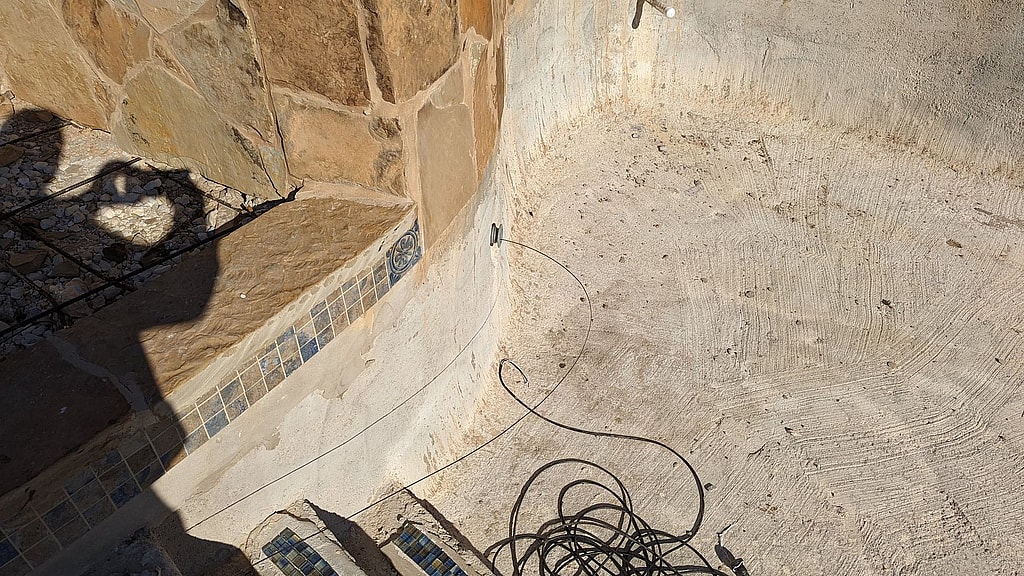
Under NEC® 680.26, the conductive parts in and around the pool have to be bonded together into a common grid, usually with a solid copper conductor no smaller than 8 AWG. That generally includes the structural reinforcing steel in the pool shell, metal ladders, rails and fittings, the metal parts of pool equipment such as pump motors, and metal piping and wiring methods close to the pool. The grid also takes in the perimeter surfaces around the pool. So is the pool water itself, which has to be in contact with a minimum area of bonded conductive surface. The grid is local, and it doesn’t have to run back to a ground rod or a panel to do its job.
For a field example, see the pool and splash pad bonding inspections in Austin.
GFCI protection
Ground-fault circuit interrupters come up again and again in Article 680. Pool pump motors and the receptacles near the pool generally need GFCI protection, and underwater luminaires have their own rules. If a pool receptacle or pump circuit at your facility isn’t GFCI protected, get it fixed before the next swim season starts.
Corrosion in the bonding grid
Pool water carries treatment chemicals and dissolved oxygen, and often salt. That makes it aggressive toward the metals the bonding grid ties together, especially if the pool has a salt chlorine generator. Bonding connections corrode over time, and anchors and light niches rust. The grid degrades along with them, and it’s easy to miss. Add a periodic inspection of the bonding connections to the same maintenance list as the water chemistry.
Texas adopted the 2026 NEC® effective September 1, 2026; our Texas NEC® adoption by city page shows what each city publishes about its own code.
When to bring in an engineer
Which edition of the Code applies, and with what local amendments, depends on where the pool is. Have a licensed professional verify the specifics. If swimmers say they’ve felt a tingle, don’t wait to call. The same goes if you’ve remodeled or added equipment around the pool, or if an inspection has flagged the bonding. We do grounding system testing, and our engineers investigate electrical incidents around pools and other wet locations. For general background, see our guide to electrical grounding and bonding.