The Different Arc Flash PPE Categories Explained
Understand the four NFPA 70E arc flash PPE categories, the minimum arc rating for each (4 to 40 cal/cm2), and the gear workers must wear at every level.
Reach out to Dreiym Engineering for any Corrosion, Electrical or Forensic Questions.
Contents
Arc flashes are intense electrical explosions that can result in severe harm to employees and company infrastructure. To help protect those who work with electrical equipment, companies can require employees to wear PPE while on the job. Which of the arc flash PPE categories applies, however, depends on the equipment and the task at hand.
The National Fire Protection Association has made maximizing electrical safety easier by creating the standard NFPA 70E. It’s titled the Standard for Electrical Safety in the Workplace and outlines electrical safety requirements and practices for employees. In this standard, the NFPA sorts arc flash PPE into four categories. Below we explain when the arc flash PPE categories can be used and what each one requires.
How an Arc Flash PPE Category Is Chosen
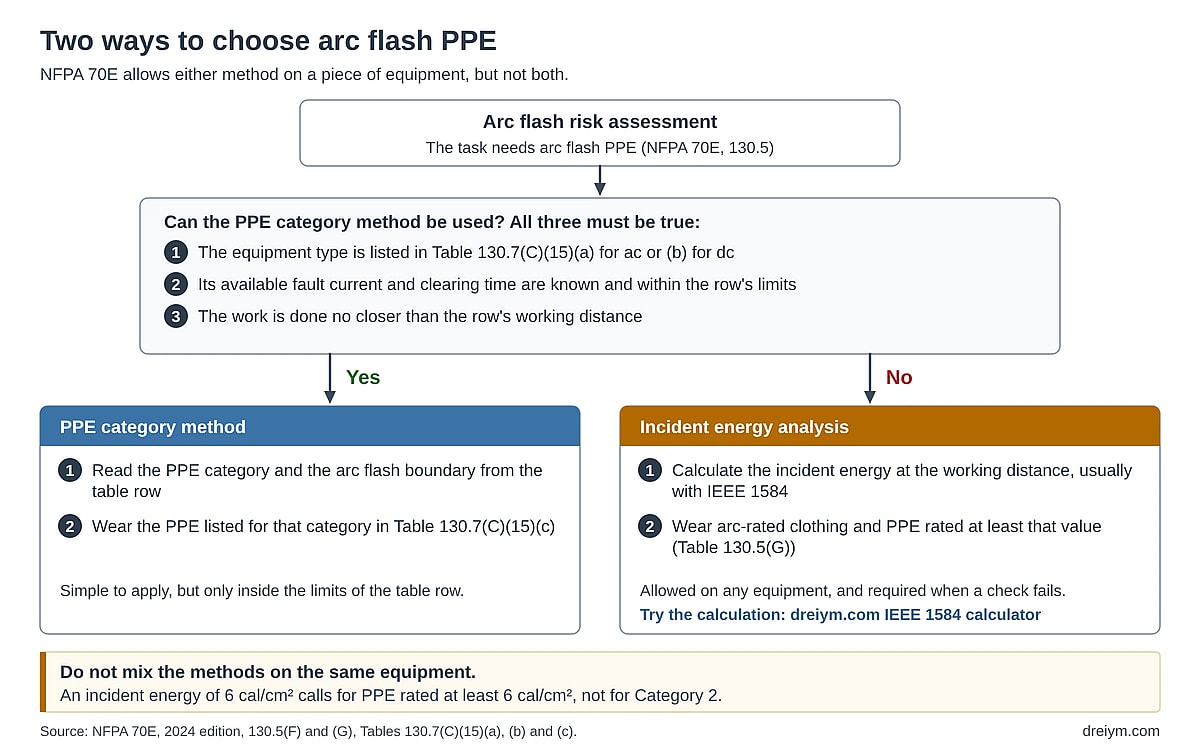
NFPA 70E (130.5(F)) gives you two ways to select arc flash PPE. On any one piece of equipment, you can use only one of them:
- The arc flash PPE category method uses Table 130.7(C)(15)(a) for ac equipment or Table 130.7(C)(15)(b) for dc equipment. Each row lists a type of equipment with its PPE category and arc flash boundary. You can use a row only if the equipment’s available fault current and fault clearing time are known and fall within that row’s limits, and the work is done no closer than the row’s working distance. The PPE for each category comes from Table 130.7(C)(15)(c), which we summarize below.
- In the incident energy analysis method, an arc flash study calculates the incident energy at the working distance, usually to IEEE 1584. The worker then wears arc-rated clothing and PPE with an arc rating at least equal to that incident energy (Table 130.5(G)).
Either way, the arc flash risk assessment comes first. It decides whether the task needs arc flash PPE at all (Table 130.5(C) lists common tasks). NFPA 70E also rules out using an incident energy result to pick a PPE category. If a study gives 6 cal/cm2, that doesn’t put the equipment in category 2. The worker needs arc-rated clothing and PPE rated at least 6 cal/cm2. When the equipment doesn’t match any row of the tables, or its fault current or clearing time isn’t known, the category method can’t be used and you need an incident energy analysis. Because the two methods can’t be mixed on one piece of equipment, its arc flash label shows either the PPE category or the incident energy, never both (see our guide to arc flash labeling requirements).
Estimating Incident Energy
To see how the incident energy calculation works, try our arc flash calculator. It shows each step of the IEEE 1584-2018 model and gives a screening estimate, not a label value.
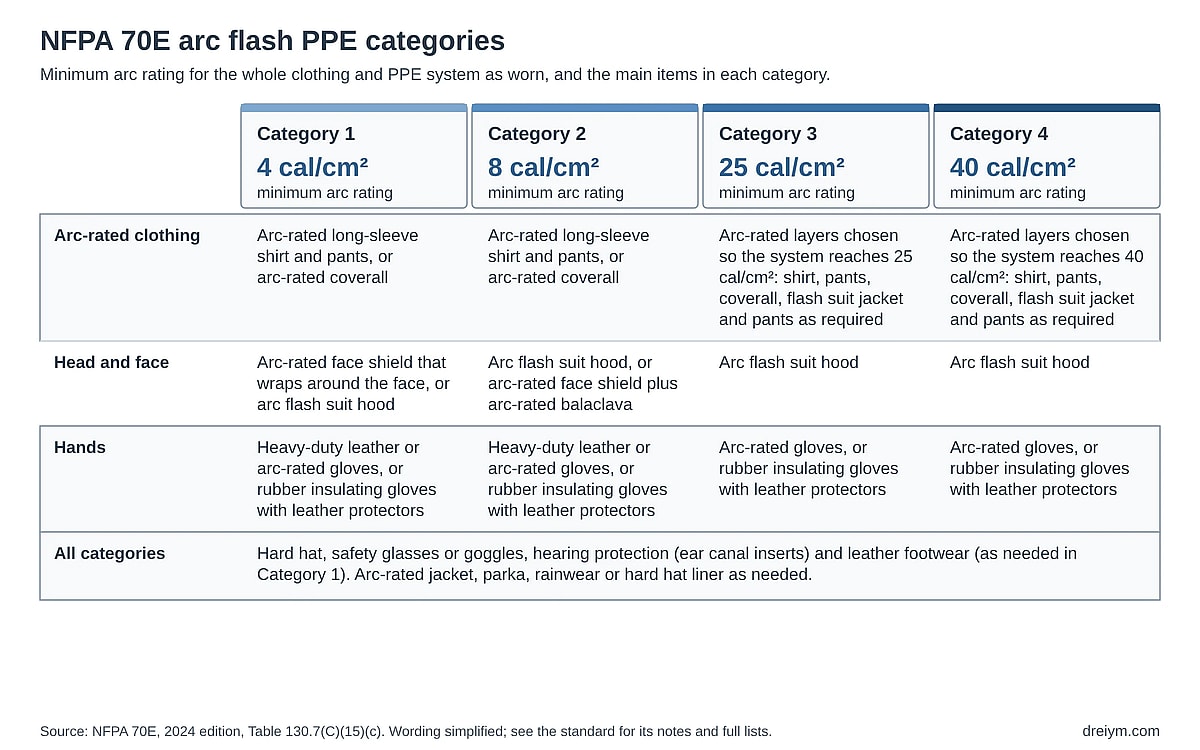
Each category below sets a minimum arc rating, in cal/cm2, for the arc-rated clothing and PPE system as it’s worn. An arc rating comes from testing the fabric, or the layered system, against an electric arc. It’s given as an ATPV or EBT value and printed on the garment’s label.
Category 1: Minimum Arc Rating 4 cal/cm2
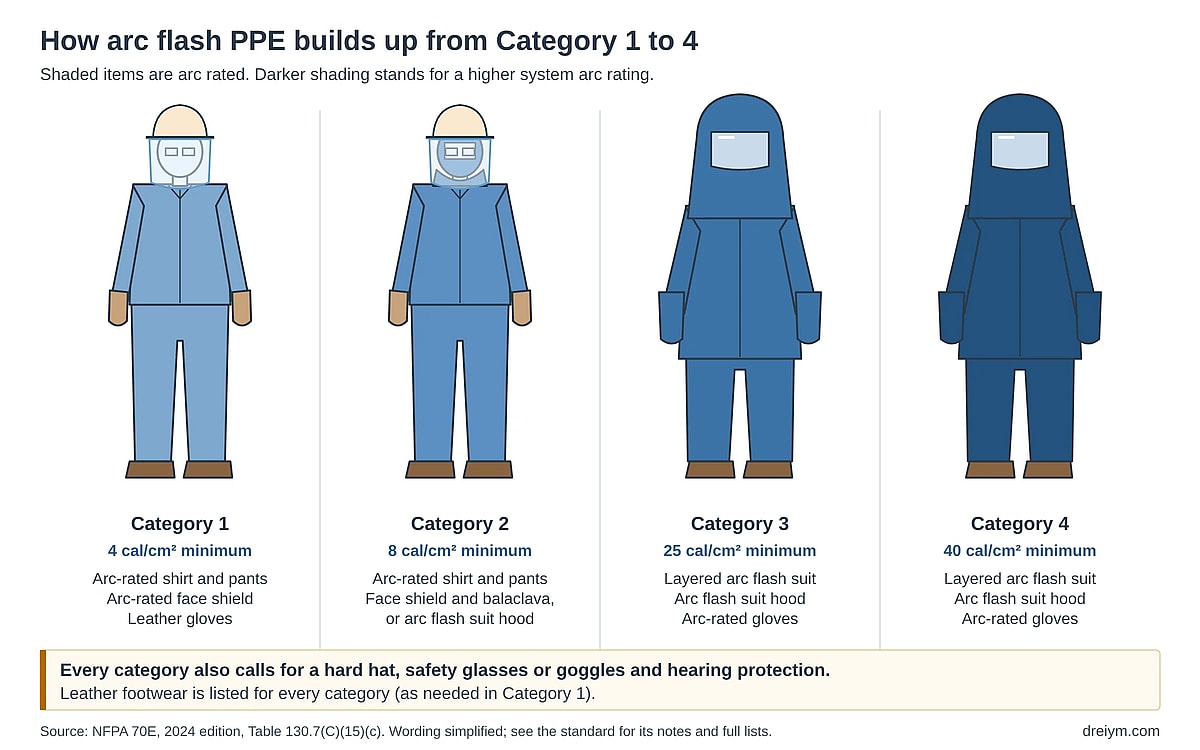
This is the lowest category. Each arc-rated garment needs an arc rating of at least 4 cal/cm2, and the worker wears:
- Arc-rated long-sleeve shirt and pants, or an arc-rated coverall
- Arc-rated face shield that wraps around the face, chin, forehead, ears, and neck, or an arc flash suit hood
- Hard hat
- Safety glasses or safety goggles
- Hearing protection (ear canal inserts)
- Heavy-duty leather gloves, arc-rated gloves, or rubber insulating gloves with leather protectors
- Leather footwear
- Arc-rated jacket, parka, rainwear, or hard hat liner, as needed
Category 2: Minimum Arc Rating 8 cal/cm2
Here the minimum arc rating for arc-rated clothing doubles to 8 cal/cm2, and a face shield on its own is no longer enough. The category calls for:
- Arc-rated long-sleeve shirt and pants, or an arc-rated coverall
- Arc flash suit hood, or an arc-rated face shield together with an arc-rated balaclava (sock hood)
- Hard hat
- Safety glasses or safety goggles
- Hearing protection (ear canal inserts)
- Heavy-duty leather gloves, arc-rated gloves, or rubber insulating gloves with leather protectors
- Leather footwear
- Arc-rated jacket, parka, rainwear, or hard hat liner, as needed
Category 3: Minimum Arc Rating 25 cal/cm2
By this level the clothing is usually layered, and the 25 cal/cm2 rating applies to the whole system as worn (more on that under Category 4 below). A face shield and balaclava no longer qualify, so the worker needs an arc flash suit hood.
- Arc-rated clothing selected so the system arc rating is at least 25 cal/cm2: an arc-rated long-sleeve shirt, pants, coverall, arc flash suit jacket, and arc flash suit pants, as required to reach that rating
- Arc flash suit hood
- Arc-rated gloves, or rubber insulating gloves with leather protectors
- Hard hat
- Safety glasses or safety goggles
- Hearing protection (ear canal inserts)
- Leather footwear
- Arc-rated jacket, parka, rainwear, or hard hat liner, as needed
Category 4: Minimum Arc Rating 40 cal/cm2
Category 4 is the highest of the arc flash PPE categories. It calls for the most layers of protective gear. The 40 cal/cm2 figure is the minimum arc rating for the whole arc-rated clothing and PPE system as worn. When you combine layers, testing the assembled system to ASTM F1959 establishes its rating. A layered system usually rates higher than any one of its layers. The layers don’t each need a 40 cal/cm2 rating on their own. A worker in category 4 PPE wears:
- Arc-rated clothing selected so the system arc rating is at least 40 cal/cm2: an arc-rated long-sleeve shirt, pants, coverall, arc flash suit jacket, and arc flash suit pants, as required to reach that rating
- Arc flash suit hood
- Arc-rated gloves, or rubber insulating gloves with leather protectors
- Hard hat
- Safety glasses or safety goggles
- Hearing protection (ear canal inserts)
- Leather footwear
- Arc-rated jacket, parka, rainwear, or hard hat liner, as needed
How To Know if Your Workplace Is Susceptible to an Arc Flash
To assess the electrical hazards in your workplace, invest in an Arc Flash study. At Dreiym Engineering, our team of Arc Flash consultants can determine the risk of an Arc Flash happening at your facility and what kind of damage to expect in a worst-case scenario. Contact us today to schedule a detailed site walk-down, which is the first step to upkeeping the electrical safety and quality of your company.