Selected Projects
Recurring Arc Flash and Coordination Studies, Greater Houston (2018 to Present)
We typically respond within one business day.
Project at a glanceDE-PRJ-8104
- Practice
- Electrical power
- Location
- Greater Houston, TX
- Service
- Arc flash, coordination
- Client
- Confidential
Recurring Arc Flash and Coordination Studies, Greater Houston (2018 to Present)
We’ve run a standing program of arc flash and protection coordination studies for industrial facilities around Greater Houston since 2018. We keep client details confidential.
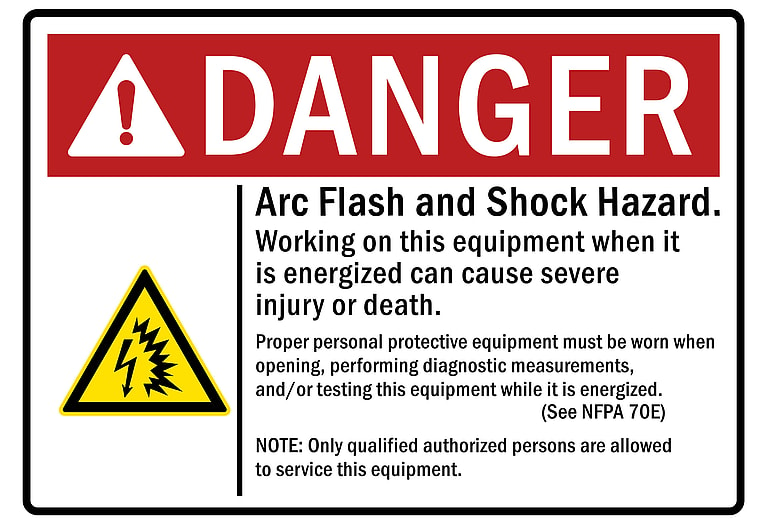
An arc flash label is the part of the study you can see. Most of the work behind it is modeling and collecting data in the field.
When the plant changes
A plant’s electrical system keeps changing after the study is done. Equipment gets added and the utility reconfigures its side, and bit by bit the old study stops matching the hazard that’s there today. Facilities need a study that keeps up with the plant.
What goes into each study
Each facility’s electrical system gets modeled from its one-line diagrams, checked in the field. That model gives us the short circuit duty on the equipment and the protective device coordination, so the device closest to a fault clears it first. It also produces the IEEE® 1584 incident-energy calculations, which set the arc flash boundary and the PPE required at every panel a worker might open. The label on the gear is just the visible end of that engineering.
How often a study needs updating
NFPA 70E® calls for the incident energy analysis to be updated whenever a change to the system could affect its results, and reviewed for accuracy at least every five years. In a working plant, changes come much faster than that. New loads go in and breakers get replaced. Sometimes the utility upgrades its service. A standing program picks those changes up as they happen, instead of rediscovering them all at the next audit.
The data behind the model
An arc flash study depends on good system data, and most of it has to be gathered in the field instead of read off a drawing. The one-line diagram gets checked against what’s installed, to see which equipment is there, how each piece is fed, and what has been added or abandoned since the last revision. Each transformer’s nameplate gives its kVA, voltage, impedance and connection. Conductor size, the number of conductors per phase, insulation and run length are recorded too, since the impedance comes from them. Protective devices are identified down to type, frame, sensor and settings. If a trip unit is set differently from what the study assumes, its clearing time changes, and the incident energy changes with it.
The serving utility is asked for its fault contribution, given as available fault current and the X over R ratio. You need both the maximum and the minimum. A higher fault current isn’t automatically the worse case for arc flash. With less current, a device can sit on a slower part of its time current curve. It takes longer to clear, and the incident energy over that longer time can be higher. A study that models only the maximum can understate the hazard at the very gear a worker is standing in front of.

A worker with a laptop at an open electrical cabinet. Beyond the printed label, the study drives the protective device settings, the check of equipment ratings against available fault current, and how the work gets planned.
What else the study is used for
The label itself shows the working distance the incident energy was calculated at, the arc flash boundary, and the protection required at that distance. But the study behind it settles other questions too. Its short circuit duties tell you whether existing equipment is applied within its interrupting rating. The coordination study decides whether a fault takes out one breaker or half the plant. And when work can’t reasonably be done de-energized, NFPA 70E® requires energized work permits and job planning, and the study is what they’re based on.
The model also shows where the hazard can be engineered down instead of only protected against. That might mean faster instantaneous settings, or the arc energy reduction techniques the National Electrical Code® requires on larger overcurrent devices. It might mean a maintenance switching mode, differential protection, remote racking, or moving a frequently operated disconnect out of the boundary. Each of these lowers either the energy or the exposure. Those recommendations come out of the same model, so the study and the protection and coordination work belong together.
Keeping each facility’s model current
Every facility in the program has its own system model, which our engineers build and maintain in ETAP® and SKM. From it we deliver the incident-energy calculations, equipment labeling, PPE guidance under NFPA 70E® and updated one-line diagrams. When a system changes, we restudy it. The work is overseen by licensed Professional Engineers and PE-stamped where required.
What the electrician sees
Electricians work from what the label says, so our job is keeping every label true as the plant changes. Our arc flash study services page covers what a study includes.
We’ve also written about the dangers of arc flash and why regular arc flash studies pay off.
Electrical power
Related projects
Dripping Springs, TX
Arc Flash Study for a School Building Addition, Dripping Springs
Arc flash, coordination
Pflugerville, TX
Arc Flash Study at a Truss and Wall Panel Plant, Pflugerville
Arc flash, coordination
Houston, TX
Federal Campus Arc Flash Study, Houston
Arc flash, coordination
More work in: Texas, Arc Flash and Power Studies in the Houston Area
Get your project started
We typically respond within one business day.