NFPA 70B Requirements: Building an Electrical Maintenance Program
What NFPA 70B requires: a documented electrical maintenance program, condition-based intervals, infrared and testing, and system studies kept current.

Contents
- What Changed When NFPA 70B Became a Standard
- Who Has to Follow NFPA 70B?
- The Electrical Maintenance Program: What Has to Be Written Down
- Equipment Condition Assessment and Maintenance Intervals
- Infrared Thermography and the Fundamental Tests
- Single-Line Diagrams and System Studies
- A Facility Manager’s NFPA 70B Checklist
- Frequently Asked Questions
- How Dreiym Engineering Can Help
NFPA 70B requirements center on one thing: the equipment owner has to implement and document an electrical maintenance program (EMP). The program names who is responsible, covers every piece of electrical equipment, sets inspection and test intervals from the manufacturer’s recommendations or the standard’s interval table, adjusts them with an equipment condition assessment, and records what was found and fixed. The standard also requires an accurate single-line diagram and short-circuit, coordination and arc flash studies that are kept current.
That has been true since the 2023 edition, when NFPA 70B changed from a recommended practice into a standard. Below we cover what changed, who has to follow it, what the EMP must contain, how intervals are set, and a checklist facility managers can work from.
What Changed When NFPA 70B Became a Standard
For fifty years NFPA 70B was a recommended practice. Its advice was written with “should,” and nothing in it was required. The 2023 edition, effective January 16, 2023, reissued it as NFPA 70B, Standard for Electrical Equipment Maintenance. Its requirements are written with “shall,” in a form an authority can adopt or a contract can cite, and the edition added a chapter that sets maximum maintenance intervals by equipment type and condition.
NFPA lists the 2026 edition as the current edition, and the next one, 2029, is in development. The 2026 edition keeps the same framework: a documented EMP, intervals based on an equipment condition assessment, and system studies. The section and table numbers in this article are from the 2023 edition, the first written as a standard. Check them against the edition your authority having jurisdiction (AHJ), insurer or contract cites, because that edition governs.
Who Has to Follow NFPA 70B?
A standard isn’t a law by itself. NFPA 70B becomes binding on a facility when:
- A jurisdiction adopts it into its fire or building code, and the AHJ enforces it.
- An insurer requires it as a condition of coverage.
- A contract requires it, such as a lease, a service agreement or a corporate standard.
Federal OSHA has not adopted NFPA 70B as an OSHA standard. A national consensus standard can still be used as evidence that a hazard is recognized, which matters if an incident is investigated. The companion standard, NFPA 70E®, already requires the electrical safety program to consider the condition of maintenance of electrical equipment, and an arc flash label is only as good as the protective device behind it. NFPA 70B is the document that says what that maintenance is.
The Electrical Maintenance Program: What Has to Be Written Down
The EMP is the core requirement. In the 2023 edition, Chapter 4 says the program shall include:
- An electrical safety program that addresses the condition of maintenance
- The people responsible for implementing each element of the program
- A survey and analysis of the electrical equipment and systems to set maintenance requirements and priorities
- Documented maintenance procedures for the equipment
- A plan of inspections, servicing and suitable tests
- A documentation and records retention policy for maintenance, equipment and personnel
- A process to prescribe, carry out and document corrective measures based on the data collected
- A process for designing maintainability into electrical installations
- A review and revision process that uses failures and findings for continuous improvement
Most facilities already do some of this. What the standard adds is the requirement to put it in writing, cover all of the equipment, and show that the program is followed.

Equipment Condition Assessment and Maintenance Intervals
Chapter 9 sets how often maintenance happens. The manufacturer’s recommendations come first. Where they aren’t provided or available, and a failure of the equipment would present an unacceptable risk to people or the environment, maintenance has to be done at no more than the intervals in Table 9.2.2.
Which column of the table applies depends on an equipment condition assessment that rates each piece of equipment from Condition 1 to Condition 3 on three factors:
- Physical condition. Condition 1 is like new, with a clean, dry, tight enclosure, no unaddressed alarms from continuous monitoring, no open recommendations from predictive techniques, and maintenance done as the EMP requires. Condition 2 applies when results deviate from past results, the last cycle found major components that needed repair or replacement, or monitoring or predictive techniques have flagged something. Condition 3 applies when the last two cycles were missed, the last two cycles both found major repairs, monitoring alarms are unaddressed, or predictive techniques call for urgent action.
- Criticality. Equipment whose failure could endanger people is rated Condition 3.
- Operating environment. Equipment in a harsh environment, such as exposure to chemicals or extreme temperatures, is rated Condition 3.
The most severe of the three ratings sets the interval. A few rows from Table 9.2.2 in the 2023 edition show how much the condition matters:
| Equipment and task | Condition 1 | Condition 2 | Condition 3 |
|---|---|---|---|
| All equipment: infrared thermography | 12 months | 12 months | 6 months |
| Switchgear: visual inspection | 12 months | 12 months | 6 months |
| Switchgear: electrical testing | 60 months | 36 months | 12 months |
| Panelboards and switchboards: electrical testing | 60 months | 36 months | 12 months |
| Molded-case, insulated-case and low-voltage power circuit breakers: electrical testing | 60 months | 36 months | 12 months |
| Protective relays, electromechanical: electrical testing | 36 months | 24 months | 12 months |
| Power and distribution transformers: visual inspection | 12 months | 12 months | 6 months |
| Grounding and bonding: electrical testing | 60 months | 36 months | 36 months |
| Uninterruptible power supplies: visual inspection | 6 months | 3 months | 1 month |
These are maximum intervals. Moving equipment from Condition 3 back to Condition 1, by fixing what was found and keeping to the schedule, is how the maintenance load comes back down.

Related service
Studies modeled in ETAP® and SKM, field testing and electrical design by licensed PEs.
Infrared Thermography and the Fundamental Tests
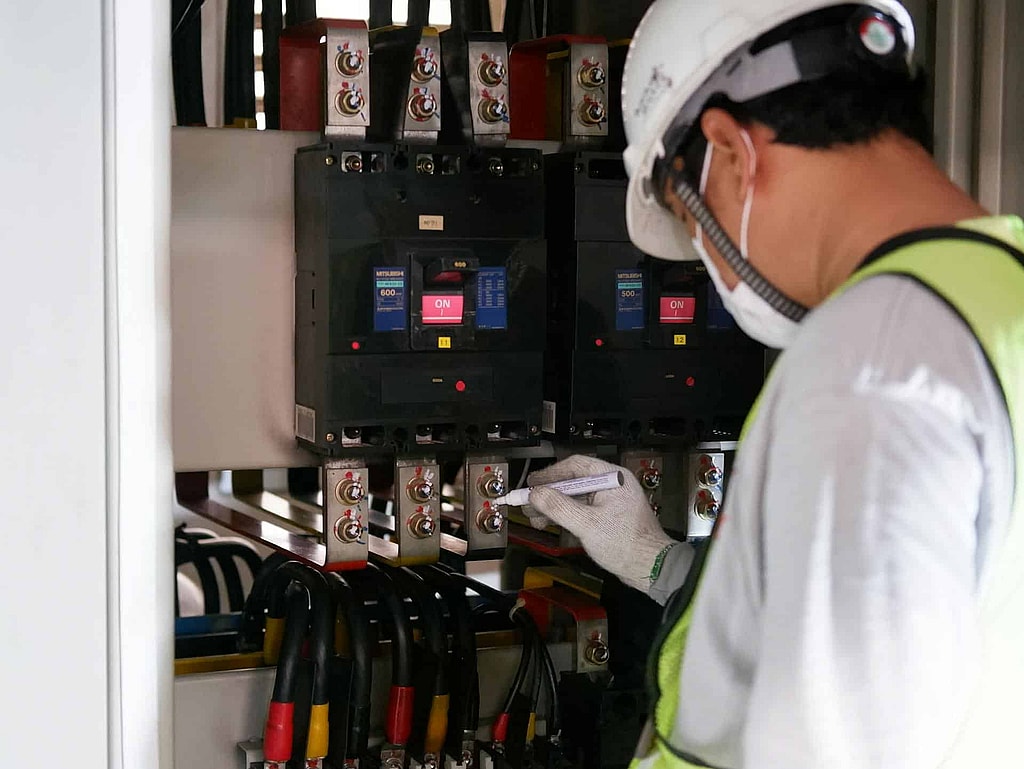
Chapter 7 describes tests that apply across most equipment types. Bolted bus connections, conductor terminations and connectors have to be checked by one or more of the methods it lists, and infrared thermography is one of them. In the 2023 edition, infrared inspections:
- Are done at normal circuit loading. Where that isn’t feasible, a load of at least 40 percent of the nominal circuit loading is permitted, and the loading is recorded.
- Need a clear line of sight, so covers are removed where necessary.
- Record the temperature difference between the area of concern and a reference.
Permanently mounted thermal sensors are also permitted for monitoring connections. Our infrared inspections scan energized equipment under load and document what they find for your EMP records.
For insulation testing of equipment rated above 1,000 volts, the EMP chooses the test method. Grounding and bonding systems have their own row in Table 9.2.2, with electrical testing every 60, 36 or 36 months by condition. Our grounding system tests measure electrode resistance and check continuity and bonding, to ANSI/NETA ATS or MTS when your specification calls for it.
What a test record has to show
Chapter 8 requires a record for every field test. At a minimum it identifies the tester and their organization, the equipment and its nameplate data, the date, the test performed, environmental conditions that could affect the results, pass/fail criteria where they apply, as-found and as-left results, and the tester’s comments. Testing personnel have to be qualified for both the test equipment and the equipment being tested.
Single-Line Diagrams and System Studies
Chapter 6 ties maintenance to the engineering studies that describe the system:
- Single-line diagrams have to be accurate and legible. A diagram that doesn’t match the installed equipment undermines every study built on it.
- Short-circuit and coordination studies have to be reviewed for accuracy at intervals not exceeding five years. A short circuit analysis confirms that equipment can withstand and interrupt the available fault current, and a coordination study confirms the settings still isolate faults the way they should.
- The incident energy analysis has to be updated when changes could affect its results. NFPA 70E already requires the arc flash risk assessment to be reviewed at least every five years, so arc flash studies and labels stay on the same cycle.
Maintenance and the studies feed each other. A breaker that hasn’t been exercised or tested may clear a fault more slowly than its curve shows, and the incident energy on the label assumes it will clear on time.
A Facility Manager’s NFPA 70B Checklist
- Find out which edition applies. Ask your AHJ, insurer and corporate risk group which edition, if any, they require.
- Name an owner for the program and the people responsible for each part of it.
- Build the equipment inventory and check the single-line diagram against what is installed.
- Collect manufacturer’s maintenance instructions for the major equipment.
- Assess the condition of each piece of equipment for physical condition, criticality and environment.
- Set the intervals, from the manufacturer or Table 9.2.2, and put them on a calendar.
- Schedule infrared scans under normal load, and outages for the tests that need equipment de-energized.
- Keep test records with as-found and as-left results, and track every corrective action to completion.
- Review the short-circuit, coordination and arc flash studies at least every five years and after any system change.
- Review the program itself, using failures and findings to adjust conditions and intervals.
Frequently Asked Questions
Is NFPA 70B mandatory?
Its text is mandatory, but it becomes binding on a facility only when a jurisdiction adopts it, an insurer requires it, or a contract cites it. Many facilities follow it anyway because it is the recognized benchmark for electrical maintenance.
How often does NFPA 70B require infrared scans?
In the 2023 edition’s Table 9.2.2, infrared thermography of all equipment is listed at 12 months for Condition 1 and 2 and at 6 months for Condition 3, where the manufacturer doesn’t recommend an interval. Scans are done under normal load, or at least 40 percent of nominal load where normal load isn’t feasible.
How often do the system studies need to be reviewed?
Short-circuit and coordination studies have to be reviewed for accuracy at intervals not exceeding five years, and the incident energy analysis has to be updated whenever a change could affect its results. NFPA 70E also requires the arc flash risk assessment to be reviewed at least every five years.
What is the difference between NFPA 70B and NFPA 70E?
NFPA 70E covers safe work practices for people working on or near electrical equipment. NFPA 70B covers maintaining the equipment itself. They work together: 70E’s protection assumes the equipment is maintained, and 70B says what that maintenance involves.
Does NFPA 70B replace the manufacturer’s instructions?
No. The manufacturer’s recommendations come first. Table 9.2.2 applies where the manufacturer’s recommendations aren’t provided or available and a failure would present an unacceptable risk.
How Dreiym Engineering Can Help
We perform much of the testing and engineering an electrical maintenance program calls for: infrared inspections, grounding system tests to ANSI/NETA ATS or MTS when specified, short circuit analysis with ongoing maintenance programs, coordination studies, and arc flash studies with labels we print and install or ship to you. Our electrical power studies are led by Brian J. Brackensick, M.S., P.E., with field data collection by Ruben A. Rodriguez, and we model systems in ETAP and SKM. We also offer training on IEEE 1584-2018 and NFPA 70E. Reports are PE-stamped where required. For background, see our post on preventive maintenance in electrical systems and our Hill Country grounding and infrared program. Contact us or call (866) 621-6920 for a free quote. We typically respond within one business day.