Selected Projects
EV Charging Capacity Studies for Condominium and Apartment Buildings, Austin (2018-2022)
We typically respond within one business day.
Project at a glanceDE-PRJ-8778
- Practice
- Electrical power
- Location
- Austin, TX
- Service
- EV charging, load studies
- Client
- Confidential
EV Charging Capacity Studies for Condominium and Apartment Buildings, Austin (2018-2022)
From 2018 to 2022 we did EV charging capacity studies, checking the electrical capacity available for electric vehicle chargers at five condominium and apartment buildings in Austin, Texas. Client details are confidential.
The question every building asks
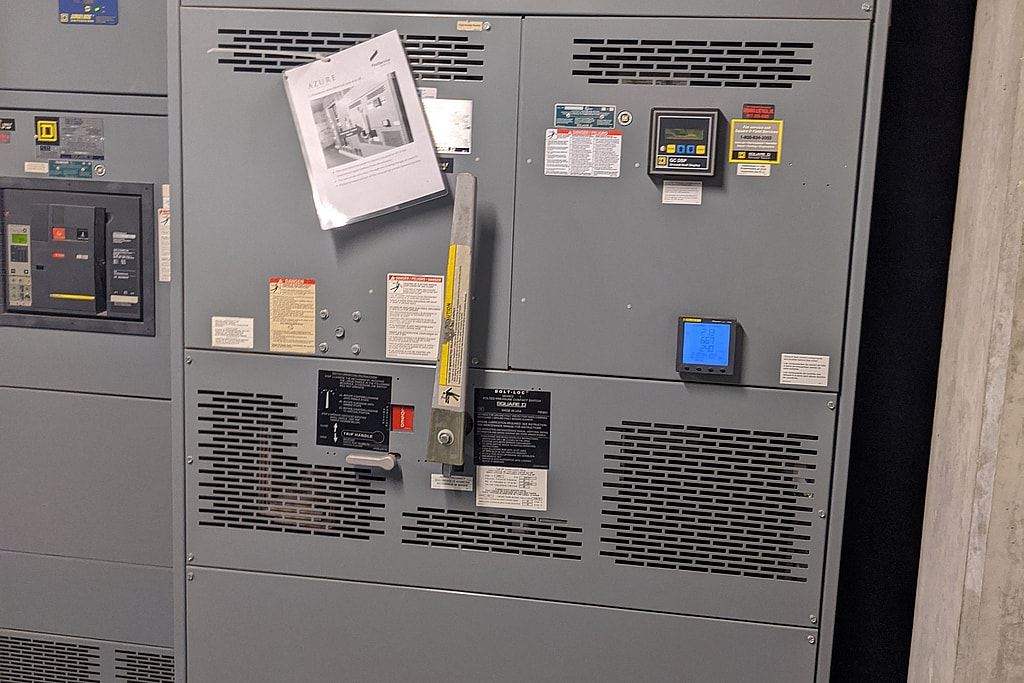
Residents buy electric vehicles faster than buildings plan for them. A board or a property manager needs to know how many chargers the existing service can carry, where they can be fed from, and what has to change before the garage fills up with requests. Each of these studies started with a site visit to document the electrical infrastructure and the chargers already installed, followed by a review of the facility drawings and a year or more of electric bills.
Reading capacity from the bills
A switchboard nameplate gives the ceiling, and the bills show how much of it is already used. At one condominium of six buildings, each fed from a 208Y/120V, 2,000 A switchboard, that ceiling works out to about 720 kVA per building, or 684 kW at a power factor of 0.95. Monthly energy from the bills was converted to average demand, and the peak demand recorded on past bills ran between 1.5 and 1.9 times that average. We assumed a ceiling of 2.5 times the average to stay conservative. The result showed more spare capacity than the facility staff expected, enough for 400 A of charging per building.
Five buildings, five answers
The other buildings gave different answers. A high-rise fed at 480Y/277V had a maximum building load of 1,555 kW and at least 400 A available for charging. A second high-rise, with peak demand on its bills ranging from 1.18 to 3.90 times the average, had at least 1,200 A available on one of its two main buses. A third building, fed from several transformers, had too little room in its main electrical room for a large build-out, so we laid out options for a new 250, 500 or 1,000 kVA service in the transformer yard. A garage fed at 208Y/120V, reviewed with 14 months of bills, had about 199 A to spare at its panel.
What we recommended
For residents, Level 2 chargers on 40 A or 50 A circuits are the practical choice. We recommended against adding more Level 1 chargers, and Level 3 DC fast chargers need 480 V and far more power than a residential garage can usually spare. Managed charging, where the chargers share the available capacity and take part in demand reduction, lets more residents charge from the same service. We also suggested a few shared charging spaces for guests and for residents whose own charger is out of service. For several of the buildings we went on to prepare the charger circuit drawings.
Planning for chargers
How existing load is measured is explained on our page for load analysis. The drawings that follow are part of our electrical design services.
Electrical power
More projects in this practice
Norman, OK
Airport Grounding Testing, Norman
Ground testing
Temple, Grand Prairie and Humble, TX
Arc Flash Studies at Manufacturing Plants in Temple, Grand Prairie and Humble
Arc flash, coordination
Hattiesburg, MS, plus AZ, WA and TX
Arc Flash Studies for Four Plants in Four States
Arc flash, labels
Get your project started
We typically respond within one business day.