Selected Projects
EV Charging Build-Out Studies for Three Downtown Austin Residential Towers and a San Marcos Apartment Building (2022)
We typically respond within one business day.
Project at a glanceDE-PRJ-8829
- Practice
- Electrical power
- Location
- Austin and San Marcos, TX
- Service
- EV charging, load studies
- Client
- Confidential
EV Charging Build-Out Studies for Three Downtown Austin Residential Towers and a San Marcos Apartment Building (2022)
By 2022 the question at many residential buildings had moved from whether to add EV chargers to how many the building could ever hold. That year we did EV charging build-out studies for three residential towers in downtown Austin and an apartment building in San Marcos.
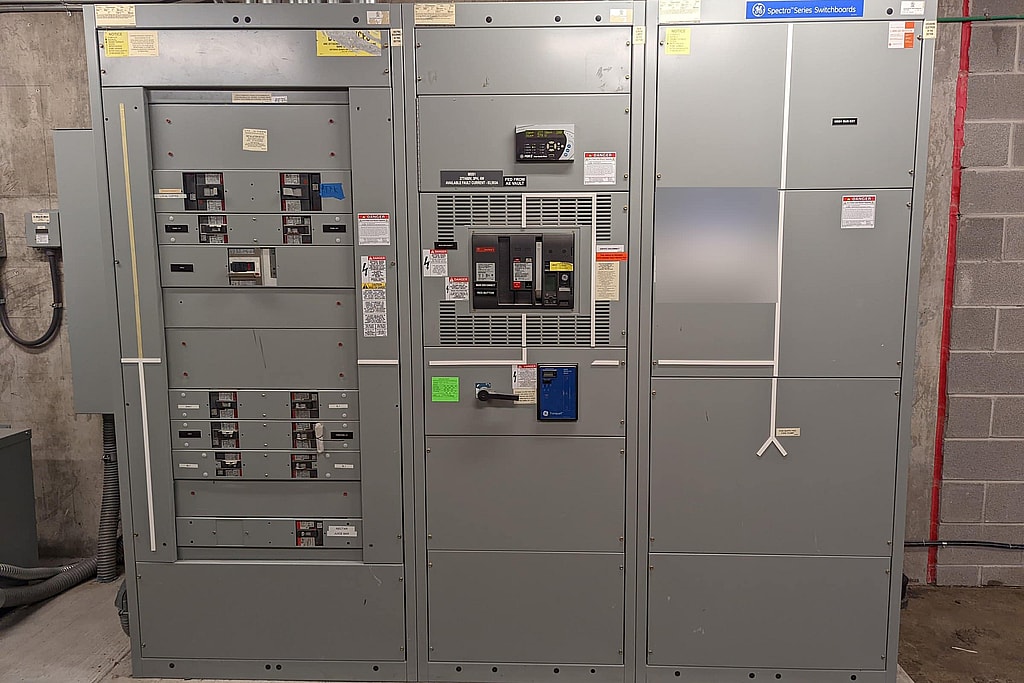
An apartment building with a plan
The San Marcos building had a few chargers and plans for 26 more on 40 A circuits. It is fed at 208Y/120 V from a 750 kVA utility transformer. A year of bills showed peak demand between 1.91 and 2.54 times the average load; we assumed up to 3.0 times, which put the building maximum near 283 kW and left at least 466 kW to spare on one bus. That was room for about 1,200 A of charging. The 26 chargers needed about 173 kVA, roughly 480 A, and we went on to design a new feed from the transformer secondary for them.
Three towers, three switchboard puzzles
The first tower, fed at 480Y/277 V, showed peaks of 1.23 to 2.16 times the average. On paper it had almost 4,000 A to spare, but the equipment limited the usable figure to 3,000 A, enough to give up to 1,000 kVA to chargers. We laid out options with two transformers in the garage at 112.5, 250 or 500 kVA each, feeding panels that could be added as demand grew, up to about 300 chargers.
At the second tower the one-line looked simple: a 1,200 A breaker labeled as the only main disconnect. An engineer for the owner told us one utility bill covered both a 3,000 A bus and the 1,200 A bus, so we went back to look. The 3,000 A bus was there, with no spare connection points other than a possible bus tap, and its breaker long-time pickup was set at 45%, so we treated it as a 1,350 A bus. Two dedicated 112.5 kVA transformers would support at least 150 smart chargers that share capacity, or 37 plain ones. That gap is a good argument for managed charging.
The third tower has two services, 2,000 A and 4,000 A, with about half and nearly two thirds of their capacity spare, and at least 500 kVA available from each bus. The board wanted simple 30 A outlets at parking spaces rather than smart chargers. The current code at the time allowed no demand factor for EV chargers, so every outlet had to be counted at full load. Our plan used seven 112.5 kVA transformers and seven panels, one on each garage floor, for 147 outlets, 21 per panel, built out in stages.
What carried over
In the three towers we recommended against Level 1 chargers in the garage. Two of the studies left the existing chargers out of the capacity math, since judging them would take 30 days of metering at each location.
Related work
Five earlier buildings are described in our EV charging capacity studies. How existing load is read from bills is explained under load analysis.
Electrical power
More projects in this practice
Norman, OK
Airport Grounding Testing, Norman
Ground testing
Temple, Grand Prairie and Humble, TX
Arc Flash Studies at Manufacturing Plants in Temple, Grand Prairie and Humble
Arc flash, coordination
Hattiesburg, MS, plus AZ, WA and TX
Arc Flash Studies for Four Plants in Four States
Arc flash, labels
Get your project started
We typically respond within one business day.