Selected Projects
Troubleshooting Low Cathodic Protection Readings on an 18-Inch Crude Oil Pipeline in a Pea Gravel Trench, Central Texas (2022)
We typically respond within one business day.
Project at a glanceDE-PRJ-8796
- Practice
- Corrosion and CP
- Location
- Central Texas
- Service
- CP troubleshooting, coupons
- Client
- Confidential
Troubleshooting Low Cathodic Protection Readings on an 18-Inch Crude Oil Pipeline in a Pea Gravel Trench, Central Texas (2022)
For years, the readings on about 20 miles of an 18-inch crude oil pipeline in Central Texas pointed to weak cathodic protection. In 2022 we were asked to find out why, and the cause turned out to be the trench the pipe sits in.
A rebuilt section in a gravel trench
About fifteen years before our work, this part of the line had been replaced with steel pipe coated in fusion bonded epoxy, laid in a rock trench and backfilled with pea gravel. Along one stretch the trench was also lined with gunite and capped with concrete. The line runs beside two pipelines of other operators and is bonded to them at two points.
Close interval surveys from 2018, 2019 and 2021 showed IR-free potentials of about -450 to -600 mV against a copper/copper sulfate electrode for roughly three miles on each side of a pump station. That met the 100 mV polarization criterion by a thin margin, although the rectifiers nearby had plenty of spare capacity and were already running high. Turning them up made the readings away from the station more positive, not more negative. In-line inspections, run almost every year, had reported no corrosion. A current mapping survey by another firm in 2021 had flagged ten locations as possible stray current.
Two site visits
We went out in February and again in June 2022, with every rectifier in the area, the neighboring operators included, switched to interrupt together on a 4 second on, 1 second off cycle. At the pump station the piping was in metal-to-metal contact with the grounding grid, structural steel and conduit through motorized valves, pump equipment and instruments. Instant-off readings on the piping and on the station ground all fell between -1,057 and -1,173 mV.
The 2019 survey data showed a sudden jump at the point where the crew had moved its pipe connection to a particular test station. A moving ground continuity test explained it: the leads at that station made only intermittent contact with the pipe, while the line itself was continuous from the pump station to the next test point beyond. A break in the pipe was ruled out.
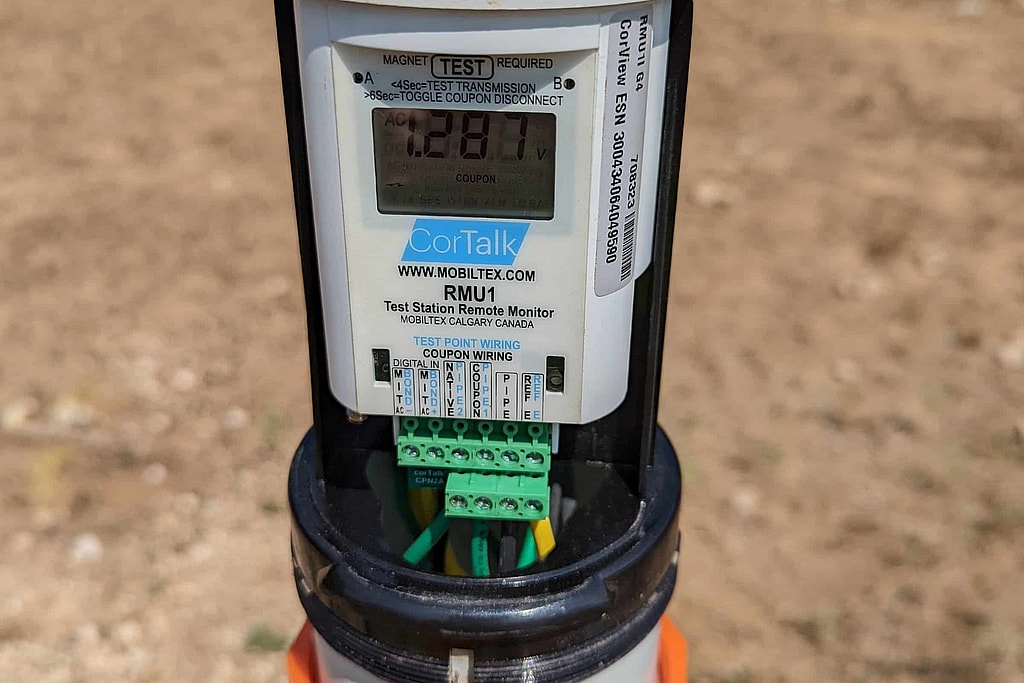
Next we connected a temporary groundbed at a coupon test station in one of the worst areas and interrupted it in step with the rest of the system. At 29.5 V it could push only 120 mA into the ground, which fits a well coated pipe in very high resistivity backfill. The pipe and coupon potentials barely moved, and the instant-off values even drifted slightly positive. Yet the coupon, left disconnected for about 48 hours, depolarized to -170 mV, a shift of roughly 300 mV, while the native coupon at the same station read -110 mV.
New coupon stations, rewired
On our recommendation the operator installed more coupon test stations through the low area. When we came back in June, they had been wired for AC and DC coupons rather than as a native coupon and a CP coupon, so the native coupon was tied to the pipe through a 10 ohm resistor and had been collecting protective current. With approval from the operator we rewired them. Each CP coupon was then disconnected for about 45 minutes, and every one depolarized by more than 100 mV. By the time the operator collected more data in August, the native coupons had settled between -10 and -249 mV.
What the readings meant
Stray current usually shows up as a local dip where current leaves the pipe, and these low readings ran for miles. The inspections found no metal loss either. The rectifiers sit at stations, where the pipe is shorted to large areas of bare copper, conduit, fencing and steel, so much of their current goes there, and readings taken on that mixed-metal system misstate the protection on the pipe. In the gravel itself, a well drained, well aerated, high resistivity backfill lets steel passivate, which gives low native and polarized potentials even while corrosion rates stay low. The effect was weaker where gunite and concrete limit the oxygen.
Our report recommended using coupon depolarization to judge protection where ordinary pipe-to-soil readings mislead, and setting up the coupons correctly in the remote monitoring software so that instant-off potentials and current densities are recorded as they should be.
The ten flagged locations
A second report covered the current mapping locations. We found the survey signal at seven of the ten, mostly on fencing, grounding and conduit at valve stations. At one of them a motorized valve was shorting the piping to ground through its conduit, and we also found a missing dielectric union and a failed insulating flange kit; at another, a failed dielectric union. One signal was on an unmarked and probably abandoned line. At the remaining three we could not confirm any signal on the neighboring pipelines. None of the ten had been identified as a point where current leaves the pipe.
Related services
Coupon and interrupted readings like these are part of our close interval surveys. Problems with shared grounding and foreign lines fall under interference testing.
Corrosion and CP
More projects in this practice
Wink and Sarita, TX
AC Interference Data Logging on Texas Pipelines
AC interference testing
Wickett, TX
ACVG Coating Survey of Two Gathering Lines, Wickett
ACVG survey
Eastland area, TX
Annual CP Survey and Ground Patrol of a Gas Line, Eastland Area
CP survey, ground patrol
Get your project started
We typically respond within one business day.