Selected Projects
Lightning-Strike and Forensic Electrical Analyses, Charlotte
We typically respond within one business day.
Project at a glanceDE-PRJ-8125
- Practice
- Forensic
- Location
- Charlotte, NC
- Service
- Lightning and surge
- Client
- Confidential
Lightning-Strike and Forensic Electrical Analyses, Charlotte
We did lightning-strike and forensic electrical analyses in Charlotte, North Carolina, and an industrial electrical inspection in Asheville. The details of those matters are confidential.

Lightning near distribution lines. What we have to work out is whether a strike explains the damage that was found.
Was it lightning?
When someone puts lightning forward as the cause of damage to electrical equipment, we still weigh the physical evidence on its own merits. A lot of different failures can leave equipment inoperable, and several of them look alike on the surface. So the question on an assignment like this is a narrow one. Does the evidence we can observe point to lightning? If it doesn’t, is it a different electrical failure mode, or something else entirely? Getting there takes a methodical examination with nothing assumed going in, because the answer carries real weight for everyone involved in a claim or dispute.
Telling a strike from an ordinary failure
A strike puts a very large current through conductors and equipment for a very short time. A loose connection or an overloaded circuit is different. It heats things over a long period. A component that fails on its own is different again, because the breakdown starts inside that one part. That’s why we look at how the damage is spread out. The surge from a strike tends to reach several circuits and devices at once. Surge protective devices and sensitive electronics often take damage, and so do the points where the surge came into or left the system. When a failure starts inside one component, most of the damage usually stays there. We examine the physical artifacts, things like arc marks, melted conductors and failed semiconductor devices, and compare each one with the mechanisms we’re still considering. Third-party lightning detection records can show whether cloud-to-ground activity was recorded near a site. We weigh those records along with the physical evidence and don’t let them stand in for it. Where fire is part of the question, we follow an approach consistent with NFPA® 921, so we develop hypotheses and test each one against the evidence, without settling on an answer first and working back from it.
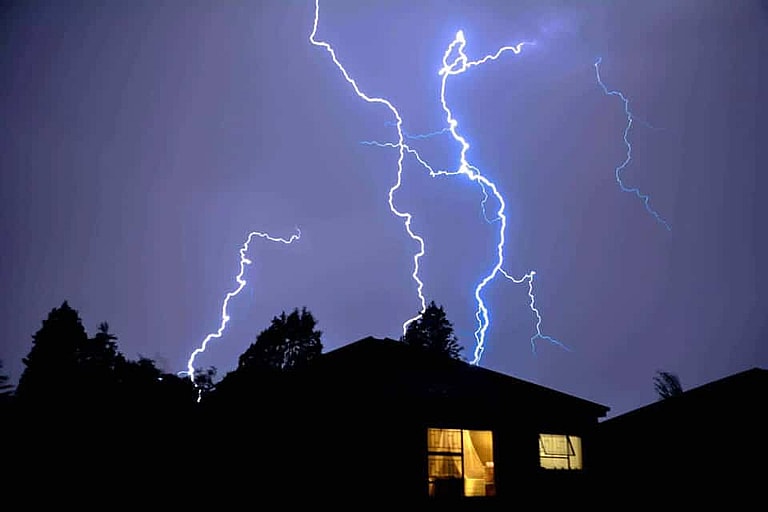
Lightning behind a house at night, with the windows lit. A protection system gives a strike a preferred path to earth. It doesn’t promise that the circuits and equipment inside will come through intact.
Lightning protection and surge protection do different jobs
Whether the site had lightning protection, and what kind, can move the analysis in either direction. A lightning protection system installed to NFPA® 780 and listed under UL® 96A doesn’t push a strike away or reduce its energy. What it does is give the current a preferred path. Air terminals intercept the strike and down conductors carry it to a grounding electrode system that dissipates it. Bonding keeps the building’s grounded systems from sitting at wildly different potentials while that’s going on. A properly installed system is designed to keep the strike’s energy out of the building’s structure and contents, so whether one was there changes what damage we’d expect to see.
Surge protective devices often get confused with lightning protection, but they do something else. They’re installed at the service and at panels under the National Electrical Code®’s surge protection requirements and listed to UL® 1449. Their job is to limit the voltage that reaches equipment downstream. Each one is rated for a certain surge current and a certain let-through voltage. They wear down with every event they absorb, and they don’t make equipment immune. A site can have code compliant surge protection and still lose sensitive electronics to a nearby strike. When we find a failed surge protective device, that failure is evidence in its own right of what the system went through.
All of this narrows the hypotheses we have to test. Damage spread across many circuits, and heaviest at the surge protective devices and the points of entry, fits a lightning related mechanism. Damage confined to one component, with the protective devices intact and undisturbed, generally doesn’t. That pattern points to something that started inside the component. We work through each of those possibilities against the physical record. A strike nearby isn’t enough by itself to settle the question.
In Charlotte and Asheville
We examined the equipment at issue in Charlotte and documented the site conditions. We collected the photographs and physical evidence needed to evaluate each candidate failure mechanism. When a matter like this raises questions at the component level, our in-house lab in Texas handles non-destructive examination, including X-ray imaging, so we can review the evidence inside a part without altering it. Licensed Professional Engineers supervised the analyses. The Asheville job was an industrial electrical inspection. We assessed the electrical installation’s condition and recorded what we observed. Where a case requires it, we testify to our findings at deposition and trial.
Lightning claims and disputes
A lightning claim or an electrical failure dispute comes down to the evidence. Our job is to keep the analysis tied to what the physical record shows. That helps every party who wants an accurate answer, whether the matter settles in negotiation, goes to appraisal or ends up in litigation. Our forensic electrical engineering consulting page has more on this kind of work, and our nationwide engineering work page covers the rest of what we do across the United States.
Forensic
Related projects
South Texas
Surge Damage to Rooftop Air Handlers, South Texas
Surge analysis
Texas Hill Country
Lightning Damage at a Communication Tower Site, Texas Hill Country
Lightning and surge
Lake Charles, LA
Lake Charles Commercial Investigations
Electrical investigation
Get your project started
We typically respond within one business day.