Selected Projects
Soil Resistivity Tests for Ground System Design on Limestone, Clay and Dry Upland Soil, Comfort, Midlothian and a Third Texas Site (2023)
We typically respond within one business day.
Project at a glanceDE-PRJ-8827
- Practice
- Electrical power
- Location
- Comfort and Midlothian, TX
- Service
- Soil resistivity testing
- Client
- Confidential
Soil Resistivity Tests for Ground System Design on Limestone, Clay and Dry Upland Soil, Comfort, Midlothian and a Third Texas Site (2023)
The same test can return numbers more than a hundred times apart, depending on where in Texas it is run. Three soil resistivity tests we did for ground system design in 2023 show the range.
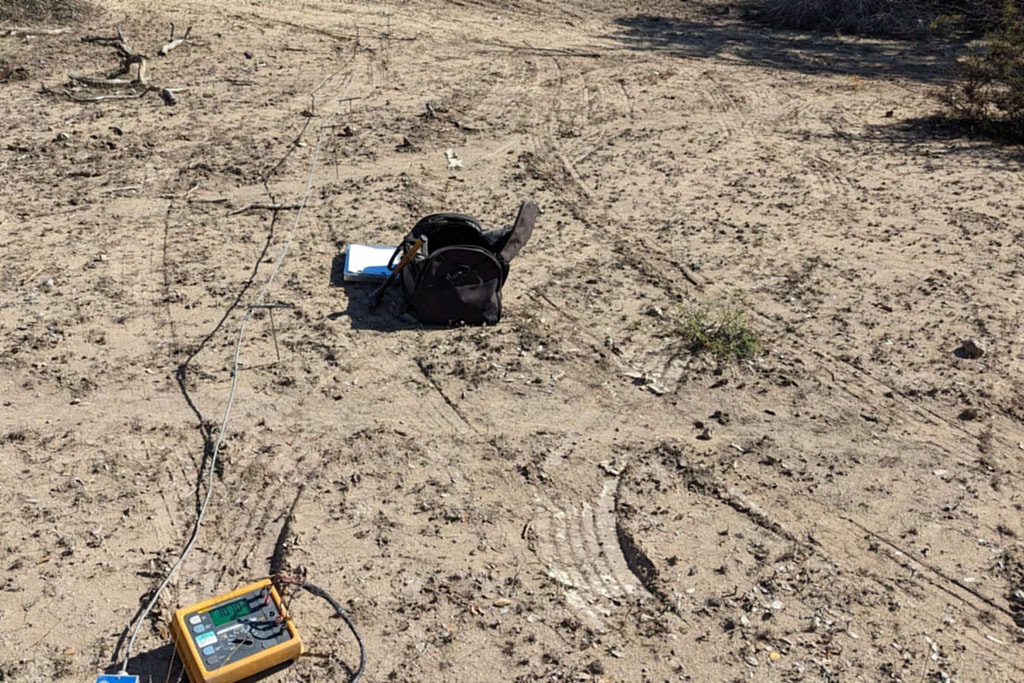
A dry site with an anomaly
In July 2023 a geotechnical firm asked us to test the soil at one of its boring locations. With the Wenner four-pin method (ASTM G57) and pin spacings from 2.5 to 20 feet, the top 10 feet came out between 20,000 and 100,000 ohm-cm, high for almost any grounding design. The reading at 20 feet looked wrong, so we turned the array 90 degrees and then 135 degrees from its first position and tested again. The same anomaly appeared all three times, which points to something in the ground at that depth rather than an error in the setup, and we left that layer out of the analysis. The soil was dry. Ground that resistive needs more material, such as deeper rods, more conductor or ground enhancement, to reach a given resistance to remote earth.
Comfort: limestone
In November 2023, for a geotechnical laboratory, we ran two arrays at a site near Comfort, one south to north and one west to east. The top 10 feet measured 5,000 to 25,000 ohm-cm, consistent with the limestone and rock of the area. Again high, and again the designer would need extra material.
Midlothian: clay
The same month and for the same laboratory, a site near Midlothian gave 600 to 1,000 ohm-cm in the top 10 feet, low for grounding and typical of clay. A ground system there reaches its target with far less copper, though low resistivity soil is also more corrosive to buried steel.
In each case the Barnes layer method turned the average readings into layer values, and the report left the ground system layout to the responsible designer, using these values together with the boring logs.
Related services
Soil testing for ground systems is part of our grounding system tests. The corrosion side of the same numbers is covered under soil corrosivity analysis.
Electrical power
More projects in this practice
Norman, OK
Airport Grounding Testing, Norman
Ground testing
Temple, Grand Prairie and Humble, TX
Arc Flash Studies at Manufacturing Plants in Temple, Grand Prairie and Humble
Arc flash, coordination
Hattiesburg, MS, plus AZ, WA and TX
Arc Flash Studies for Four Plants in Four States
Arc flash, labels
Get your project started
We typically respond within one business day.