Selected Projects
ACVG Coating Survey and Validation Digs on a Power Station Fuel Gas Line, El Paso (2019-2020)
We typically respond within one business day.
Project at a glanceDE-PRJ-8782
- Practice
- Corrosion and CP
- Location
- El Paso, TX
- Service
- ACVG, direct examination
- Client
- Confidential
ACVG Coating Survey and Validation Digs on a Power Station Fuel Gas Line, El Paso (2019-2020)
In 2019 we surveyed the coating on the buried fuel gas line of a power station in El Paso, Texas, and in 2020 we led the validation digs that followed. Client details are confidential.
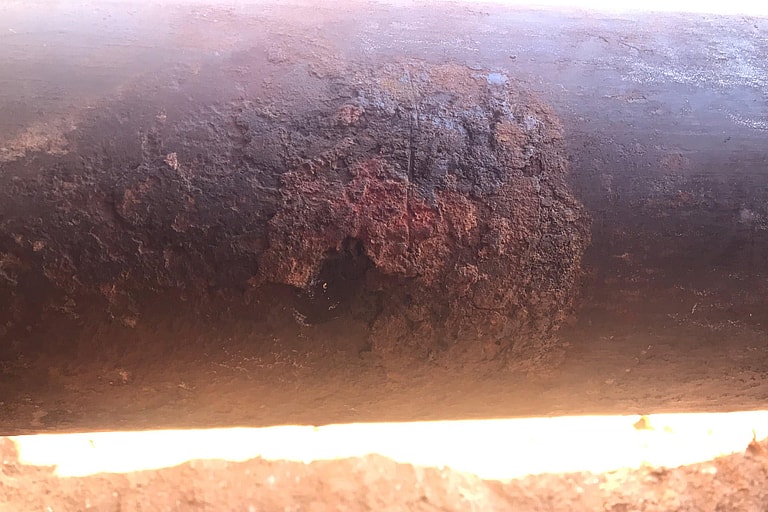
Surface corrosion where the pipe had been in contact with the soil at a coating holiday. The survey had pointed to this spot from above ground.
A line that cannot be pigged
The line carries high-pressure fuel gas to four turbine generators. It is not configured for in-line inspection, which leaves above-grade surveys as the practical way to judge its external condition. We recommended an alternating current voltage gradient (ACVG) survey as the first step. A transmitter puts an AC signal on the pipe, and where the coating is damaged, the signal leaves the pipe and sets up a voltage gradient in the soil that the receiver can find and size.
The survey
We surveyed the line in February 2019 with a Radiodetection PCMx receiver and A-frame. The transmitter was connected at five points, using the deep anode wells of the new CP system and other isolated structures as grounds. The magnesium anodes of the original CP system were left connected on purpose. Each one appears to the receiver as a large coating defect, so they became a check on the survey. Of 19 indications, 8 were confirmed as existing anodes, and the other 11 appeared to be coating anomalies. We recommended exposing the five at highest risk, based on the survey, earlier CP readings and their closeness to plant grounding.
What the first dig found
Two of the indications were excavated in January 2020. The first excavation was made by hydro-vac and benched to 6.5 feet for safety. The 10-inch pipe sat about 4.5 feet deep and carried two coatings: an extruded polyethylene sheath over a rubberized asphalt adhesive, and a 16-inch section of butyl tape over a girth weld. Bare steel showed at one end of the tape. That was the holiday the survey had found, with surface corrosion beneath it. After blasting to white metal per SSPC SP-5, the deepest pit measured 0.01 inch, and nine ultrasonic wall readings averaged 0.510 inch, ranging from 0.464 to 0.539 inch.
Soil and repair
A soil sample from the trench wall at pipe depth measured 1,880 ohm-cm as received and 1,360 ohm-cm saturated, with a pH of 7.7, which makes the soil corrosive to steel. Pipe-to-soil readings at the dig were -593 mV on and -508 mV off against a copper-copper sulfate electrode. The pipe was recoated with a viscoelastic wrap and an outer PVC wrap under our supervision, then holiday tested at 15 kV with no holidays found before the excavation was backfilled.
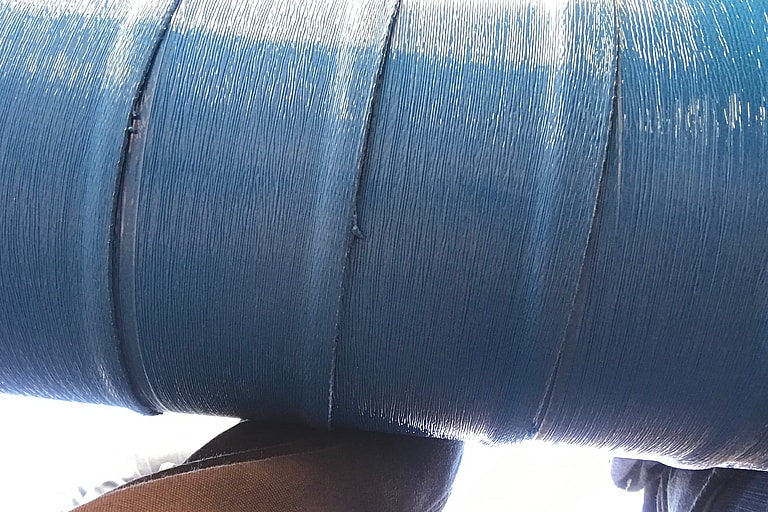
The repair coating going on after blasting and inspection. An outer wrap went over it, and a high-voltage holiday test followed before backfill.
Why validation digs matter
An above-ground survey is indirect. Digging a few of its indications shows whether the grading matches the pipe, and whether the rest of the list deserves the same attention. The survey method is explained on our page for ACVG surveys. The full process is explained on our page for direct assessment.
Corrosion and CP
More projects in this practice
Wink and Sarita, TX
AC Interference Data Logging on Texas Pipelines
AC interference testing
Wickett, TX
ACVG Coating Survey of Two Gathering Lines, Wickett
ACVG survey
Eastland area, TX
Annual CP Survey and Ground Patrol of a Gas Line, Eastland Area
CP survey, ground patrol
Get your project started
We typically respond within one business day.