Selected Projects
Soil Corrosivity Study and Corrosion Control Recommendations for a 24-Inch Water Line, New Braunfels (2021)
We typically respond within one business day.
Project at a glanceDE-PRJ-8817
- Practice
- Corrosion and CP
- Location
- New Braunfels, TX
- Service
- Soil corrosivity study
- Client
- Confidential
Soil Corrosivity Study and Corrosion Control Recommendations for a 24-Inch Water Line, New Braunfels (2021)
Sometimes the corrosion study comes before the pipe material is chosen. For a planned 24-inch water line of about 11,500 feet in New Braunfels, the utility was weighing PVC against ductile iron, and in June 2021 we studied the corrosivity of the soil so that the ductile iron option would come with a corrosion plan.
Seven test sites
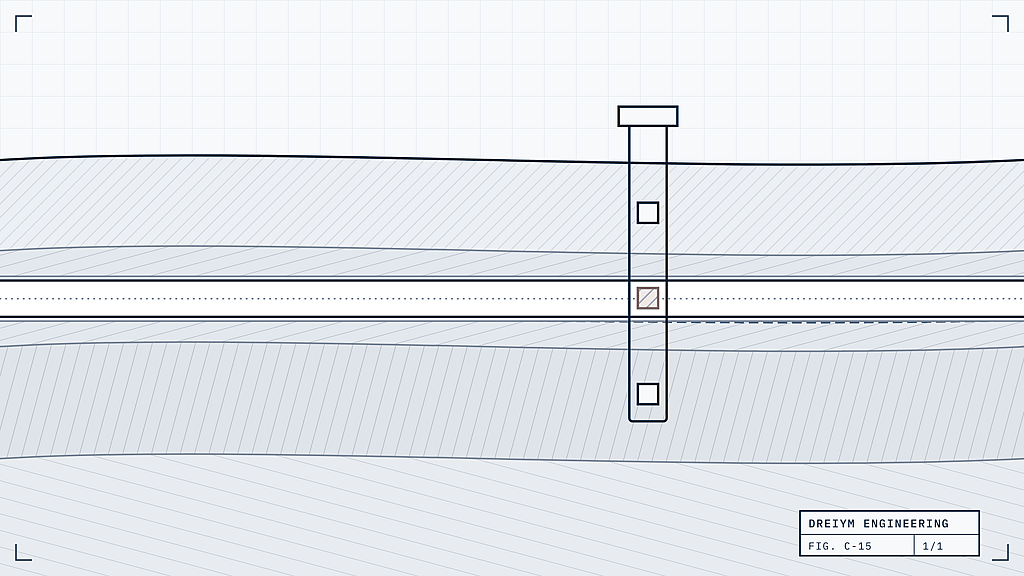
We ran Wenner four-pin tests (ASTM G57) at seven sites along the alignment on June 2, each near one of the geotechnical borings, so the readings could be set beside the soil logs. The north end sits on limestone, and a site near a boring that hit limestone from 1 to 28 feet read high, as expected. Most of the route is fat clay, lean clay and clayey gravel. In the 2.5 to 7.5 foot layers the resistivity averaged 3,120 ohm-cm, but the lowest layer measured 321 ohm-cm.
The geotechnical work included 17 borings from 15 to 30 feet deep, with groundwater as shallow as 11.5 feet in two of them. Laboratory tests on four samples gave resistivities from 553 to 7,270 ohm-cm, pH from 7.6 to 8.4, chlorides of 20 to 40 ppm and sulfates up to 1,020 ppm. On balance we classed the soil as highly corrosive to ferrous metals. We also noted that overhead distribution lines run along the whole alignment, and unbalanced loads on them can induce AC on a metallic pipeline.
If ductile iron is chosen
For the ductile iron option we recommended insulating joints with test stations at connections to other piping (NACE SP0286), bonding of every joint, including each bell and spigot, so the line can be protected as one structure, test stations along the route, dielectric coating or encasement, coated fittings and sleeves through concrete, and cathodic protection. A PVC line needs none of that for the pipe itself, which is part of what a utility weighs when it compares the two.
Related services
Studies of this kind are described under soil corrosivity analysis. If the line goes ahead in metal, the next step is cathodic protection design.
Corrosion and CP
More projects in this practice
Wink and Sarita, TX
AC Interference Data Logging on Texas Pipelines
AC interference testing
Wickett, TX
ACVG Coating Survey of Two Gathering Lines, Wickett
ACVG survey
Eastland area, TX
Annual CP Survey and Ground Patrol of a Gas Line, Eastland Area
CP survey, ground patrol
Get your project started
We typically respond within one business day.