Selected Projects
Energy-Sector Cathodic Protection, Bismarck Area, North Dakota
We typically respond within one business day.
Project at a glanceDE-PRJ-8129
- Practice
- Corrosion and CP
- Location
- North Dakota
- Service
- Cathodic protection
- Client
- Confidential
Energy-Sector Cathodic Protection, Bismarck Area, North Dakota
We’ve supported energy-sector cathodic protection work around Bismarck, North Dakota, and in 2026 we also investigated a fire in the state. Client details are confidential.

An impressed current anode. In ground that freezes, anodes go in below the frost depth so the system keeps working through the winter.
When the ground freezes
The electrochemistry of cathodic protection is the same on the northern plains as anywhere else, but for part of the year the ground itself changes state. Once the top several feet of soil freeze, assumptions that work fine in a temperate climate no longer hold. A system that measured well in August can be underperforming by January without anyone having touched it.
How frost cuts the protection current
Soil conducts current because it holds moisture with salts dissolved in it. When the water freezes, the ions can’t move freely anymore, and the soil’s resistivity goes up sharply. On an impressed current system it shows up as circuit resistance climbing and current output falling at the same rectifier setting, right when nobody is in the field to notice. Galvanic anodes have it worse. They only have a small driving voltage to work with, so there’s no headroom to push against a higher-resistance path.
There are practical ways to design around it. Anodes go below the local frost depth so the working part of the system stays in unfrozen ground. On the northern plains that means deeper than in most of the country, and sometimes it points toward a deep anode bed rather than a shallow distributed one. Rectifiers get sized for the whole seasonal swing instead of for whatever the ground was doing on commissioning day. Survey dates go in the record next to the readings. If you compare a midwinter potential with a late-summer one and don’t note the difference, you get a trend that’s really just weather. The same goes for soil resistivity testing, where the season you measured in is part of the measurement.
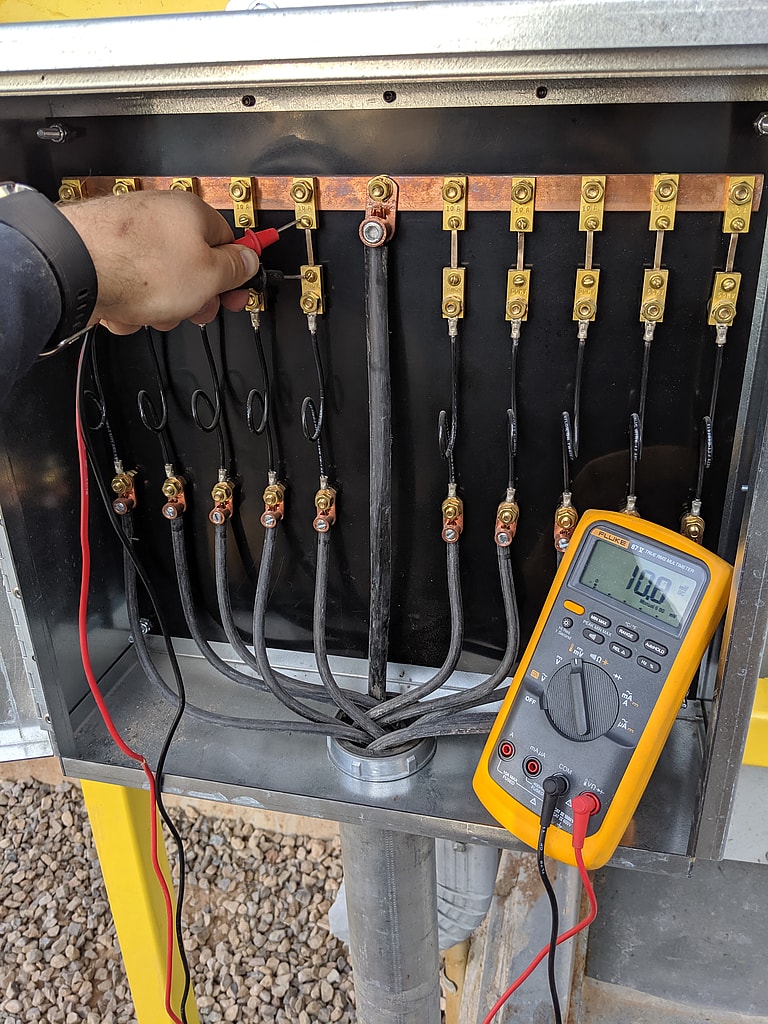
Shunts on a copper busbar, one in each anode lead. The voltage drop across a shunt gives the current in that circuit. That’s a diagnostic reading, separate from the annual potential survey the rules require.
Annual surveys and rectifier checks
On a regulated pipeline, the operator doesn’t get to pick the monitoring interval. The federal pipeline safety regulations set it. Cathodically protected pipelines have to be tested at least once each calendar year, with no more than fifteen months between tests, to verify that the protection is adequate. Each rectifier has to be inspected six times each calendar year, with no more than two and a half months between inspections. Reverse current switches, diodes and interference bonds have their own inspection frequencies. When a survey shows a deficiency, the operator has to correct it promptly.
The climate on the northern plains complicates those intervals. Fifteen months is longer than a year so that an annual survey has room to move. But if the schedule drifts until back-to-back surveys land in opposite seasons, the record ends up comparing a frozen-ground reading with a late-summer one, and the change it shows is really the weather. Keep the surveys in the same season, or note the conditions when you can’t, and you can trend the annual data instead of just filing it for compliance. The bimonthly rectifier checks help with this too. A rectifier logged six times a year shows the seasonal swing in circuit resistance directly. An operator who sees output falling as the ground freezes can respond before the next annual survey instead of after it.
We’d recommend the same routine for systems that aren’t federally regulated. The rules set an interval because a protection system nobody checks can stop working without anyone noticing. A plant yard or a tank farm is just as exposed to that as a regulated line.
The North Dakota work
Around Bismarck, our AMPP® (NACE) certified cathodic protection personnel supported the energy-sector work. AMPP®’s cathodic protection certifications are national. No state issues them, so the same qualification carries across state lines. Our forensic team handled the 2026 fire investigation in North Dakota. The client got our findings and recommendations in engineering reports.
Between site visits
In cold regions, energy infrastructure gets visited less often than sites near a city, so the margin built into the design has to carry more of the load between visits. Someone also has to understand how seasonal ground conditions move the numbers, or the readings pile up without the system ever really being maintained. For help with a system of your own, see our cathodic protection services or our soil corrosivity analysis. There’s more background in our article on how soil resistivity affects pipes, which explains why the ground around a structure decides how hard the protection has to work.
Corrosion and CP
Related projects
Edna, Victoria and Placedo, TX
Water Transmission Line CP Upgrades, Edna to Placedo
CP installation support, test stations
Austin, TX
Gas Line Holiday Testing, CP Start-Up and a Chilled Water Survey, Austin
Holiday testing, CP start-up, CP survey
El Paso, TX
Fuel Gas Line CP Surveys at a Single-Unit Power Station, El Paso
CP surveys, electrical isolation
Get your project started
We typically respond within one business day.