Selected Projects
Post-Fire Electrical Origin Investigation, Baton Rouge Metro (2021)
We typically respond within one business day.
Project at a glanceDE-PRJ-8105
- Practice
- Forensic
- Location
- Baton Rouge metro, LA
- Service
- Origin and cause
- Client
- Confidential
Post-Fire Electrical Origin Investigation, Baton Rouge Metro (2021)
After a 2021 fire in the Baton Rouge metro area, our forensic team was brought in for a post-fire electrical origin investigation, to work out whether the fire was electrical in origin. The parties and the property stay confidential.

Post-fire examination. The origin comes first, because it narrows down which causes are still possible.
On the scene and in our lab
We worked systematically, using a method consistent with NFPA® 921. That meant documenting the scene first. Then we developed hypotheses and tested them against the physical evidence, letting the evidence knock explanations out instead of propping up a favorite. The electrical evidence that mattered was documented and collected, then taken to our in-house engineering lab in Texas. There, tools like X-ray imaging let us examine suspect components without destroying them.
Working out where the fire started
We pin down the origin before we look at cause. A cause only makes sense inside an area where the fire could have started, so a wrong origin takes everything built on it down with it. The fire patterns and the depth of damage they show are one line of evidence. Ventilation counts as well, since the openings change how a fire burns and the patterns it leaves. Then there’s the condition of the contents and the structural elements, and what witnesses saw and when. All of it gets weighed together. When two lines of evidence disagree, that disagreement is part of the analysis. We don’t settle it by picking the one we like better.
A fully involved compartment is the hard case. Once a room burns until everything in it is consumed, the patterns that would have marked the area of origin can be wiped out, and ventilation can leave patterns that look like burn intensity but aren’t. Sometimes the finding is that the scene can no longer support a reliable origin, and then we say so plainly. That holds up better than narrowing to an origin the evidence can’t carry.
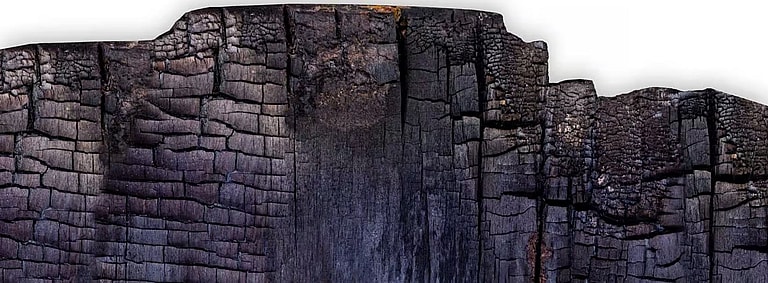
Charred wood. The burned material is evidence in itself, and leaving it undisturbed keeps every party’s options open.
What arcing does and doesn’t show
Few things at a fire scene get misread as often as electrical artifacts. When we find arc damage on a conductor, it proves two things. The conductor was energized when it faulted, and the fault was at that spot. On its own, that doesn’t prove the electrical system caused the fire. A spreading fire breaks down the insulation on the wiring it reaches and causes arcing of its own. Sorting arc damage from melting caused by the fire’s heat takes up a lot of the technical work. So does sorting the arcing that started a fire from the arcing the fire started.
Read carefully, the same evidence helps. Mapping where the arcing happened along a circuit can show where the fire reached energized wiring first, and that either supports the origin hypothesis built from the patterns or contradicts it. The as-found position of the overcurrent devices narrows things further. The state of the service equipment and utility records of what the circuit was doing add their own limits. None of it, though, lets us call a fire electrical just because no other cause turned up. If we name a cause, there has to be evidence for it beyond the fact that we ruled out the others.
Handling and storing the evidence
Fire evidence has to be usable by every party who may examine it after us, so we plan around spoliation from the moment we collect it. The chain of handling is documented, and what we retain goes to our secure facility north of Houston, where it stays available for later inspection. If the matter goes further, careful handling early on leaves everyone’s options open.
The opinion and report
The work ended in an expert opinion on electrical origin and cause, set out in a written report we can defend. If a matter calls for it, we can also testify at deposition and trial.
Ruling electrical in or out
The electrical system is often the first thing people suspect after a fire. Confirming or ruling it out takes a disciplined method. A defensible origin-and-cause opinion from licensed engineers, with lab work behind it, protects everyone’s position. Our fire and explosion investigation practice handles losses like this in Texas, Colorado and the states around them. If you’re assigning a loss, you can submit a forensic assignment, or request our CVs and rates first.
Forensic
Related projects
Louisiana
Louisiana Electrical Failure and Fire Investigations
Fire and electrical
Texas
Texas Forensic Investigation Casework
Fire and electrical
North Texas
Built-In Gas Grill Flash Fire, North Texas
Fuel gas fire review
More work in: Louisiana
Get your project started
We typically respond within one business day.