Selected Projects
Electrical Design Project, Southern Colorado (2025)
We typically respond within one business day.
Project at a glanceDE-PRJ-8112
- Practice
- Electrical power
- Location
- Southern Colorado
- Service
- Electrical design
- Client
- Confidential
Electrical Design Project, Southern Colorado (2025)
Our electrical team delivered this southern Colorado electrical design project in 2025. We keep the client’s details confidential.
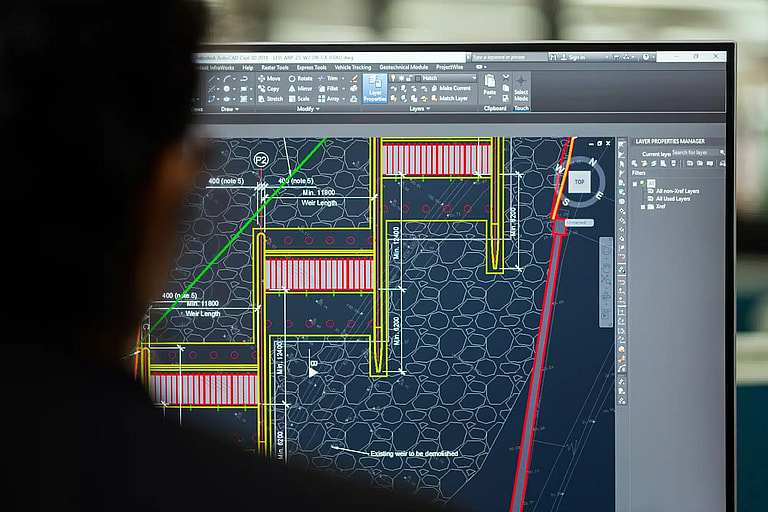
Design documents for a stamped package, which carries the calculations and one-lines along with enough detail to build from.
Who the drawings are for
An electrical design gets judged by what the installer ends up with. The drawings need to match the site. A bidder has to be able to price the specifications, and the calculations have to get through plan review. Sites away from the major metros can also bring their own access, utility coordination and environmental constraints.
What’s in a design package
A full package usually has single-line diagrams, layout drawings and installation details, load calculations and equipment specifications. The pieces have to agree with each other and with the codes the jurisdiction enforces. A licensed Professional Engineer’s stamp means someone accountable checked exactly that.
The numbers behind the drawings
Drawings can look complete long before a design is ready to seal. The numbers behind them have to hold up first, starting with the load calculations. Those set the demand the service and feeders will carry, and they need to be built on how the facility will be used instead of a generic assumption. Available fault current has to be calculated at each piece of equipment and checked against the interrupting and short-circuit current ratings of whatever is specified there. Equipment applied above its rating is a code violation and a hazard at the same time. Conductor sizing doesn’t stop at the ampacity table. The size has to survive the adjustments for ambient temperature and conduit fill. On long runs, voltage drop has to be checked too, before a motor at the end of a feeder starts acting up. Grounding and bonding, overcurrent protection, working clearances and equipment labeling all need to be worked out on paper. None of it should be left for the installer to figure out.
Utility coordination comes on top of all that. The service voltage, available fault current, metering arrangement and point of delivery are the utility’s to set. A design drawn before they’re confirmed usually ends up redrawn.

Reviewing a plan sheet on site. Before anyone builds from a drawing set, it has to agree with the field conditions and fit with the other trades’ work.
Where the trouble usually starts
Calculation errors do happen, but most problems on a design job start with an assumption nobody checked. Maybe the existing conditions don’t match the record drawings, or a piece of equipment gets specified with a lead time nobody priced. Two trades end up claiming the same ceiling space. An equipment submittal comes back with a substitution whose dimensions, weight or fault rating doesn’t match what the design assumed. Any of these is cheap to sort out during design. After that the cost climbs, first at bid, then at submittal, and most of all in the field.
So construction-phase work belongs in the same job as the design. That way, submittals get checked against the design intent, the engineer who did the calculations is the one answering requests for information, and someone from the design side observes the installation at the right moments. Those steps keep the built system matching the sealed one. The owner also ends up with record documents that match what’s in the building, and those are what the next engineer to work on it will start from.
Licensed PEs on the design
We did the electrical design under our licensed Professional Engineers and coordinated the package for construction in southern Colorado.
Before the wire is pulled
A design error costs little to fix on paper and a lot once it’s in the conduit. Our electrical design services and Colorado team take projects like this from concept through construction support.
Electrical power
Related projects
Houston, TX
New Electrical Service for a Plastics Plant Expansion, Houston
Electrical design, load analysis
Austin, TX
Electrical Service Design for a Retail Space in a Shopping Center, Austin
Electrical design, service and feeder
San Antonio, TX
EV Charger Panel Design for a Condominium Garage, San Antonio
EV charging, electrical design
More work in: Colorado
Get your project started
We typically respond within one business day.