Selected Projects
Galvanic CP Design and Commissioning for Two New Gulf Coast Process Plants, Sweeny and Baytown (2020-2021)
We typically respond within one business day.
Project at a glanceDE-PRJ-8783
- Practice
- Corrosion and CP
- Location
- Sweeny and Baytown, TX
- Service
- CP design, commissioning
- Client
- Confidential
Galvanic CP Design and Commissioning for Two New Gulf Coast Process Plants, Sweeny and Baytown (2020-2021)
In 2020 and 2021 we designed galvanic cathodic protection (CP) for buried piping at two new process plants on the Texas Gulf Coast, one near Sweeny and one in Baytown, and handled the CP commissioning at both. Client details are confidential.
Testing the soil first
The Sweeny plant was built about 3 miles northwest of town. In January 2020 we measured soil resistivity at three sites along the project by the Wenner four-electrode method of ASTM G57, using a Fluke® 1625-2 at pin spacings from 2.5 to 20 feet, and calculated layer resistivities with the Barnes method. Averaging can hide a corrosive layer between two drier ones, which is why the layers are worked out. In the top 5 feet the layers averaged 819 ohm-cm, with a low of 662 ohm-cm, which ranks the soil as highly corrosive to steel. The geotechnical borings showed clays and sandy clays above pipe depth, consistent with those readings.
Seven systems in one plant
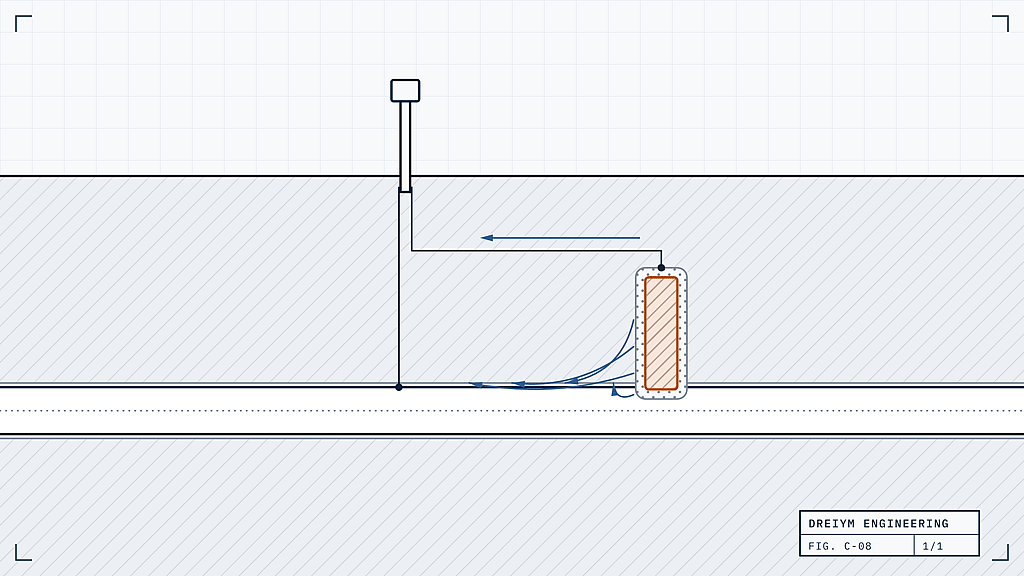
The design, issued in February 2020, protects the buried parts of seven piping systems: cooling water supply and return, natural gas, blowdown and service water, all in dielectrically coated carbon steel, an instrument gas system in coated stainless steel, and firewater and process sewer systems in HDPE with metallic components. The pipe was factory coated with fusion bonded epoxy. Galvanic magnesium anodes were used, and each system has test stations so its protection can be measured.
Training the crew
A CP system is only as good as its connections. During our March 2020 visit, coating damage on the cooling water pipe was being found and repaired. We met the installation crew, went over surface preparation, grinding the steel to a clean near-white finish before each pin braze and care of the brazing tools, and watched them make test brazes on scrap pipe until they had it down. We then observed connections on the plant piping and checked the anode materials delivered to site.
Commissioning
At the final visit in May 2020, the components were in general conformance with the design. One item went on the punch list: four firewater hydrant risers that would be installed later. On readings at the test locations across the systems ranged from about -1,360 to -1,600 mV against a copper-copper sulfate electrode, and instant-off readings on the natural gas, instrument gas and firewater systems were all more negative than -1,100 mV. We recommended retesting within 12 months.
The missing flange kit in Baytown
In Baytown the job was a new 2-inch buried fuel gas line, designed in December 2020. At start-up in April 2021, protection levels were deficient, with off readings between -347 and -530 mV, and the insulating flange kit at the fuel gas tie-in was confirmed missing. It was installed that afternoon. The next day, with GPS-synchronized current interrupters, the readings were -1,680 to -1,780 mV on and -1,130 to -1,210 mV instant-off.
CP for new plants
Soil testing is covered on our page for soil corrosivity analysis. The design is covered on our page for cathodic protection design. Commissioning is covered on our page for start-up and commissioning.
Corrosion and CP
More projects in this practice
Wink and Sarita, TX
AC Interference Data Logging on Texas Pipelines
AC interference testing
Wickett, TX
ACVG Coating Survey of Two Gathering Lines, Wickett
ACVG survey
Eastland area, TX
Annual CP Survey and Ground Patrol of a Gas Line, Eastland Area
CP survey, ground patrol
Get your project started
We typically respond within one business day.