Selected Projects
Water-System Cathodic Protection Designs, Tulsa and Del City (2018)
We typically respond within one business day.
Project at a glanceDE-PRJ-8127
- Practice
- Corrosion and CP
- Location
- Tulsa and Del City, OK
- Service
- CP design
- Client
- Confidential
Water-System Cathodic Protection Designs, Tulsa and Del City (2018)
These water system cathodic protection designs were for Tulsa and Del City, Oklahoma. Our corrosion team prepared them in 2018. Client details are confidential.

Corrosion in a water system. Whether the joints carry current decides how much of a main the cathodic protection can reach.
What’s connected to what
A water system is harder to protect than it looks. A distribution main is a chain of segments rather than one continuous piece of metal, and the joints between them may or may not carry current. The soil it’s buried in changes character block by block. Service lines, valves, hydrants and other structures tie into it, put in by different crews in different decades. Cathodic protection can only protect metal that current can reach. So before anyone designs it, somebody has to find out what’s electrically connected to what.
Rubber gaskets break the circuit
Joints are where a water-system design parts ways with a pipeline design. A lot of modern water pipe goes together with push-on or mechanical joints that seal on rubber gaskets, and the gaskets are electrical insulators. Electrically, then, a run of ductile iron pipe with gasketed joints is a row of isolated segments sitting end to end. Apply cathodic protection to it without dealing with continuity and you protect whichever segments the current can reach. The rest stay exactly as they were.
That leaves two defensible options, and they lead to different designs. One is to bond across the joints to make the line electrically continuous, then protect it as a single structure. The other is to leave the joints unbonded and handle the corrosion risk some other way. For ductile iron, that commonly means loose polyethylene encasement installed to AWWA® C105 instead of an impressed current system. Which way to go depends on the pipe material, the soil and the length of line involved, and on what the utility can realistically maintain afterward.
Steel water storage tanks are a third case. On a tank, the concern moves from buried exterior steel to the submerged interior surface. AWWA® D104 deals with impressed current protection of those surfaces, with the anodes arranged to suit the tank’s geometry and, in freezing climates, to allow for ice movement. A utility that owns both mains and tanks has two separate corrosion problems to pay for out of one budget.
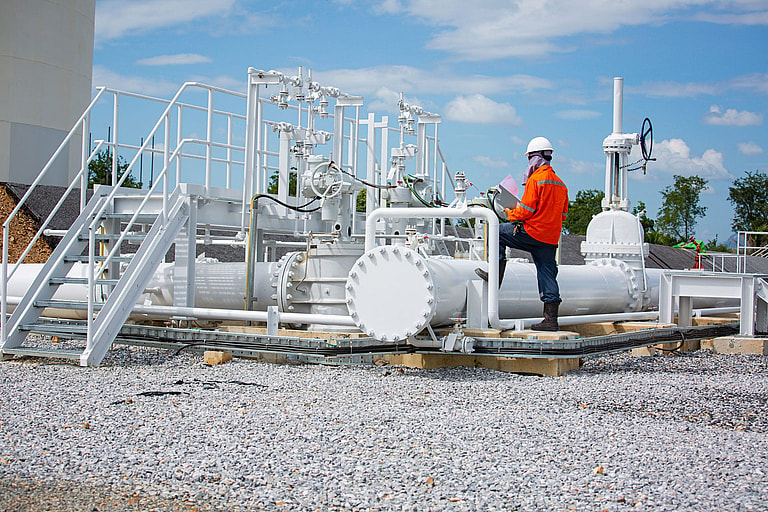
An above-ground valve station on a gravel pad. Cathodic protection only stays effective if the utility can get to its test stations and record readings on a regular schedule.
A design the utility’s own crews can run
Water utilities don’t keep a corrosion department on standby. Whatever the cathodic protection design leaves behind, the people already on staff have to be able to operate it, and that shapes the design as much as the engineering does. For the test stations, that means putting them where a crew can reach them without traffic control, then marking and recording them so the locations survive staff turnover. It also means keeping the count low enough that the annual reads get done. A design that would be excellent if somebody took forty readings a year is the wrong design for a system where nobody will take more than ten.
The readings are worth more once they’re tied to what the utility already tracks. Line up the protection readings with the break and leak history, the pipe material and installation year, and the soil conditions along each alignment, and you can see which segments are at risk. Used that way, the corrosion record also helps the utility decide what to replace first. Utilities that keep it up over the years find the argument for capital funding gets easier. They can point to measured deterioration instead of just the age of the pipe.
Protection costs the least on new construction. While the trench is open, bonding joints and installing test stations are cheap, and so is isolation at the connections. Once it’s backfilled, the same work costs far more. That’s the practical reason to bring corrosion engineering into a main replacement project during design, before the first failure. Deciding where that spending is justified usually starts with our soil corrosivity analysis.
Laying out anodes and test stations
The design deliverables came from licensed Professional Engineers, with support from AMPP® (NACE) certified cathodic protection personnel. A design like this starts with field and record data on the soil and on which parts of the structure are electrically continuous. From there the design sets a current requirement and picks a galvanic or impressed current approach. Then the anodes and test stations are located so the installed system can be verified once it’s in and monitored for the rest of its service life.
When a main breaks
Corrosion costs a water utility money without drawing much attention. But a failed main doesn’t just leak. It takes out pavement and service, and the repair uses up a budget that was meant for something else. Usually it fails at the point nobody was watching. If the protection is designed deliberately, with continuity established and test stations where readings can be taken, the utility knows what it has and can maintain it. A utility, or an engineer working for one, can start with our cathodic protection design services or with our soil corrosivity analysis. Our article on how corrosion threatens residential water supply goes into what corrosion does to distribution systems.
Corrosion and CP
Related projects
Oklahoma
Federal Installation CP Design
CP design
Brownsville area, TX
Canopy Pier CP Designs at Two Federal Facilities, Brownsville Area
CP design, soil testing
El Paso, TX
Power Station Impressed Current CP, El Paso
CP design, installation
More work in: Oklahoma
Get your project started
We typically respond within one business day.