Eutectic Melting in Fire Investigation: When Aluminum Melts Copper Wire
Eutectic melting lets molten aluminum dissolve copper wire near 548 °C, far below 1,085 °C. How investigators tell alloying from arc beads and fire melting.
Contents
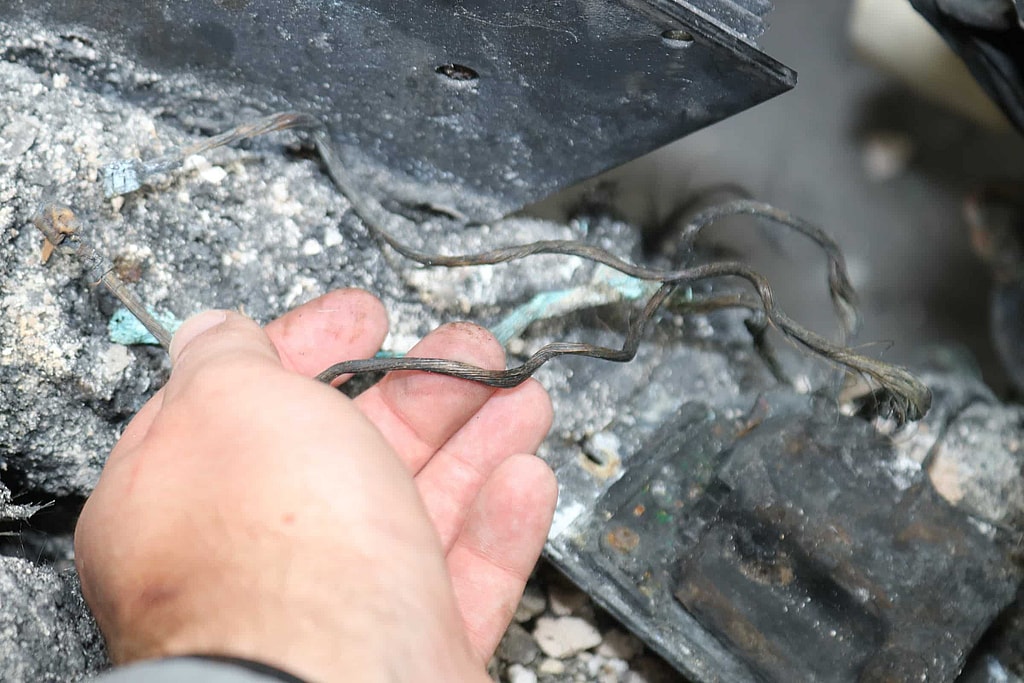
Eutectic melting is the name fire investigators often give to copper wire that was melted not by an electric arc and not by fire temperatures above copper’s melting point, but by molten aluminum, zinc or tin that alloyed with it. Copper melts at about 1,085 °C (1,984 °F). An alloy of aluminum and copper can stay liquid down to about 548 °C (1,018 °F), so a drip of molten aluminum can eat into a copper conductor at temperatures well below those many fires sustain. The result can look like an arc bead or an arc notch, and mistaking one for the other can move the area of origin or point to the wrong cause.
Below we explain what the term means, where alloying happens in a fire, why it resembles arc damage, and how an investigator tells alloying apart from arcing and from ordinary fire melting. Our article on arcing vs. melting damage covers the first two of those three patterns. The guidance follows NFPA 921, Guide for Fire and Explosion Investigations, whose current edition is 2024, and published research on copper conductors from fire scenes.
What Eutectic Melting Means
Two metals mixed together usually melt at a different temperature than either metal alone. In some pairs there is one composition, the eutectic composition, at which the mixture melts at the lowest temperature of all, below the melting point of both metals. For aluminum and copper that point is about 548 °C at roughly 33 percent copper by weight. Pure aluminum melts at about 660 °C (1,221 °F).
In a fire, aluminum melts first. When the liquid aluminum touches solid copper, copper dissolves into it at the contact, the liquid moves toward compositions with lower melting points, and the copper appears to melt away even though the fire never came near 1,085 °C. Researchers at the Université de Sherbrooke reproduced this in the lab and showed that molten aluminum in contact with copper conductors drastically lowers the melting point of the copper by alloying, and a later paper in the Journal of the National Academy of Forensic Engineers described molten aluminum dissolving copper and steel below their melting points.

Strictly, “eutectic” describes only some metal pairs. Copper and aluminum form a eutectic; copper and zinc do not, although molten zinc still dissolves copper and forms brass. For that reason forensic engineers increasingly use the broader word alloying, which covers any mixing of dissimilar metals that melts a conductor, and treat alloying as a kind of fire melting rather than as electrical damage.
To see how the melting temperature of an alloy changes with its composition, try our eutectic melting calculator. It shows the temperature at which a mix stays fully liquid and why a small amount of a second metal can lower it so much.
Where Alloying Happens in a Fire
Alloying needs a lower-melting metal, enough heat to melt it, and contact with the copper. Common sources at fire scenes are:
- Aluminum. Light fixtures, appliance housings and parts, window and door frames, ductwork, soffits and siding, ladders, vehicle parts and aluminum conductors or bus bars. Aluminum melts at about 660 °C, so in many fires it melts, runs and drips.
- Zinc. Galvanized steel such as boxes, conduit, fasteners and sheet metal, and zinc die castings. Zinc melts at about 420 °C (787 °F).
- Tin and solder. Tinned conductors, soldered joints and circuit boards in equipment. Tin melts at about 232 °C (449 °F), and tin-based solders melt lower still.
Because molten metal runs downhill, alloying is usually found where copper sat below or beside the aluminum or zinc: a branch circuit under a melted light fixture, cords beneath an appliance, wiring in a ceiling under aluminum ductwork. NFPA 921 also notes that alloying can create holes in conduit that look like the blowholes an arc leaves, and that pitting at a connection can come from alloying rather than from overheating or arcing.
Why Alloying Can Look Like an Arc Bead
An arc melts a small spot of a conductor in a fraction of a second and leaves a round bead or a notch. Alloying also melts copper at one spot, where the drip landed, and the melted metal can solidify as a rounded globule, a pit or a hole with fairly well defined edges. To the eye at the scene, an alloyed spot can resemble an arc site closely.
NFPA 921 warns that damage from nonelectrical causes, including fire melting, alloying and mechanical damage, can resemble arc melting, and that a visual examination at the scene may not be enough to identify arc sites correctly. The mistake matters in an arc mapping survey: one false arc site placed in the wrong room or on the wrong circuit can shift the area of origin. It also matters for temperatures. Melted copper does not by itself prove that the fire reached 1,085 °C, and an alloyed conductor proves only that a lower-melting metal reached it while molten.
Arc Bead, Alloyed Conductor or Fire Melting
The three kinds of damage leave different evidence in their location, their surface, their internal structure and their chemistry. The figure and table below set the features side by side; none of them is decisive alone.

| Feature | Arc bead or notch | Alloyed conductor | Fire melting |
|---|---|---|---|
| Where it is | At one spot on an energized circuit, often with a matching mark on the other conductor | Below or beside an aluminum, zinc or tin source, often where drips landed | Along the length that sat in the hottest area, energized or not |
| Boundary | Sharp line between melted and unmelted copper | Can be fairly sharp at the edge of the drip | Gradual, with thinning or tapering |
| Surface and color | Copper colored or oxidized bead, smooth in part, often with porosity | Silver gray or brassy, rough and pitted | Copper globules and drips pulled down by gravity |
| Composition (SEM/EDS) | Copper and copper oxide | Copper with aluminum, zinc, tin or lead | Copper and copper oxide |
| In section (metallography) | Resolidified metal with porosity and a sharp boundary to unaffected grains | A mixed-metal structure where the other metal attacked the copper | Grain growth over a length and a gradual transition |
| What it can show | The circuit was energized when the fire reached that spot | A molten metal reached the copper; nothing about the circuit | Local fire temperatures near or above copper’s melting point |
How Investigators Tell Alloying From Arc Damage
Location and Context at the Scene
The first test is where the damage sits. Before anything is moved, the investigator photographs and maps the conductor and notes what was above and beside it: a melted fixture, an appliance chassis, aluminum ductwork, galvanized boxes. Drips, splashes or a gray coating on nearby surfaces point to molten metal. The conductor is collected by cutting rather than pulling, with the surrounding debris, as our fire scene evidence preservation checklist describes.
X-ray Before Anything Is Cut Apart
Radiography shows conductors where they lie inside debris, cords, appliances or conduit without disturbing them. In a 2023 study, Svare and Nic Daeid used X-ray radiographs to characterize damage on post-fire conductors, including internal porosity that the eye cannot see. Our lab’s real-time X-ray is used this way before any disassembly.
Microscope, SEM and EDS
Under a stereo microscope the examiner looks at the boundary, the surface texture and the color of the damaged spot. Scanning electron microscopy (SEM) resolves the transition between resolidified metal and the original surface, and energy dispersive X-ray spectroscopy (EDS) identifies the elements present. Aluminum, zinc or tin in the melted region of a copper conductor is strong evidence of alloying; a bead of copper and copper oxide alone is consistent with an arc or with fire melting and needs the next step.
Sectioning and Metallography
A metallographic section cuts through the damaged spot, which is polished and etched to show its grain structure. Arc melting typically shows resolidified metal with porosity and a sharp boundary to unaffected grains; fire melting shows grain growth over a length and a gradual transition; alloying shows mixed phases where the other metal attacked the copper. The second Svare paper describes this sequence. Sectioning destroys the original, so it comes last, after the nondestructive steps are documented and every interested party has had the chance to attend.
Arc Mapping Context
Each identified site then has to fit the circuit. A true arc site sits on a conductor that was energized, at a point consistent with the power source and the protective device, and it tells the investigator which parts of a circuit were still energized as the fire spread. A spot confirmed as alloying is taken out of the arc survey, and the hypotheses about origin and cause are tested again against the revised data, a step our fire investigation guide walks through.

Frequently Asked Questions
Can molten aluminum melt copper wire?
Yes. Liquid aluminum dissolves copper where the two touch, and aluminum copper alloys can stay liquid down to about 548 °C. A copper conductor under a drip of molten aluminum can be pitted, holed or severed at temperatures far below copper’s melting point of about 1,085 °C.
Is eutectic melting the same as alloying?
Nearly. Eutectic melting is the common name at fire scenes, but strictly a eutectic exists only for some metal pairs, such as copper and aluminum. Alloying is the broader term and also covers copper attacked by zinc, tin or lead.
Does melted copper prove the fire was very hot?
Not by itself. Copper that melted from fire heat alone points to local temperatures near 1,085 °C, but copper melted by an arc or by alloying does not. The cause of the melting has to be identified before it is used to estimate temperatures.
Can alloying be identified at the fire scene?
Sometimes it can be suspected there, from the location under an aluminum or zinc source and from a gray or brassy, pitted surface. Confirming it usually takes laboratory work: X-ray, microscopy, SEM/EDS for composition and, if needed, metallography.
Does an alloyed conductor rule out an electrical cause?
No. It means that particular spot is not evidence of arcing. Other conductors on the same circuit may still carry true arc sites, and the electrical system is evaluated with all of the evidence like any other hypothesis.
How Dreiym Engineering Can Help
We examine electrical evidence from fire scenes as part of our forensic electrical engineering and fire and explosion investigation practices. Our team includes licensed Professional Engineers with active and past licensure in multiple states, and Brian J. Brackensick, M.S., P.E. and Stepan V. Eero, M.S., P.E. both hold the NAFI CFEI and CVFI certifications. Our engineering lab in Coldspring, Texas has in-house real-time X-ray (a Nordson Dage Quadra 3) and a microscope with an 18 MP camera for examining conductors and components, and evidence storage is video-monitored. We accept consulting-only retentions, and reports are PE-stamped where required. To start an assignment, use our forensic assignment form. Contact us or call (866) 621-6920 for a free quote. We typically respond within one business day.