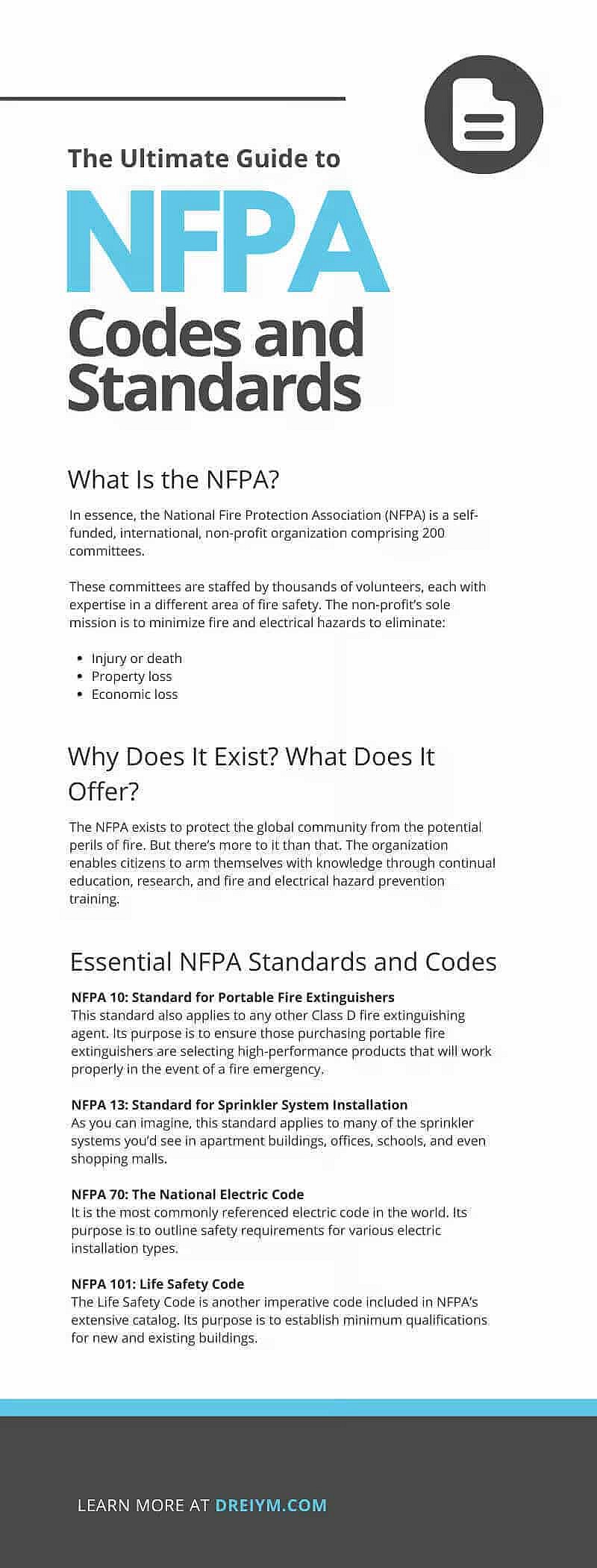
The Ultimate Guide to NFPA Codes and Standards
Explore key NFPA codes and standards - NFPA 70 (NEC), 70E, 72, 101, and more - and learn how each one protects facilities from fire and electrical hazards.
Reach out to Dreiym Engineering for any Corrosion, Electrical or Forensic Questions.
Contents
The NFPA has worked tirelessly to enhance fire safety for over a century. As a result, they have an extensive catalog of codes and standards that educate us and protect us from fire and electrical hazards. Take a moment to read about what this incredible organization does to protect our safety. This article also covers some of the codes and standards that protect us every day.
What Is the NFPA?
Before looking at its codes and standards, it helps to know what the NFPA is. In essence, the National Fire Protection Association (NFPA) is a self-funded, international, non-profit organization comprising 200 committees.
These committees are staffed by thousands of volunteers, each with expertise in a different area of fire safety. The non-profit’s sole mission is to minimize fire and electrical hazards to eliminate:
- Injury or death
- Property loss
- Economic loss
The NFPA was established in 1896 with a clear vision to reduce fire-related losses and save lives by sharing information, resources, and their passion for fire safety with the world.
Why Does It Exist? What Does It Offer?
As stated previously, the NFPA exists to protect the global community from the potential perils of fire. But there’s more to it than that. The organization enables citizens to arm themselves with knowledge through continual education, research, and fire and electrical hazard prevention training.
The NFPA also partners with complementary organizations globally. This helps ensure they can educate as many people as possible. But they’re most renowned for setting a precedent for best practices in fire hazard prevention.
The Fire Code
Since its establishment, the NFPA has worked tirelessly to provide the highest fire safety standard possible. In pursuit of that, they’ve delivered high-quality information through the 300+ fire codes and standards they’ve drafted to enhance fire safety.
Perhaps the most crucial among them is the official Fire Code, NFPA 1. The NFPA itself was founded in 1896 by insurance interests seeking uniform sprinkler and fire-protection standards, and the Fire Code came later in its catalog. The point of the Fire Code was to set a precedent for best practices in fire safety, regulations, and hazard management.
The Fire Code is still updated every few years, and it is widely considered one of the only codes that comprehensively covers:
- Occupant safety (with infrastructure, hazardous, and flammable materials)
- Fire safety (for the public and first responders)
- Life safety (for the public and first responders)
- Fire protection systems
- Fire protection equipment
It also outlines requirements for specific areas of interest. For instance, it covers things like common workplace fire prevention. It does not, however, cover fire investigation. Fire and explosion investigation is governed by NFPA 921, Guide for Fire and Explosion Investigations, which sets out the scientific method, origin and cause determination, arc mapping and evidence handling, and by NFPA 1033, Standard for Professional Qualifications for Fire Investigator, which establishes the job performance requirements an investigator must meet; those two documents, not the Fire Code, are the governing references for forensic fire and explosion investigation.
Related service
Studies modeled in ETAP and SKM, field testing and electrical design by licensed PEs.
Essential NFPA Standards and Codes
The Fire Code is central to NFPA’s mission. But it’s only one among hundreds of standards and codes that keep us safe daily. Below we’ve listed a few more of the most prominent codes the NFPA provides to the public.
NFPA 10: Standard for Portable Fire Extinguishers
Covers the following things regarding portable fire extinguishers:
- The selection process
- The installation process
- The inspection protocols
- The maintenance procedures
- The recharging process
- The testing protocols
This standard also applies to any other Class D fire extinguishing agent. Its purpose is to ensure those purchasing portable fire extinguishers are selecting high-performance products that will work properly in the event of a fire emergency.
NFPA 12: Standard of Carbon Dioxide Extinguishing Systems
This standard is very straightforward. It outlines the minimum requirements a carbon dioxide extinguishing system must meet before being used.
This standard aims to ensure these innovative systems will function optimally without inadvertently harming the people or infrastructures they’re designed to protect.
NFPA 13: Standard for Sprinkler System Installation
Sprinkler systems are a pretty common aspect of fire safety across the board. That’s why it’s crucial to have a standard that provides the minimum requirements for the design and installation procedures.
Fortunately, NFPA 13 outlines these requirements for both:
- Automatic sprinkler systems
- Exposure protection sprinkler systems
As you can imagine, this standard applies to many of the sprinkler systems you’d see in apartment buildings, offices, schools, and even shopping malls.
NFPA 20: Standards for Stationary Pump and Fire Protection Systems
This standard outlines the proper selection and installation process for those using liquid pumps for private fire protection measures. These systems are typically used for infrastructure with high-pressure demands. As such, this standard is significant for high-rise buildings or large warehouses.
NFPA 25: Standards for Inspection, Testing, and Maintenance of Water-Based Protections
This is another straightforward standard. It exists as an outline for the inspection, testing, and maintenance requirements for any water-based fire protection system. This includes certain types of sprinkler systems, other types of water-based suppression systems, and the like.
NFPA 70: The National Electrical Code
The National Electrical Code is in the same realm as The Fire Code in regard to comprehensiveness and how widely it’s used. It is the most commonly referenced electrical code in the world. Its purpose is to outline safety requirements for various electric installation types.
NFPA 72: National Fire Alarm and Signaling Code
This code outlines provisions for various sectors to help them keep up with society’s ever-evolving fire safety protections. This code includes requirements for changes to:
- Fire detection systems and protocols
- Fire signaling methods and protocols
- Emergency communications demands
The National Fire Alarm and Signaling Code ensures safety protocols are current with any new technologies or hazard management procedures that are put in place over time. For this reason, it’s a necessary code for everyone who adheres to fire safety protocols.
NFPA 101: Life Safety Code
The Life Safety Code is another imperative code included in NFPA’s extensive catalog. Its purpose is to establish minimum qualifications for new and existing buildings.
This code includes infrastructure requirements that should be put in place to protect building occupants from smoke, toxic fumes, and fires.
15 Additional NFPA Standards You Should Know
NFPA 30: Flammable and Combustible Liquids Code
Covers safe storage, handling, and use of flammable and combustible liquids.
NFPA 30B: Aerosol Products Code
Addresses fire and explosion prevention in aerosol manufacturing and storage.
NFPA 33: Spray Application Using Flammable or Combustible Materials
Focuses on spray booth design, ventilation, and fire protection.
NFPA 54: National Fuel Gas Code
Establishes safety requirements for fuel gas piping systems and appliances.
NFPA 58: Liquefied Petroleum Gas Code
Covers LP-Gas storage, handling, and transportation.
NFPA 70E: Electrical Safety in the Workplace
Includes arc flash risk assessment, PPE requirements, and safe work practices.
NFPA 77: Static Electricity
Provides grounding and bonding requirements to prevent ignition hazards.
NFPA 80: Fire Doors and Other Opening Protectives
Covers installation, maintenance, and testing of fire doors.
NFPA 90A: Air-Conditioning and Ventilating Systems
Addresses fire dampers, smoke control, and duct construction.
NFPA 92: Smoke Control Systems
Provides design and performance criteria for smoke management systems.
NFPA 99: Health Care Facilities Code
Includes requirements for medical gas systems, electrical systems, and fire protection in healthcare settings.
NFPA 101A: Guide on Alternative Approaches to Life Safety
Offers performance-based design options and risk assessment methodologies.
NFPA 110: Emergency and Standby Power Systems
Covers generator installation, fuel supply, and operational readiness.
NFPA 400: Hazardous Materials Code
Consolidates requirements for hazardous material storage and emergency planning.
NFPA 5000: Building Construction and Safety Code
Addresses structural integrity, fire resistance, and life safety features in building design.
How To Get the Information You Need
The examples above are just a handful of the numerous codes you can access through NFPA. Of course, we can only provide so much information on what each of these imperative codes and standards covers. Fortunately, you can also visit NFPA’s website to learn more.
There, you’ll find more detailed literature on each code. You can also find other helpful resources, such as up-to-date data and research reports. And finally, you can visit their official catalog to download materials that elaborate on the specific code or standard you’re looking for.
In short, NFPA plays an integral part in protecting everyone from fire and electrical hazards. Hopefully, this blog sheds some light on how important this organization is.
If you need help applying these codes (arc flash studies, NEC compliance reviews, or fire investigations), contact Dreiym Engineering PLLC to speak with a licensed engineer.