Electrical Interactive
Loose Wires and Loose Electrical Connections: Warning Signs, Fire Risk and Prevention
Loose wires and loose electrical connections heat up and can start fires without tripping a breaker. The warning signs, causes and what to do.

Contents
- How a Loose Wire Starts a Fire
- What Causes Loose Electrical Connections
- Signs of a Loose Wire
- What to Do If You Suspect a Loose Connection
- How an Electrician Fixes a Loose Connection
- Loose Connection, Open Circuit or Short Circuit?
- Loose and Open Neutrals: Lights That Brighten and Dim
- How to Prevent Loose Electrical Connections
- Loose Connections After a Fire: What Investigators Look For
- How Dreiym Engineering Can Help
Loose electrical connections, often called loose wires, are joints where a conductor no longer makes firm contact with its terminal, splice or connector. Less contact means more resistance at that one spot, so ordinary current heats it. The heat oxidizes the metal and loosens the joint further. In time the connection can glow or arc. It can then ignite the wood, plastic or insulation around it, often without ever tripping a breaker.
Key takeaways
- A loose connection has higher resistance at one spot, so normal current heats it, and it can ignite nearby material without tripping a breaker.
- Warning signs include a warm or hot cover plate, switch, receptacle, plug or breaker, and brown or black marks or melted plastic.
- Push-in terminals and older solid aluminum branch wiring are common trouble spots.
- Repairs are work for a licensed electrician, with conductors tightened to the torque in the manufacturer instructions.
- If you see smoke, flames or sparks, get everyone out and call 911.
Key facts
- Heat at a joint follows P = I²R: a connection with 0.1 ohm of resistance carrying 15 amps turns 22.5 watts into heat, while the breaker sees only normal current. Source: Joule heating, P = I²R
- Where the equipment or the manufacturer’s instructions give a numeric tightening torque, NEC® 110.14(D) requires the connection to be tightened to that value. Source: NFPA® 70 (NEC®) 110.14(D)
- Where the manufacturer gives no interval, NFPA® 70B (2023) Table 9.2.2 lists infrared thermography of electrical equipment every 12 months for equipment in Condition 1 or 2 and every 6 months in Condition 3. Source: NFPA® 70B (2023), Table 9.2.2
- U.S. fire departments responded to an estimated average of 46,652 home structure fires a year in 2020 to 2024 that involved an electrical failure or malfunction, or electrical distribution, lighting or power transfer equipment. Source: NFPA®, electrical safety in the home
Technical review: Brian J. Brackensick, M.S., P.E. and Stepan V. Eero, M.S., P.E. Last reviewed
Project example: Rental Compact Track Loader Fire, East Texas
We investigate these failures after the fact, for example in commercial electrical investigations in Lake Charles and electrical failure and fire investigations across Louisiana.
Below we cover how that happens, the warning signs and what to do. We also cover repair, prevention and what investigators look for after a fire.
How a Loose Wire Starts a Fire
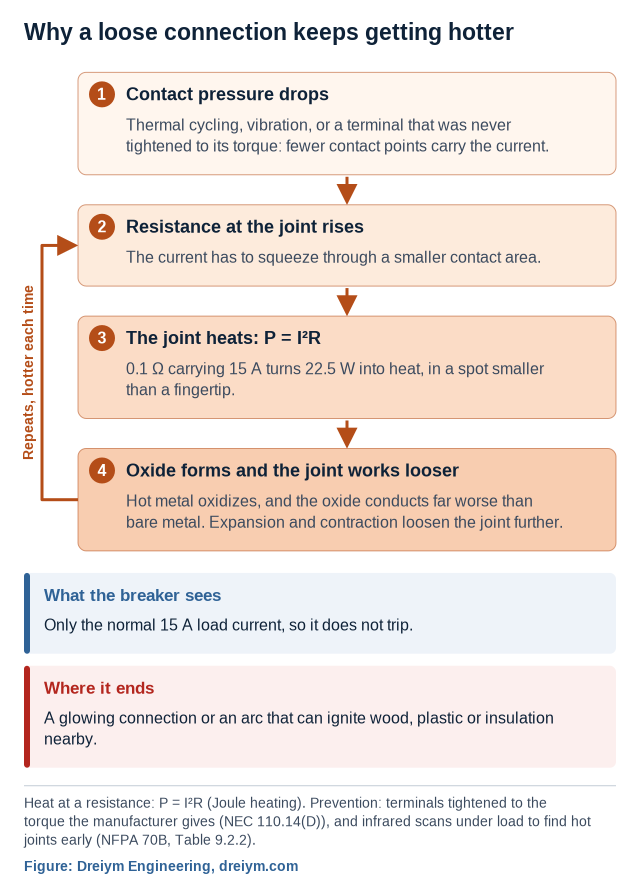
Even a tight connection touches only at many small points. When clamping pressure drops, fewer points carry current and the joint’s contact resistance rises. The heat produced is I²R, current squared times resistance. A loose joint with just 0.1 ohm of resistance carrying 15 amps turns about 22 watts into heat. That is roughly what a small soldering iron uses, in a spot smaller than a fingertip inside a closed box. A sound joint gives off a fraction of a watt.
The circuit current stays normal, so a standard breaker doesn’t trip. And once a connection starts to overheat, it tends to get worse:
- Oxidation. Heat oxidizes the contact surfaces, and the oxides conduct far worse than bare metal, so the joint runs hotter.
- Thermal cycling. Each time a load cycles, the conductor, screw and terminal expand and contract by different amounts, and the joint works looser. Vibration does the same.
- Glowing. A loose, oxidized copper joint can form a glowing hot spot at ordinary household currents, hot enough to ignite nearby materials.
- Arcing. As contact makes and breaks, current jumps the gap, melting metal and charring insulation. Charred insulation can conduct, and the damage can grow into an arc between conductors.
Most circuits in new homes now need arc-fault circuit interrupters (AFCIs). These detect many arcing faults, but they may not detect a connection that overheats or glows without arcing.

The figure below works through the 0.1 ohm, 15 amp example above: pick the condition of the joint or move the sliders to see how much heat a loose joint makes while the breaker still sees normal current.
About 22 W, in the range of a small soldering iron, inside a closed box. The breaker still sees normal current.
Condition of the joint
Numbers at 15 A on a 120 V circuit
| Joint | Resistance | Heat at the joint |
|---|---|---|
| Sound | 0.5 mΩ | 0.1 W |
| Loose | 0.10 Ω | 22 W |
| Loose and oxidized | 0.25 Ω | 53 W |
What Causes Loose Electrical Connections
Installation errors are a usual cause: terminals not torqued to specification, the wrong connector, poorly twisted splices or nicked conductors. Others are years of thermal cycling and vibration, corrosion and worn devices. Heavy, long-running loads such as space heaters also keep a weak joint hot. Loose connections most often turn up at:
- Push-in (“back-stab”) terminals on receptacles and switches
- Receptacles that feed other outlets downstream and carry their current
- Twist-on wire connectors in junction boxes and light fixtures
- Breaker terminals and the neutral bar in the panel
- The meter base and service conductors
- 240-volt appliance connections, such as dryer and range cord terminal blocks and water heaters
NEC® 110.12 and its neat and workmanlike rule also apply here: poorly torqued terminals and the wrong connectors are workmanship defects that inspectors cite.
Aluminum Branch Wiring
Solid aluminum branch-circuit wiring, installed in many U.S. homes from the mid-1960s to the mid-1970s, is a known fire risk. Aluminum expands more than copper or a steel terminal screw. It also creeps under clamping pressure and forms a hard, insulating oxide. As a result, its connections loosen and overheat more readily. Have an electrician experienced with aluminum wiring evaluate it. Recognized repairs use connectors made specifically for joining aluminum to copper at every connection, or replace the wiring. Ordinary twist-on connectors and devices not marked CO/ALR are not a fix. Stranded aluminum service and feeder conductors are a separate case and perform well when properly installed.
Signs of a Loose Wire
- Heat: a cover plate, switch, receptacle, plug or breaker that feels warm or hot. Dimmers normally run slightly warm; a hot one doesn’t.
- Discoloration: brown or black marks, scorching or melted plastic.
- Smell: burning or hot plastic, sometimes described as fishy.
- Sound: buzzing, crackling or sizzling from a device or the panel.
- Flickering: lights on one circuit that flicker or dim when a load starts.
- Intermittent power: a receptacle or fixture that works on and off, plugs that have to be wiggled, or several outlets that go dead together.
- Unexplained tripping: a breaker, often an AFCI, that trips with no overload.
- Whole-house symptoms: lights that brighten in one room as they dim in another, several appliances failing at once, or a tingle from a faucet. These point to a loose or open neutral.
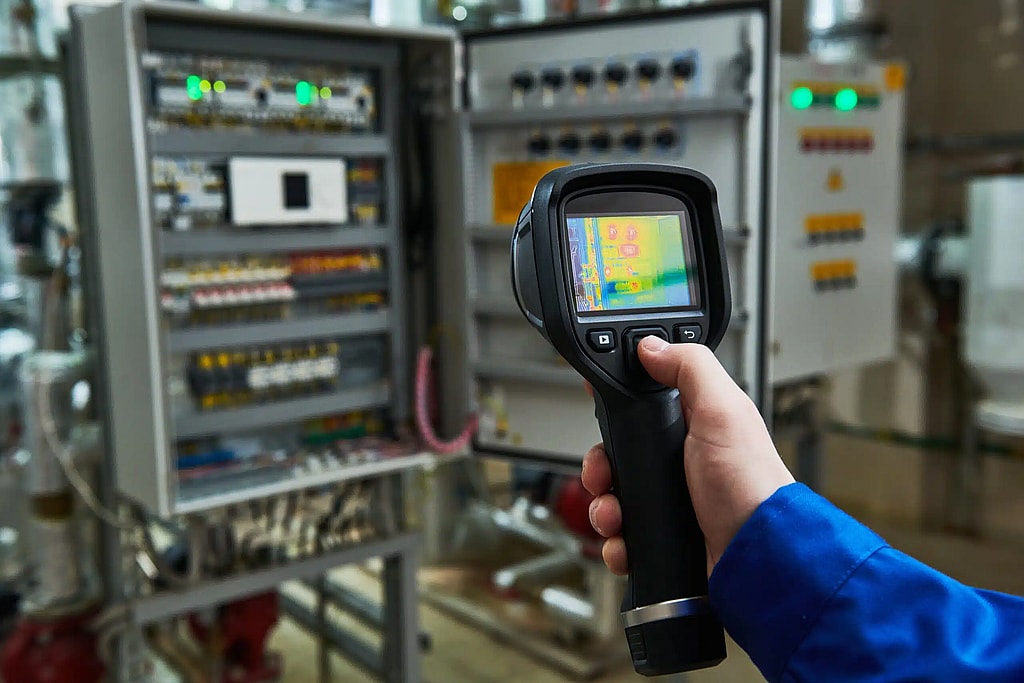
Many loose connections give no warning. An infrared scan of the electrical system, done under load, can find hot connections first.
What to Do If You Suspect a Loose Connection
- If you see smoke, flames or sparks, get everyone out and call 911.
- Stop using the receptacle, switch or fixture, and unplug what’s connected if the plug and cover plate aren’t hot.
- Switch off that circuit’s breaker, unless the panel itself is hot, buzzing or smells burned. Flipping a breaker is fine; don’t remove the panel cover, open the meter base or open the device box to look.
- Don’t keep resetting a breaker that trips.
- Call a licensed electrician, and for whole-house symptoms, the utility as well. A loose connection doesn’t fix itself.
- If anything was damaged, photograph it and ask the electrician to save the removed parts.
How an Electrician Fixes a Loose Connection
Repairing a loose connection is work for a licensed electrician; don’t try it yourself. A proper repair de-energizes the circuit and verifies it is dead, cuts back any discolored, heat-damaged or nicked conductor, and replaces any device, connector or breaker with heat damage. The conductor is landed on a device rated for it and tightened to the torque marked on the equipment or in the manufacturer’s instructions, which Section 110.14(D) of the National Electrical Code® (NFPA® 70) (opens in a new tab) requires in its 2020 and 2023 editions, using an approved means such as a calibrated torque tool. The circuit’s other connections, and any wiring that overheated, should be checked before power is restored.
Loose Connection, Open Circuit or Short Circuit?
A loose connection still carries current, but through a smaller contact area, so the joint heats. An open circuit has no path at all: the light or outlet simply goes dead. A short circuit is an unintended low-resistance path between conductors, and it draws a very high current that should trip the breaker. A loose connection can turn into either one. When the contact fails completely, the circuit opens. When the joint arcs and chars the insulation around it, the damage can lead to a short circuit or a ground fault.
Loose and Open Neutrals: Lights That Brighten and Dim
A suspected open neutral is a shock and fire hazard. Call the utility or a licensed electrician, and don’t open the meter base or panel yourself.
Most U.S. homes have a 120/240-volt service with two hot legs and a neutral, which holds each leg near 120 volts. Suppose the neutral works loose or breaks anywhere between the utility transformer and the panel. The loads on the two legs then end up in series across 240 volts. The lightly loaded leg gets the larger share and rises well above 120 volts, while the heavily loaded leg sags. That’s why lights brighten in one room while they dim in another and electronics fail together. The simulator below models it. It shows two 120-volt sources with the neutral between them and unequal loads on the two legs. A switch in the neutral opens partway through the scope window. While the neutral is intact, both legs sit at 120 volts; once it opens, the lightly loaded leg rises and the heavily loaded leg sags.
Our open neutral guide goes further: each warning sign, what a plug-in tester can and can’t tell you, and what the utility and your electrician will check.
How to Prevent Loose Electrical Connections
- Have a licensed electrician do electrical work, with terminals torqued to the manufacturer’s values, devices rated for the conductor (AL/CU or CO/ALR for aluminum), and screw or clamp terminals rather than push-in ones.
- Replace worn receptacles, and plug space heaters and other heavy loads directly into a sound receptacle, not an extension cord.
- Have older homes and aluminum-wired homes inspected.
- In commercial and industrial buildings, include infrared thermography in electrical maintenance, as NFPA® 70B does. An overheating connection in switchgear can also start an arcing fault, a common cause of arc flash fires.
Loose Connections After a Fire: What Investigators Look For
Fire investigators generally work to the methods in NFPA® 921, Guide for Fire and Explosion Investigations (opens in a new tab). Evidence of a loose or high-resistance connection can include localized melting, pitting or erosion at a terminal or splice. It can also include oxidation and heat damage concentrated at the connection, more severe than the fire around it explains. Arc mapping, which locates arc sites along the circuits, helps narrow the area of origin.
Fire also damages wiring, so investigators must tell cause from result. Arcing and melting damage look different, and devices can be X-rayed before they are taken apart so the internal evidence isn’t lost. The investigation also establishes whose connection failed: the utility’s, the installer’s or a manufacturer’s.
That evidence is easy to destroy. After a fire or electrical failure:
- Don’t clean up, and don’t let anyone discard receptacles, switches, breakers, cords or wire ends.
- Photograph the area before anything is moved.
- Notify your insurer, and give other parties who may be responsible a chance to attend before evidence is removed or tested. ASTM® E1188 and E860 describe accepted practices for preserving and examining items that may become involved in litigation.
How Dreiym Engineering Can Help
When a loose connection may have caused a fire or loss, our forensic engineers find where and why it failed. Our forensic electrical engineers examine the failed connection, the damage pattern and the utility and building records, including in residential electrical investigations. Brian J. Brackensick and Stepan V. Eero hold NAFI CFEI® and CVFI certifications, our team has over 30 years of combined experience, we inspect scenes as soon as possible, and evidence is kept in video-monitored storage. We accept consulting-only (non-testifying) retentions, and attorneys and insurers can submit a forensic assignment online. To find hot connections before they fail, we perform infrared electrical inspections. Contact us for a free quote.
Discussion
Comments are reviewed before they appear. We cannot give opinions on specific incidents or cases in comments.