Selected Projects
Cathodic Protection Construction-Phase Services, Tulsa (2020)
We typically respond within one business day.
Project at a glanceDE-PRJ-8128
- Practice
- Corrosion and CP
- Location
- Tulsa, OK
- Service
- Construction phase
- Client
- Confidential
Cathodic Protection Construction-Phase Services, Tulsa (2020)
During a 2020 cathodic protection installation in Tulsa, Oklahoma, our corrosion team provided construction-phase services. The client’s name and details are confidential.
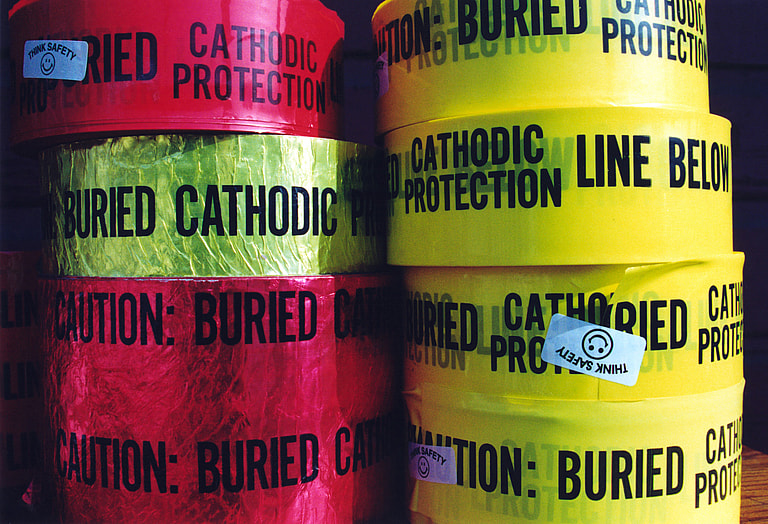
Coating and wrap applied during installation. A reviewer on site can catch details like this while the trench is still open.
How a CP system can pass for working
Cathodic protection is one of the few systems that can go in almost entirely wrong and still look right. The rectifier hums and the anodes are in the ground. The drawings were sealed, and nothing you can see suggests a problem. Whether the system works depends on current reaching the structure at the level the design called for, and the only way to know is to check while the work is still open, then again once it’s energized.
From submittals to closeout
Construction-phase work fills the gap between a sealed design and a system that works. Most of it is confirming things now that would be expensive to find out about later.
The first step is submittal review. Someone has to confirm that the anodes, cable, rectifier and test station hardware the contractor proposes match what the design assumed, because a substitute that looks equivalent on a cut sheet can change current output or service life. During installation, the job is watching the parts that will end up buried. That includes anode placement, spacing and depth, the backfill around the anodes and how well it’s compacted, and the cable routing and slack. Most of all it means the connections. Cable-to-structure connections and splices are the classic failure point. A connection that isn’t properly made and properly recoated is an electrical weak spot, and it turns into a corrosion cell of its own. Continuity checks go in this stage too, before the trench is closed.
After it’s energized, the system still has to be commissioned. That means setting the rectifier output and running a potential survey to confirm the structure meets the protection criterion in the governing standard. For buried steel, that criterion is commonly a polarized potential of negative 850 millivolts referenced to a copper/copper sulfate electrode, or a demonstrated 100 millivolts of polarization. Every annual survey from then on gets compared against those first readings, so they have to be recorded properly. They’re still in use long after the contractor has left. At closeout, the owner should end up with the as-built locations and the commissioning data, along with enough documentation to maintain the system.
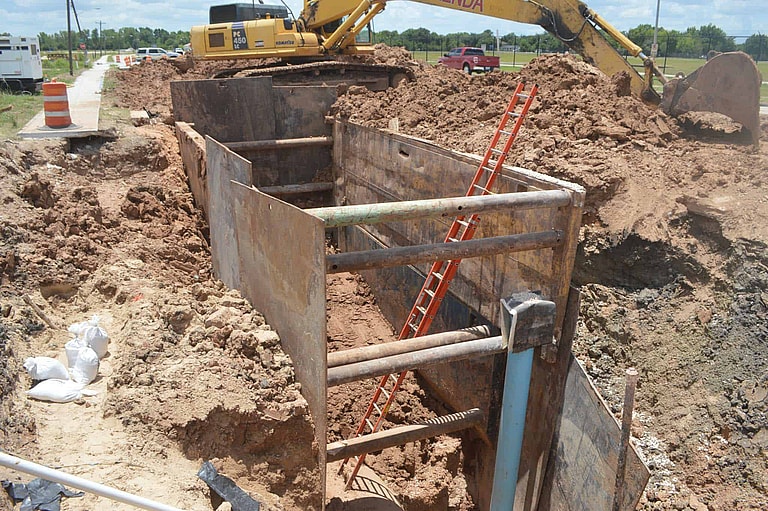
Open trench braced with steel shields, excavated soil piled along the edge. Construction-phase review covers the bedding and backfill as well as the coating, since whatever goes back into the trench can damage what was just applied.
Defects that end up under the backfill
Being on site during installation is about catching a short list of defects. Between them, they account for most cathodic protection systems that underperform, and you can’t see any of them once the trench is closed. Anode backfill is a good example. The carbonaceous backfill around an impressed current anode has to be placed in continuous contact with the anode and consolidated. An anode set in a void, or with native soil around it, delivers a fraction of its intended output. Galvanic anodes have their own version of the problem when the packaged backfill isn’t wetted or is left in a torn bag.
The other failure that keeps coming up is connections. Exothermic welds that connect cable to structure have to go on properly prepared metal and then be coated completely. Left uncoated, the connection is a bare steel site drawing current. A poor weld puts resistance into a circuit whose whole purpose is to carry current. Insulation on header cable and lead wire is easy to nick during backfill, and a nicked impressed current cable becomes an anode that consumes itself underground. Isolation kits often get installed and then shorted by a stray bolt, a piece of hardware or debris across the gasket. That’s why they get tested afterward.
That leaves continuity and the test stations. If the structure was assumed to be continuous, that has to be verified before it’s buried. Test leads need to be identified and terminated so a technician years later knows what each wire is connected to. None of these checks costs much at the time. Finding the same problems afterward is expensive, because it means excavating.
Our team on the Tulsa job
Field measurements were taken by AMPP® (NACE) certified cathodic protection personnel, with licensed Professional Engineers overseeing the construction-phase work. Our part ran from the design documents through to an installed, energized system that was verified and documented for the owner.
The installation is usually the weak link
Most cathodic protection systems that underperform had a sound design and a bad installation. By the time anyone thinks to look, the evidence is buried. Being involved during construction is the least expensive quality control you can get on a corrosion project. It catches substitutions, bad connections and continuity problems while the trench is still open. Owners with an installation coming up can look at our start-up and commissioning services and our cathodic protection design services. Our article on cathodic protection commissioning for your construction site goes through what commissioning should produce.
Corrosion and CP
Related projects
Fort Worth and San Antonio, TX
Construction-Phase CP Work on Two New Water Mains, Fort Worth and San Antonio
Construction phase CP testing, joint bonding
El Paso, TX
Power Station Impressed Current CP, El Paso
CP design, installation
Freeport, TX
Wharf CP Evaluation, Redesign and Commissioning, Freeport
CP design, testing
More work in: Oklahoma
Get your project started
We typically respond within one business day.