Selected Projects
Electrical Failure and Fire Origin Investigations, Southwest and Central Louisiana (2021)
We typically respond within one business day.
Project at a glanceDE-PRJ-8130
- Practice
- Forensic
- Location
- Louisiana
- Service
- Fire and electrical
- Client
- Confidential
Electrical Failure and Fire Origin Investigations, Southwest and Central Louisiana (2021)
Two assignments came to our forensic engineers in 2021, an electrical failure in southwest Louisiana and a fire in central Louisiana. Client details are confidential.
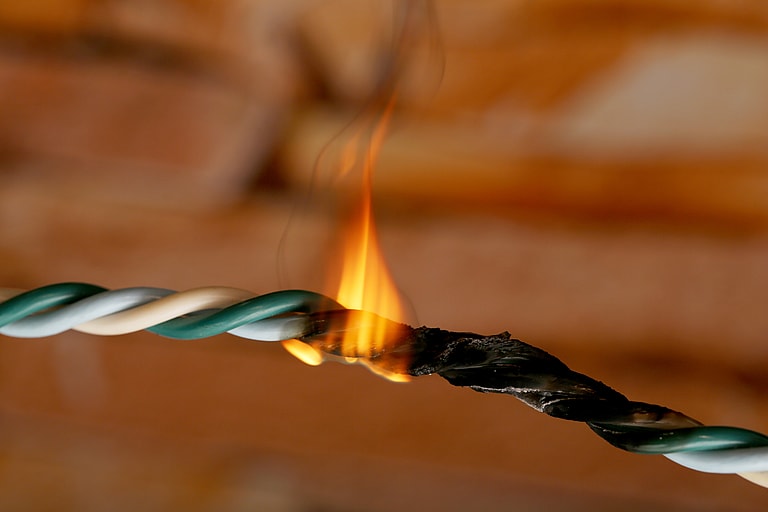
Burnt conductor. Arcing damage proves a fault happened. Whether that fault started the fire is a separate question.
Where each investigation starts
Each assignment asked its own version of one question. What happened here, and what does the physical evidence support? The two start from different places, though. An electrical failure investigation usually begins with equipment that stopped working or damaged something, and we work backward through the electrical system from there. A fire origin and cause investigation begins with a scene the fire has already changed. Suppression changes it again, and cleanup often does too, so the sequence has to be pieced together from whatever survived. Either way, the bar is the same. The conclusion has to follow from the evidence, and it has to hold up when somebody else examines that same evidence later.
Applying the scientific method to a fire
Fire investigators in the United States don’t rely on experience alone. They follow a documented method, set out in NFPA® 921, which applies the scientific method to fire and explosion investigation. You recognize the need and define the problem, then collect the data and analyze it. From there you develop a hypothesis and test it against the data, and you select a final hypothesis only if it survives that testing. The order matters. Testing a hypothesis also means trying to disprove it. If an investigator settles on an answer early and then gathers the data that agrees with it, what they have is an opinion. They haven’t done the analysis.
Origin comes first, and it limits what the cause can be. Fire patterns and depth of damage narrow down where the fire began. So do ventilation effects and witness accounts, and the condition of the electrical and fuel systems. Until an area of origin is reasonably established, there’s no point asking what within it could have ignited what. Electrical artifacts matter here, and they’re often misread. If a conductor shows arcing damage, it was energized and a fault occurred. That alone doesn’t mean the electrical system started the fire, because fire damages wiring as it spreads and causes arcing along the way. A large share of the work is telling arcing damage from melting damage, and telling arcing that caused a fire from arcing a fire caused.
Protecting evidence that can’t be replaced
The physical evidence in these matters is usually one of a kind and often fragile, and examining it can consume it. That makes spoliation a real concern from the first day. Evidence gets documented in place before anyone moves it, and it’s moved and stored in a controlled way. An examination that would change it gets coordinated with the other interested parties ahead of time, so they can attend or send a representative. Timing matters for the same reason. An engineer who’s brought in early has more of the scene left to examine, and fewer questions have to be answered from photographs that somebody took for a different purpose.
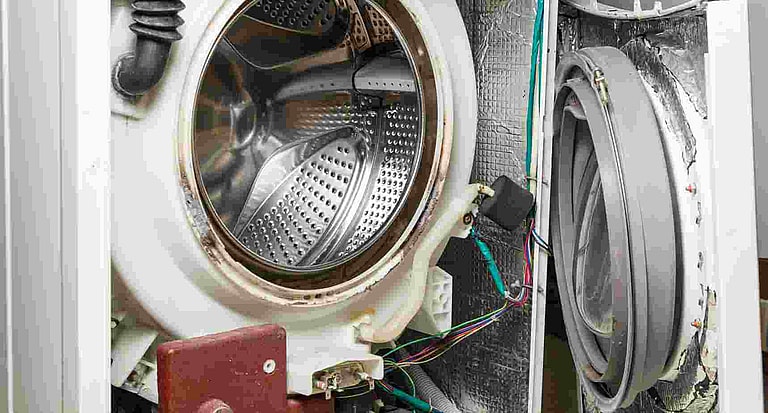
Disassembled washing machine. Once an artifact has been taken apart, it can’t be put back the way it was, so an examination like this is normally scheduled once, with every interested party invited.
When several parties share the evidence
There’s rarely just one expert on losses like these. The cause and origin investigator, engineers retained by other parties, the insurer’s adjuster and counsel for several interests can all have a stake in the same physical evidence. That evidence usually can’t be examined twice in its original condition. So scene and lab work is planned around joint access, and no single party’s schedule sets the dates. The interested parties are identified and notified. An examination protocol spells out what will be done and by whom, and destructive steps wait until everyone entitled to attend has had the chance.
The consensus practices for this are ASTM® E860, which covers examining and testing items that are or may become involved in litigation, and ASTM® E1188, which covers how a technical investigator collects and preserves information and physical items. They aren’t formalities. If an examination goes ahead without notice, or evidence is altered before the other parties have seen it, the findings get argued over on procedure instead of on substance. It can also prejudice the position of the party whose expert did it.
When to bring in an engineer is a decision with technical consequences. The sooner it happens, the more of the evidence can be documented where it was found, and the fewer conclusions end up resting on someone else’s photographs. To assign a loss, start with our assignment intake.
The two Louisiana investigations
Both investigations were handled by licensed Professional Engineers. They examined the physical evidence and the electrical systems involved and delivered their findings in written engineering reports. Physical evidence that needs a controlled bench examination, rather than a field assessment, can go to our in-house engineering laboratory.
The question behind the assignment
Insurers and attorneys rarely want a narrative from us, and property owners usually don’t either. They want to know whether a specific proposition is supported by the evidence. Work built on a documented method and preserved evidence answers that question, and it can still be checked when a second expert goes through the file. Attorneys and adjusters can look over our forensic electrical engineering services and our fire and explosion investigation services, or submit an assignment directly. Our article on the differences between arcing and melting damage goes into one of the distinctions this work turns on.
Forensic
Related projects
Texas
Texas Forensic Investigation Casework
Fire and electrical
North Texas
Built-In Gas Grill Flash Fire, North Texas
Fuel gas fire review
Baton Rouge metro, LA
Post-Fire Electrical Origin Investigation
Origin and cause
More work in: Louisiana
Get your project started
We typically respond within one business day.