Corrosion and Cathodic Protection
Annual Cathodic Protection Survey: What 49 CFR 192.465 Requires and What to Expect
What 49 CFR 192.465 and 195.573 require of an annual cathodic protection survey: intervals, criteria, rectifier and bond checks, records and repairs.
Contents
- The Compliance Calendar at a Glance
- What the Annual Test Has to Show
- Short Sections and Service Lines: The 10 Percent Rule
- Rectifier and Bond Inspections
- Remedial Action and Records
- What to Have Ready Before the Survey
- What Happens During and After the Survey
- What an Annual Survey Can’t Tell You
- Frequently Asked Questions
- How Dreiym Engineering Can Help
Under 49 CFR 192.465, every cathodically protected gas pipeline has to be tested at least once each calendar year, at intervals not exceeding 15 months, to show that its protection meets the criteria in 192.463. Rectifiers are inspected six times each calendar year, at intervals not exceeding 2½ months, and so are critical bonds, diodes and reverse current switches. Other interference bonds are checked once a year, and any deficiency the monitoring finds has to be corrected promptly. Hazardous liquid pipelines follow nearly the same calendar under 49 CFR 195.573.
This post explains what each requirement means in the field, what to have ready before the survey crew arrives, what the report should contain, and what the annual survey can’t tell you. It is written for operators of gas distribution systems, municipal gas utilities, gathering and transmission lines, and the people who audit their records.
The Compliance Calendar at a Glance
| Item | Minimum frequency | Gas (Part 192) | Liquid (Part 195) |
|---|---|---|---|
| Pipe-to-soil potential tests on protected pipe | Once each calendar year, intervals ≤ 15 months | 192.465(a) | 195.573(a) |
| Separately protected short sections (100 ft or less) and separately protected service lines, where annual testing is impractical | 10% each year, a different 10% each year, whole system every 10 years | 192.465(a) | Bare or ineffectively coated short sections: at least once every 3 calendar years, intervals ≤ 39 months (195.573(a)(1)) |
| Rectifiers and other impressed current sources | Six times each calendar year, intervals ≤ 2½ months | 192.465(b) | 195.573(c) |
| Reverse current switches, diodes, and interference bonds whose failure would jeopardize protection | Six times each calendar year, intervals ≤ 2½ months | 192.465(c) | 195.573(c) |
| Other interference bonds | Once each calendar year, intervals ≤ 15 months | 192.465(c) | 195.573(c) |
| Re-evaluation of unprotected pipelines | Every 3 years, intervals ≤ 39 months | 192.465(e) | 195.573(b) |
| Records of tests, surveys and inspections | At least 5 years; some for the life of the pipeline | 192.491 | 195.589 |
Both “calendar year” and “interval” limits apply. Surveys done in January of one year and December of the next meet the calendar-year rule but break the 15-month interval, as Figure 1 shows. Scheduling each survey within 12 months of the last one keeps both satisfied.

What the Annual Test Has to Show
The annual test answers one question for each protected segment: does the cathodic protection meet a criterion? For gas pipelines, 192.463 points to the criteria in Appendix D of Part 192. For steel, these include:
- A negative potential of at least 850 mV to a copper/copper sulfate reference electrode (CSE), with the protective current applied. Appendix D requires voltage (IR) drops other than those across the pipe-to-soil boundary to be considered for a valid reading.
- A negative polarization shift of at least 100 mV.
- A negative voltage shift of at least 300 mV with the protective current applied, for structures not in contact with metals of different anodic potentials.
- Two less common criteria based on the E-log-I curve and on net protective current.
Hazardous liquid pipelines use the criteria in NACE SP0169, through 195.571. The criterion an operator applies, and how it accounts for IR drop, belongs in its procedures and in every survey report.
In practice, considering IR drop usually means taking an instant-off reading. Every current source affecting the pipe is switched off at the same moment for a short off period, typically a second or less, and the potential read in that instant is close to the polarized potential, largely free of the IR drop through the soil, as Figure 2 shows. That needs GPS-synchronized current interrupters on the operator’s rectifiers and, where they affect the pipe, on foreign rectifiers. Galvanic anodes wired directly to the pipe can’t be interrupted, so those systems rely on test stations with anode leads that can be disconnected, coupons, or another documented way of accounting for IR drop. Our interrupted potential surveys page covers the method in more detail.

Short Sections and Service Lines: The 10 Percent Rule
Gas distribution systems often have hundreds or thousands of separately protected service lines, many protected by a single anode, and short sections of main with their own protection. Testing every one each year is often impractical, so 192.465(a) allows sampling: at least 10 percent of these structures, spread across the whole system, each calendar year, with a different 10 percent each year, so that the entire system is tested in each 10-year period.
The rule is simple. Keeping track of it is where operators get caught. Auditors ask to see that this year’s 10 percent is different from last year’s, that it is distributed over the system rather than clustered on one side of town, and that every structure has been tested within the last 10 years. A sampling plan built on the system map, as in Figure 3, answers all three before anyone asks.

Rectifier and Bond Inspections
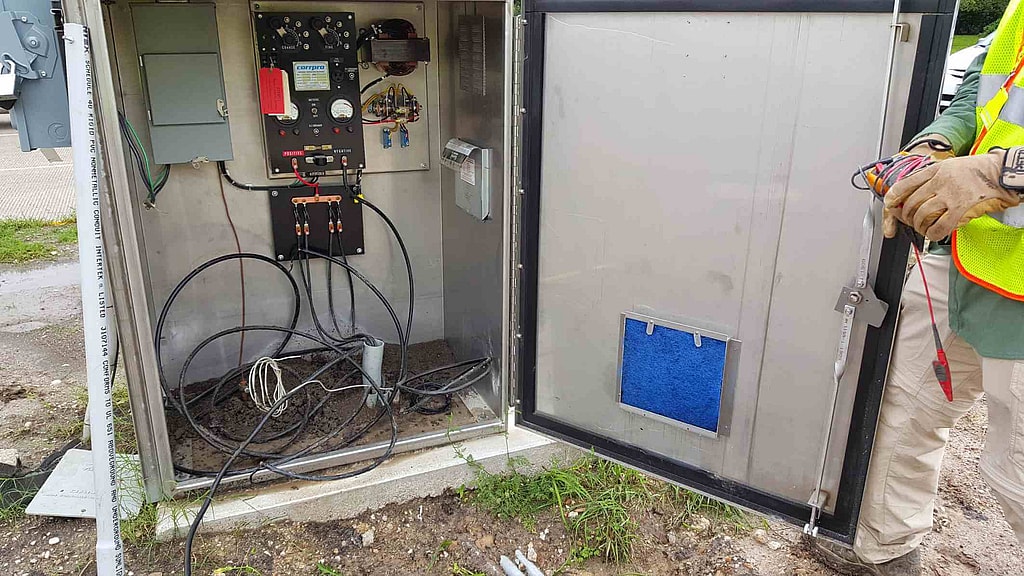
The rectifier inspection checks that the unit is operating: output voltage and current read and compared with the previous readings and the target settings, tap settings recorded, and any alarm or trip condition noted. A rectifier that has drifted, been switched off, or lost AC power stops protecting the pipe the day it fails, which is why the interval is 2½ months and not a year. Section 192.465(b) allows the six inspections to be done either on site or by remote measurement. A rectifier that is inspected remotely still has to be physically inspected for continued safe and reliable operation at least once each calendar year, at intervals not exceeding 15 months.
Bonds take a decision first. The operator has to determine which interference bonds would jeopardize the protection if they failed, and document it, because those are checked six times a year and the rest once a year. Reverse current switches and diodes are on the six-times-a-year list too.
Remedial Action and Records
Section 192.465(d) requires every operator to correct promptly any deficiency the monitoring finds. An inspector reviewing the records will look for exactly this: the same failing reading, year after year, with no repair.
Onshore gas transmission lines have firmer deadlines, added by PHMSA’s 2022 gas transmission rule. The operator has to develop a remedial action plan and apply for any permits within 6 months of the test that found the deficiency, and finish the repair by the earliest of: the next required test or inspection, 1 year (not to exceed 15 months) after the test, or 6 months after the permits are obtained. Under 192.465(f), when an annual test station reading on an onshore transmission line falls below the required levels, the operator also has to find out how far the low protection extends: local causes are investigated and fixed, and for systemic causes a close interval survey is run in both directions from the test station, at intervals of about 5 feet or less and with the protective current interrupted, unless that is impractical. The restored protection then has to be confirmed.
Records are the other half of compliance. Under 192.491, each test, survey and inspection has to be recorded in enough detail to show that corrosion control is adequate. Most records are kept for at least 5 years, but records of the annual tests under 192.465(a), the unprotected-pipe re-evaluations under 192.465(e) and internal inspections of removed pipe under 192.475(b) are kept for as long as the pipeline is in service. So are maps or records showing where the protected piping, CP facilities, anodes and bonded neighboring structures are.
In Texas, intrastate pipeline safety is enforced by the Railroad Commission of Texas; in Oklahoma, by the Oklahoma Corporation Commission. For Colorado, see our post on cathodic protection compliance for Colorado pipelines and flowlines.
What to Have Ready Before the Survey
A survey goes faster, and the report means more, when the crew has the system’s history. Before the crew mobilizes, gather:
- System maps with test stations, rectifiers, anode beds, insulating joints, casings and foreign line crossings.
- Last year’s readings for every test station, and earlier years if you have them, so trends stand out.
- The rectifier list: location, rating, current settings and recent inspection readings.
- The bond list, with each bond’s critical or non-critical designation.
- Your service line sampling plan and the record of which structures were tested in prior years.
- The criterion your procedures apply to each system, and how IR drop is considered.
- Foreign operators’ contacts where their rectifiers need to be interrupted for instant-off readings.
- Site access: gate codes, landowner notices and any facility safety requirements.
What Happens During and After the Survey
At each test station the technician checks the test lead, places the CSE in moist soil directly over the pipe, and records the potential. On impressed current systems, that means on and instant-off readings with the interrupters running. Where the station allows, the technician also checks casing isolation, the potentials on each side of an insulating joint, and foreign line crossings. Reference electrodes are checked against a reference kept for calibration, and the check is recorded.
The report should let an auditor, or next year’s crew, follow every reading back to how it was taken:
- The date, the technician, and the instruments and reference electrodes used, with their calibration checks
- Each test station, its location, the readings, and the criterion applied there
- How IR drop was considered, including interrupter locations and cycles
- Rectifier outputs and bond readings
- A list of every reading that fails its criterion, with the likely cause and the recommended remedial action
- Changes from last year’s readings
What an Annual Survey Can’t Tell You
Test stations are often far apart, and a reading only describes the pipe near the station. A coating holiday, a shorted casing farther down the line or interference from a new foreign line can sit between two passing test stations for years. Close interval surveys read the potential every few feet along the line, and DCVG surveys locate and grade coating defects. When annual readings start to drift, or a new foreign line, rail line or power line shows up nearby, these surveys and interference testing find what the test stations can’t. Our post on why cathodic protection systems stop working covers the usual causes.
Frequently Asked Questions
Does an annual cathodic protection survey have to be done by a NACE-certified person?
Part 192 requires corrosion control procedures to be carried out by, or under the direction of, a person qualified in pipeline corrosion control methods (192.453). It doesn’t name a specific certification. AMPP (formerly NACE) certifications are a common way to show that qualification, and many operators require them. Separately, the operator qualification rules in Subpart N require the people performing covered tasks, which commonly include taking pipe-to-soil readings and inspecting rectifiers, to be qualified for those tasks.
What happens if a test station fails the criterion?
The operator has to correct the deficiency promptly. The first step is finding out why: a rectifier that is off, a broken test lead, a shorted casing or insulating joint, depleted anodes, coating damage or interference. Then the repair is designed and made, and the location is retested to show it meets the criterion again.
Can the annual survey be done at the same time as the rectifier inspections?
Yes, and it often is. One rectifier inspection each year can coincide with the annual survey, since the rectifiers have to be read and interrupted for it anyway. The other five rectifier inspections still have to happen at intervals of no more than 2½ months.
How Dreiym Engineering Can Help
We perform annual compliance surveys, rectifier and bond inspections, and the cathodic protection potential surveys that follow up on them, and our municipal gas cathodic protection service covers the annual survey, rectifier rounds and any repair design for a town-owned gas system in one engagement. Because we also design and install CP systems, a failed reading can go straight to a repair design, PE-stamped where required, and installation. We also design remote monitoring. Our corrosion team includes Stepan V. Eero, M.S., P.E., NACE CP Specialist (CP4), and Brian J. Brackensick, M.S., P.E., NACE CP Technologist. For other programs we’ve run, see our Texas plant cathodic protection testing program and Colorado pipeline surveys. Contact us or call (866) 621-6920 for a free quote. We typically respond within one business day.