Selected Projects
ACVG Coating Survey of a Newly Built 10-Inch Pipeline, Port Arthur (2020)
We typically respond within one business day.
Project at a glanceDE-PRJ-8784
- Practice
- Corrosion and CP
- Location
- Port Arthur, TX
- Service
- ACVG survey
- Client
- Confidential
ACVG Coating Survey of a Newly Built 10-Inch Pipeline, Port Arthur (2020)
In October 2020 we ran an ACVG coating survey on a newly built segment of 10-inch pipeline near Port Arthur, Texas. Client details are confidential.
Survey right after backfill
The project team asked for an alternating current voltage gradient (ACVG) survey shortly after each portion of new pipe was backfilled. Coating damage from handling, lowering-in and backfill is easiest and cheapest to repair while the contractor is still on the job and before the line goes into service. This segment was about 14,260 feet of pipe installed by rack pulling, roughly 2.7 miles, and we surveyed it in one day.
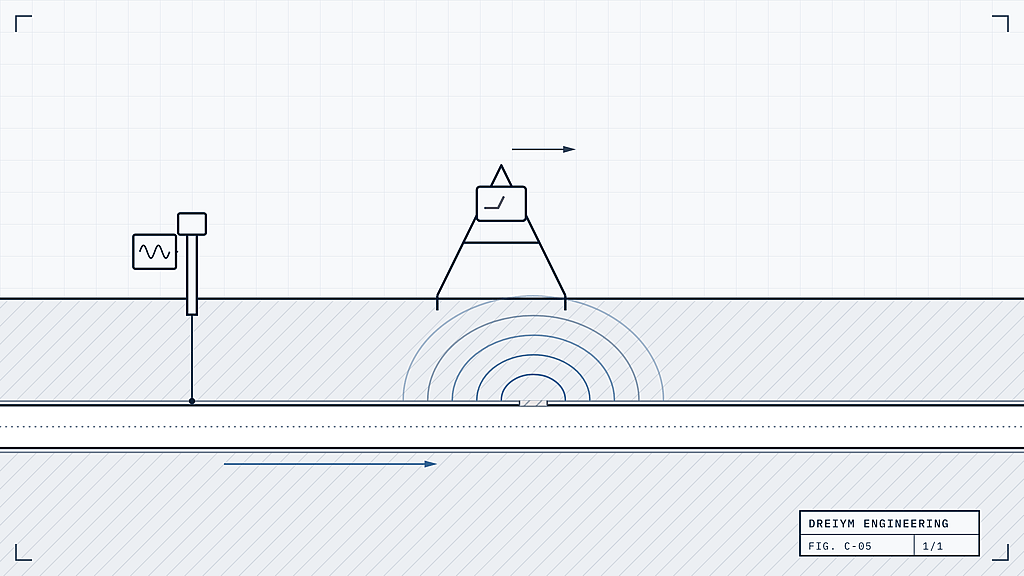
How ACVG finds a defect
A transmitter puts an AC signal on the pipe. Where the coating has a holiday, the signal current leaves the pipe through the soil, and the voltage gradient around the holiday can be measured from the surface with an A-frame probe. As the receiver approaches a defect, the signal grows and the current direction points ahead. Past it, the direction reverses. Each suspected defect is confirmed by placing the probes on both sides of the pipe. For this survey we used a Radiodetection® PCMx receiver and A-frame, with the transmitter connected at a valve set and a temporary anode as its ground, and the signal set to 2.0 A.
Eight defects, graded
The survey found eight coating defects. For each one we recorded the signal strength in decibels, the signal current at that point and the GPS location. Because the current drops with distance from the transmitter, each reading was normalized to a reference current of 1,000 mA before grading, so that defects far from the transmitter are not undervalued. The defects were then graded using the manufacturer categories, which follow the guidance in NACE TM0109. Four graded as minor, three as intermediate and one as major. Soil resistivity affects the gradient around a defect, so the categories are guidelines, not exact sizes.
What we recommended
We recommended exposing, examining and repairing the four highest-risk defects in the near future. Their condition would also show how well the survey grading matched the pipe, and so whether the four minor indications warranted digs as well.
Coating surveys on new lines
A survey at the end of construction gives the owner a baseline for the life of the line. The method is explained on our page for ACVG surveys. What a dig can confirm is shown in our project on El Paso ACVG and validation digs.
Corrosion and CP
More projects in this practice
Wink and Sarita, TX
AC Interference Data Logging on Texas Pipelines
AC interference testing
Wickett, TX
ACVG Coating Survey of Two Gathering Lines, Wickett
ACVG survey
Eastland area, TX
Annual CP Survey and Ground Patrol of a Gas Line, Eastland Area
CP survey, ground patrol
Get your project started
We typically respond within one business day.