Selected Projects
Recloser, Transformer, and Heavy-Equipment Fire Investigations, Alabama
We typically respond within one business day.
Project at a glanceDE-PRJ-8131
- Practice
- Forensic
- Location
- Alabama
- Service
- Failure analysis
- Client
- Confidential
Recloser, Transformer, and Heavy-Equipment Fire Investigations, Alabama
Our utility equipment failure investigations in Alabama have covered recloser failures and transformer fires. There was also a heavy-equipment fire. We keep client details confidential.
One of these assignments, in 2024, was a recloser failure on an electrical distribution system in Alabama. Our engineers examined and tested the failed equipment and documented their work in a written engineering report.

A failed pole-top transformer. The evidence has to show whether the failure started inside the tank or outside it.
Rarely a useful witness
Reclosers work up on poles. A transformer sits on a crossarm, or on a pad behind a fence. When one of them fails, it’s rare for anyone to have had a good view of it. What’s left is a damaged device and a service interruption. Sometimes there’s been a fire too. Several parties get involved, and each of them needs to know whether the failure started inside the equipment or something outside caused it.
What a recloser is supposed to do
An automatic circuit recloser is a protective device. It interrupts fault current, then closes back in after a set interval. The idea is that most faults on a distribution line are temporary, the kind you get when a branch touches a line or an animal bridges a gap, or when wind swings the conductors together. Interrupting the circuit and then reclosing clears a fault like that and restores service without a crew having to go out. If the fault is still there when the recloser closes, it interrupts again. After a preset number of operations it locks out and stays open.
For an investigator, that behavior means a recloser that has operated carries a history worth recovering. The operation count and the control settings show what the device saw and what it did about it, and on units with electronic controls, so do the event records. From the outside, though, several different failures look alike, and the analysis has to separate them. The interrupting mechanism may have failed to clear the fault, or the insulation may have broken down inside the unit. A control or sensing problem can make the device act on bad information. And sometimes it’s ordinary end-of-life wear in a unit that has operated many times over the decades.
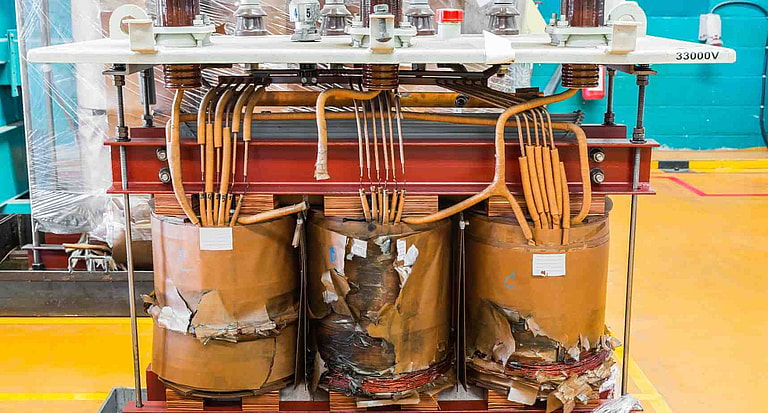
The winding assembly from a three-phase transformer, with the center coil burned through and charred debris piled at its base. When one phase is damaged far worse than the two next to it, that difference is where the investigation starts.
Transformer fires
A liquid-filled distribution transformer fails in only a few typical ways, and the evidence usually tells them apart. With an internal fault, an arc inside the tank breaks down and vaporizes the insulating liquid, and pressure builds faster than the tank or its relief device can handle. The rupture and ignition that follow leave a different signature from a fire that reached the transformer from outside. A bushing failure does most of its damage where the conductor passes through the tank. Surges from lightning or switching stress the insulation, which can lead to a failure that comes some time later. Sustained overload heats the insulation and breaks it down over a long period before anything dramatic happens.
If enough of the unit survives, much of the story is inside it. Where the arcing happened and what the damage looks like say a lot. So does the state of the windings and core. It also matters whether the relief device operated and what condition the bushings are in. If some insulating liquid can still be recovered, a lab analysis of the gases dissolved in it can point to the kind of internal fault the liquid was exposed to. A unit the fire consumed may not leave a sample good enough for that. Evidence outside the unit matters just as much. That includes what the fire damage around it indicates about which way the fire spread, and what the utility’s records show the circuit was doing at the time.
Our engineers and the lab
On each assignment, licensed Professional Engineers examined the failed equipment and the evidence around it. Their findings went out in written engineering reports. We took the same approach with the heavy-equipment fire. A machine like that has its electrical, fuel and hydraulic systems close together. Our Jacksonville heavy-equipment fire write-up describes that kind of investigation. Some parts have to be opened up and documented instead of judged in the field, and our in-house engineering laboratory gives us a controlled place to do that.
Before anyone scraps the unit
A failure like this involves several interests at once. There’s the owner of the equipment and the owner of whatever burned, and then whoever insures either of them. For any of them to get a sound answer, the failed device has to be treated as evidence and kept off the scrap pile. That means preserving it before anyone analyzes it. Adjusters and attorneys handling losses like these can read about our electrical failure analysis services and our industrial fire investigation services. On the transformer side, our article on what engineers look for after a transformer failure goes into more detail.
Forensic
Related projects
North Dakota and Texas
Bench Examinations of a Burned Control Panel and Two Breakers
Component examination
Texas
Chiller Drive Fire Analysis, Texas
Failure analysis
Central Texas
Wheel Loader Rear Camera Failures, Central Texas
Equipment failure analysis
Get your project started
We typically respond within one business day.