Selected Projects
Heavy-Equipment Fire Investigation, Jacksonville (2024)
We typically respond within one business day.
Project at a glanceDE-PRJ-8123
- Practice
- Forensic
- Location
- Jacksonville, FL
- Service
- Vehicle fires
- Client
- Confidential
Heavy-Equipment Fire Investigation, Jacksonville (2024)
Our forensic engineering team investigated a heavy-equipment fire in Jacksonville, Florida, in 2024. The details of the matter are confidential.
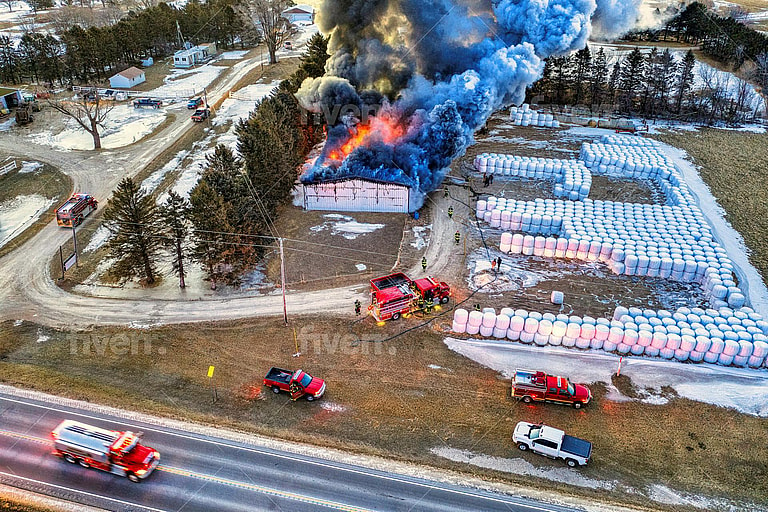
An industrial fire scene. On a machine the fuel and hydraulic lines run so close to the wiring that everything turns on pinning down the origin.
What’s left after a machine burns
When heavy equipment burns, the machine itself is rarely the whole loss. Owners and insurers need a clear technical account of where the fire started and how it spread before they can decide anything about the loss. So does counsel. Fire on a compact steel chassis often does severe damage, and what survives of the physical record has to be read carefully and preserved properly. Our job was to examine the available evidence and form origin and cause opinions using a recognized methodology, without assuming anything going in.
Tracing each system through the chassis
One chassis holds several different fire hazards. Diesel fuel, pressurized hydraulic fluid, lubricants, rubber hoses and tires sit in tight quarters with batteries, alternators, wiring harnesses and electronic controllers. In a building, an investigator can often work room by room. On a machine the work goes system by system, following the fuel lines, hydraulic circuits and electrical conductors through the same cramped space. Hydraulic fluid escaping from a pressurized line can atomize and ignite on a hot surface. Chafed or overloaded wiring can start a fire another way, and the physical evidence for each looks different.
Just as important is what the machine was doing when the fire started. Whether it was working, idling, parked or shut down decides which systems were energized and which surfaces were hot. And that changes which failure modes are plausible. Sorting that out takes knowledge of the equipment as much as fire science, and that’s why machinery fire investigation is treated as a discipline of its own.

An opened machine housing in a shop full of parts. Disassembly can’t be undone, so the machine stays as it was found until the examination has been planned.
Keeping the machine and its data intact
Left outside, a burned machine keeps changing. Rain washes residues away and corrosion spreads across freshly exposed metal. Components that were readable in week one aren’t readable by month three. Salvage and recovery can remove exactly the evidence the analysis depends on, and so can cleanup, however well meant. So the first practical step after an equipment fire is custody and storage, indoors and under cover. The machine is handled as something the other parties will want to examine, and it isn’t disposed of as a total loss.
Examining a machine is often destructive, so disassembly is coordinated and no one does it on their own. A joint examination protocol sets out who attends, what comes off the machine, how it’s documented and where the removed items go. Components that need an internal look can often be checked non-destructively first, with X-ray imaging at our laboratory showing their internal condition before anything is cut. Fluid samples and filters are collected before they’re lost, along with whatever remains of the hoses and fittings.
Some of the evidence on a modern machine isn’t physical. Engine and machine controllers, telematics systems and fleet monitoring platforms can record operating hours, fault codes and temperatures, and the machine’s state before the fire. That data has retention limits of its own, and preserving it is a separate problem. The rest comes from maintenance records and prior repairs, along with any aftermarket installations and any manufacturer service bulletins for the model. Getting all of this collected while it still exists is most of the reason to bring an engineer in early.
Investigating the Jacksonville fire
For this fire we used a methodology consistent with NFPA® 921, the guide for fire and explosion investigations. We started by defining the problem. Then we examined the equipment and the scene systematically to collect data, and documented the damage patterns. We tested each hypothesis against the physical evidence instead of starting from a preferred conclusion and working backward. Licensed Professional Engineers oversee our forensic work. Our in-house engineering laboratory in Texas, with its non-destructive X-ray capability, is there when a component needs a closer look without giving up its value as evidence. We handle the evidence so the findings can hold up under scrutiny, and when a case needs it, we give deposition and trial testimony.
After an equipment fire
Machinery fires raise technical questions a generalist investigation can miss, and the answers often shape where a claim or dispute goes from there. A careful examination that sticks to a set method gives everyone involved a defensible account of what the physical evidence supports. If you’re dealing with an equipment fire, our fire and explosion forensic consulting team can look at it. For other jobs we’ve done in the state, see our Florida page.
Forensic
Related projects
Central Florida
Central Florida Vehicle Fire Investigations
Vehicle fires
North Texas
Refuse Truck Hopper Fire, North Texas
Vehicle fire
Greater Houston, TX
Diesel Work Truck Engine Fire, Houston Area
Vehicle fire
More work in: Florida
Get your project started
We typically respond within one business day.