Selected Projects
Vehicle Fire Investigations, Orlando and Central Florida (2021)
We typically respond within one business day.
Project at a glanceDE-PRJ-8124
- Practice
- Forensic
- Location
- Central Florida
- Service
- Vehicle fires
- Client
- Confidential
Vehicle Fire Investigations, Orlando and Central Florida (2021)
In 2021 our forensic team investigated Orlando and Central Florida vehicle fires. The matters are confidential, so what follows is how we work a burned vehicle.

Fire damage to a vehicle. We work out origin and cause on a car the same systematic way we would on a building.
Why a burned car is hard to read
A car fire destroys a lot of its own evidence. The plastics, upholstery, fluids and wiring insulation burn away, and aluminum parts can melt and run. Putting the fire out, towing the car and storing it can all disturb what survived. A vehicle also packs several credible ignition sources into a small space. There are energized circuits, fuel and other flammable liquids, and hot surfaces like the exhaust. In a burned shell, competing explanations can look alike at first glance, so a quick walk around the car isn’t enough. We have to rebuild the event from what remains, step by step and without assuming the answer.
Reading the burn patterns, then the systems
Our method is consistent with NFPA® 921, the recognized guide to fire and explosion investigation. We start by documenting the vehicle as we find it. That means photographs from every side, the vehicle identification number (VIN), and the as-found condition of the doors, windows and compartments. Then we read the burn patterns. How much paint burned off, what happened to the glass and how the metal deformed all vary across a burned vehicle. Those differences help place the area of origin, whether that’s the engine compartment, the passenger compartment, or the underbody and cargo areas.
Once we have an area of origin, we look at every system in it that could have started a fire and rule each one in or out against the physical evidence. That can mean the battery and charging circuits, wiring harnesses, fuses and relays, fuel delivery, the hot exhaust, and any aftermarket accessories. An undamaged exemplar vehicle often shows what a melted or burned part looked like to begin with. Non-destructive examination such as X-ray lets us see the inside of a part without altering the evidence.
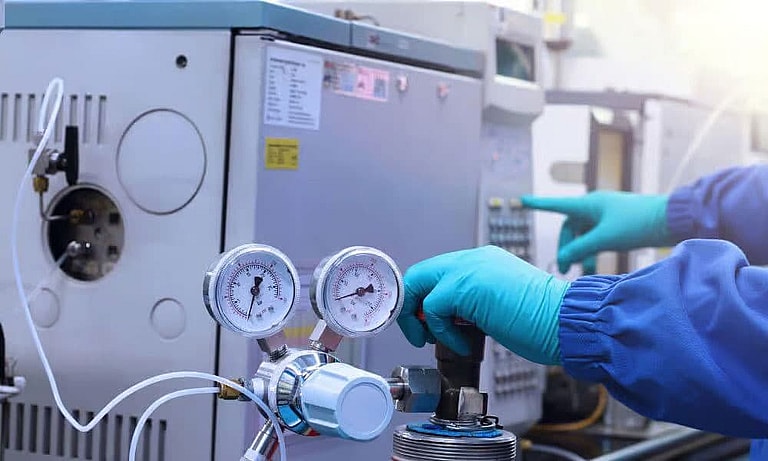
Lab instruments of the kind used to test fire debris for ignitable liquids. Unlike a building, a vehicle and its parts can be moved to a controlled setting and examined there.
What’s different about a car
A vehicle fire comes with some advantages a structure fire rarely has, and we use them. Every vehicle has a VIN that decodes to one specific build. That covers the engine, transmission and options, and the plant and date it was assembled. From there we can look up the manufacturer’s service bulletins and recall campaigns for that exact configuration, along with its known failure history. An open recall on a part in the area of origin is a lead, and the physical evidence can then back it up or rule it out. An exemplar of the same year and configuration shows what a melted or consumed part looked like before the fire. Often that’s the only way to tell what a piece of debris used to be.
There’s also what the vehicle records about itself. The event data recorder, the powertrain and body controllers, and any telematics or connected service can hold fault codes and operating state, and sometimes data from the period before the fire. Those records are only kept for so long. They can be lost if a module is damaged or thrown out, or if someone powers it up carelessly, which is another reason to decide early what gets preserved.
Aftermarket work gets a close look, because it comes up again and again in vehicle fires. Add-on audio amplifiers, lights, winches, remote starters and trailer wiring often go in without proper overcurrent protection or routing, and none of it is part of the manufacturer’s design. Electric and hybrid vehicles change the analysis again. A high voltage battery brings failure modes and safety requirements a conventional vehicle doesn’t have, and the scene has to be handled differently too. We handle those losses through our electric vehicle fire investigation services.
Examining the Central Florida vehicles
On these jobs our engineers examined the burned vehicles in Orlando and Central Florida and documented the burn patterns inside and out. In each area of origin they went through the electrical, fuel and mechanical systems one at a time. We preserved and tracked the evidence so it stayed available for later examination. Wherever a part needed a closer look, our own engineering lab in Texas backed up the field work. It can X-ray a component without destroying it. Licensed Professional Engineers oversaw each investigation. We wrote up our observations and analysis in reports, and if a matter goes to deposition or trial, we can testify.
Why the method has to hold up
Where a vehicle fire started, and why, can have real consequences, from insurance questions to disputes over a product or a repair. How much weight an opinion carries depends on the method behind it, so we work through the systems one at a time and stay with what the evidence supports. That leaves a defensible technical record, with no speculation filling the gaps. Our vehicle fire investigation work is part of our fire and explosion consulting practice, and these jobs are one example of the forensic engineering we do in Florida.
Forensic
Related projects
Jacksonville, FL
Jacksonville Heavy-Equipment Fire
Vehicle fires
East Texas
Side by Side Utility Vehicle Fire, East Texas
Vehicle fire
Texas
Truck Sleeper Air Conditioner Fire, Texas
Vehicle fire
More work in: Florida
Get your project started
We typically respond within one business day.