Selected Projects
DCVG Coating Surveys on a 20-Inch Pipeline Under Construction, Hico and Turnersville (2019)
We typically respond within one business day.
Project at a glanceDE-PRJ-8795
- Practice
- Corrosion and CP
- Location
- Hico and Turnersville, TX
- Service
- DCVG and ACVG surveys
- Client
- Confidential
DCVG Coating Surveys on a 20-Inch Pipeline Under Construction, Hico and Turnersville (2019)
Backfill is where a pipeline coating gets hurt, so this project required a DCVG survey shortly after each stretch of new 20-inch pipe was buried. In November 2019 we surveyed the first four segments, near Hico and Turnersville in Central Texas.
Four segments, two kinds of construction
Two of the segments were horizontal directional drills, about 1,600 feet under a river and about 850 feet under a creek, surveyed on November 22. The other two were mostly trenched: about 7,300 feet heading southeast from a farm road, surveyed on November 23, and about 7,000 feet near Turnersville, surveyed on November 26. In all, 16,750 feet. The new pipe had no cathodic protection, so a portable rectifier and temporary anodes supplied the survey current at each segment. Readings were logged about every 7.5 feet, and every indication DCVG found was confirmed with an ACVG receiver before it went into the report.
What came out of the ground
The two bores were essentially clean. The only indication on the river crossing was at its pull end, where a sacrificial spool of bare pipe was in contact with the soil. That spool is cut off after the pull, so we did not grade it. On the trenched pipe we found fifteen coating defects. Three were on the first trenched segment, two of them along a short road bore and one of those directly under the county road. The other twelve were on the south segment, where the soil is rocky and backfill damage to the coating is most likely. By size, the fifteen included one small defect, nine medium and five large.
What we recommended
We graded the defects by percent IR, using industry guideline ranges rather than a published standard, and recommended exposing a sample of the five largest, examining and repairing them. That checks the survey against what is actually on the pipe before the contractor moves on. The report also notes the limits of the method: DCVG may not find a defect that is shielded, such as moisture under a poorly wrapped girth weld, and it can lose a deep bore, which is better judged by an average coating quality test.
How a DCVG survey finds coating defects
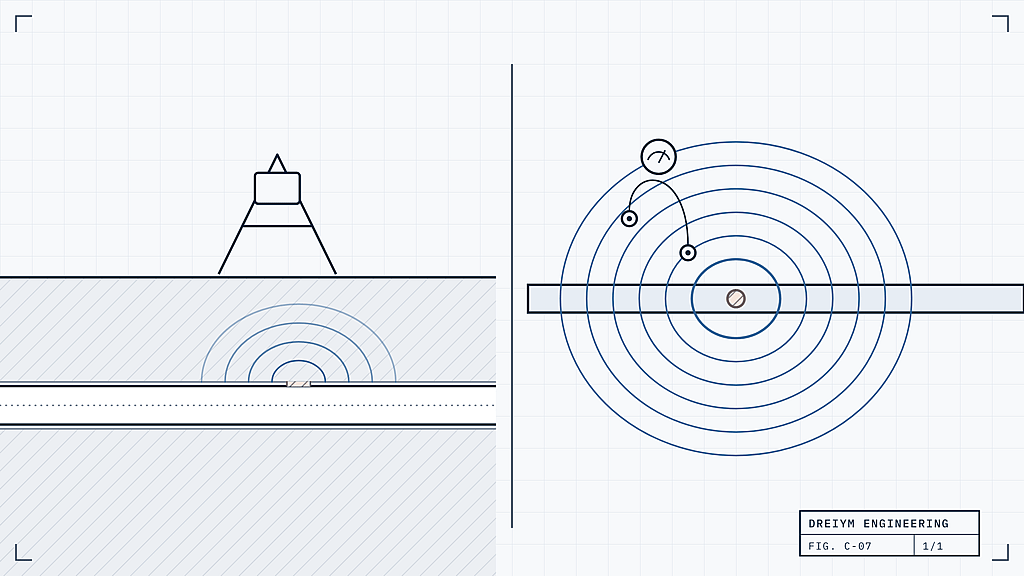
DCVG works by switching the cathodic protection current, or a temporary current source on new pipe, on and off in a regular cycle. Where the coating has a holiday, current flows to the exposed steel and sets up a voltage gradient in the soil around it. The operator walks the line with two reference electrodes, watches the meter for the swing that marks a gradient, and then works around the indication to find its center. The size of the gradient compared with the pipe potential at that spot, expressed as percent IR, is used to rank the defects by size.
Standards that apply
- NACE SP0207 covers close interval potential surveys and DC surface potential gradient surveys on buried and submerged pipelines.
- NACE SP0502 describes external corrosion direct assessment, in which DCVG and ACVG are indirect inspection tools used before excavation.
- NACE SP0169 sets the protection criteria that the permanent cathodic protection system on the finished line is designed to meet.
Why survey during construction
A defect found right after backfill is easy to reach: the right of way is still open, the crew and equipment are nearby, and the repair can be made before the line is tested and put into service. On this line each segment was surveyed soon after it was buried, and short stretches where the trench was still open were skipped, so that damage from rock, bedding or a bore pull is tied to a known stretch of pipe.
The later segments
The surveys followed the construction along the line through February 2020 and in all covered roughly 40 miles of new pipe. DCVG readings were logged with an Allegro QX field data computer and two copper-copper sulfate reference electrodes, and ACVG used a Radiodetection® PCMx receiver with an A-frame and a Tx-150 transmitter. The number of defects varied widely with the ground: one trenched stretch of about 20,000 feet in rocky and sandy soil showed 127 indications, while another of about 7,600 feet had none.
Three things changed along the way. Where the line crossed several foreign pipelines, DCVG picked up the survey signal on the other lines; an ACVG survey set up for congested areas could not confirm any of those indications, so they were reported as interference, not coating defects. In rocky and sandy ground, high soil resistivity made percent IR an unreliable guide, so defects were ranked by their total millivolt reading instead: under 100 mV most likely pinholes or small dings, 100 to 250 mV about 1 square centimeter or larger, and over 250 mV about 10 square centimeters or larger.
On long, continuous lengths of well coated pipe, even the rectifier’s lowest setting, or a single magnesium anode on its own, pushed the instant-off potential past the operator’s limit before the 500 mV IR drop that DCVG needs was reached. Those lengths were surveyed by ACVG, an approved alternative, with each reading normalized to a 1,000 mA signal current so the defects could be compared. One indication at a test station turned out to be the station’s magnesium anode, confirmed by disconnecting the anode and watching the signal fall away.
The difference between the two methods is explained in our article on ACVG and DCVG surveys. To see how instant-off readings remove IR drop from a pipe potential, try the on and instant-off readings figure.
Related services
Both methods have their own pages: DCVG surveys, which found the defects, and ACVG surveys, which confirmed them.
Corrosion and CP
More projects in this practice
Wink and Sarita, TX
AC Interference Data Logging on Texas Pipelines
AC interference testing
Wickett, TX
ACVG Coating Survey of Two Gathering Lines, Wickett
ACVG survey
Eastland area, TX
Annual CP Survey and Ground Patrol of a Gas Line, Eastland Area
CP survey, ground patrol
Get your project started
We typically respond within one business day.