Selected Projects
Engine Compartment Fire on a Diesel Work Truck, Greater Houston (2021)
We typically respond within one business day.
Project at a glanceDE-PRJ-8847
- Practice
- Forensic
- Location
- Greater Houston, TX
- Service
- Vehicle fire
- Client
- Confidential
Engine Compartment Fire on a Diesel Work Truck, Greater Houston (2021)
In 2021 a fleet operator in the Houston area asked us to find where and why a fire started on one of its diesel work trucks. The driver had noticed smoke coming from under the hood and called for help. The fleet is not named.
Damage that leans one way
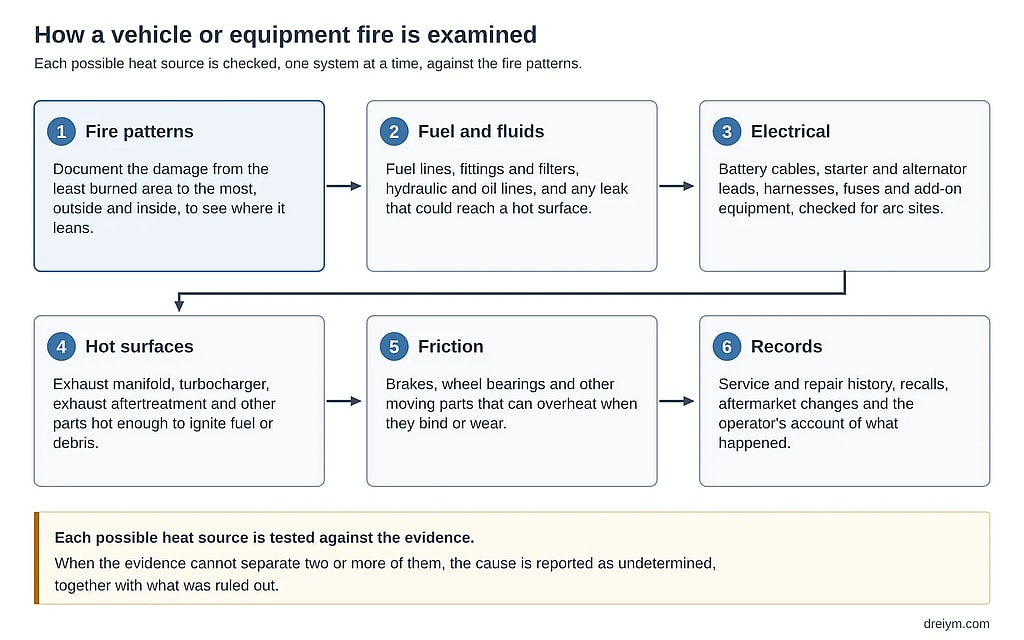
We examined the truck at the fleet yard about a month after the fire. The engine compartment was heavily burned, and the fire had moved back into the cab. On the engine, the damage was worse on the left side than on the right, and worse at the top than at the bottom. The left front fender had burned away and the left front tire was damaged. Patterns like these narrow the search before any single part is blamed.
Four systems, one at a time
We treated each system that could start a fire in that space as a hypothesis and tested it against what we found. Electrical: the battery cables and the leads to the alternator had lost their insulation and one battery was missing, but there was no arcing on the harness or the ground cables. Exhaust: the plastic hoses at the turbocharger had burned, yet the turbine wheel was in good condition and turned freely, and the exhaust system was intact. Mechanical: nothing pointed to a failure. Fuel: a braided fuel return line on the left side of the engine had a hole in it, facing the engine, where the line joins a metal fuel line.
How a small hole becomes a fire
Diesel sprayed from a small hole beside a running engine does not stay a stream. Air from the engine fan breaks it into a fine mist, and a fuel mist ignites far more easily than a puddle once it reaches a hot surface such as the turbocharger. We placed the area of origin on the left side of the engine and the point of origin at the braided line, where the hole had sprayed fuel into the engine compartment.
The service record
Days before the fire, the truck had been in the shop for low power, and a clogged manifold pressure sensor was replaced. The codes were cleared and a test drive showed no problems. Our report recorded that visit as background and did not attribute the fire to it. Fleet managers often ask about recent work after a fire, and the answer has to come from the evidence on the truck. The way we approach these losses is set out under vehicle fire investigation.
Forensic
More projects in this practice
Get your project started
We typically respond within one business day.