Consulting Areas
Short Circuit Analysis
We typically respond within one business day.
Fault current Illustrative
Trace a fault on a one-line
Pick a point on this small system to see how much current the utility and the motors send to a fault there, and which breaker has to clear it.
A fault on the switchboard bus. The utility sends about 29.8 kA through the transformer and the main breaker, and the running motors add about 0.9 kA back up their feeder. The main breaker has to clear it, so the switchboard and the main breaker need a rating of at least 30.8 kA.
Fault location
Fault type
Numbers at each point
| Fault at | Fault current | From the utility | From the motors |
|---|---|---|---|
| A Switchboard | 30.8 kA | 29.8 kA | 0.9 kA |
| B Motor control center | 20.9 kA | 19.9 kA | 1.0 kA |
| C Panel | 15.2 kA | 14.7 kA | 0.5 kA |
What Is a Short Circuit Analysis?
A short circuit analysis, also called a short circuit study or fault current study, calculates the maximum fault current your electrical system can deliver at each point, from the utility service down to each panel. Every breaker, fuse, panelboard, switchboard and motor control center is then checked against that number, so no equipment is asked to interrupt or withstand more current than it is rated for. The same values are the starting point for a coordination study and an arc flash study.
New to arc flash? Our arc flash guide puts our articles, calculators and services in the order to read them.
Short circuit currents are abnormal currents that flow into equipment due to an internal failure. This destructive energy must be safely contained in the equipment, or fire and property damage can occur. Ask for a free quote. We typically respond within one business day.
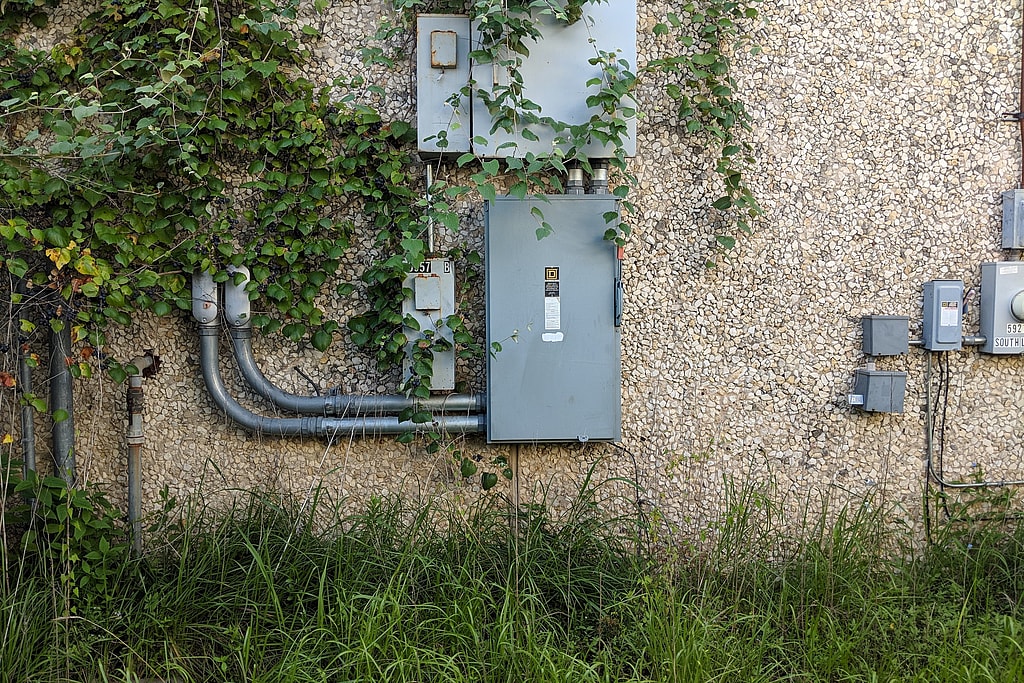
Safety switches on an exterior wall
Circuit breakers and fuses are designed to protect people and equipment from this current, but they have their limits. Just like loading a structural member too far, you must make sure the circuit breakers and fuses can stop the damaging flow of excess current safely. Short circuit analysis is required to make sure equipment is not used outside of its effective range.
Why do you need short circuit analysis?
Short circuit analysis is commonly performed during the design phase of your facility. The engineering team will calculate and confirm that your equipment is properly rated to withstand these destructive currents, with little or no damage to your surrounding equipment and facility.
These are the usual times a facility needs a short circuit analysis:
- When you’re designing new construction or a major electrical project, before any equipment is specified or bought
- Any time you upgrade the service, add generation, or bring on a large new load
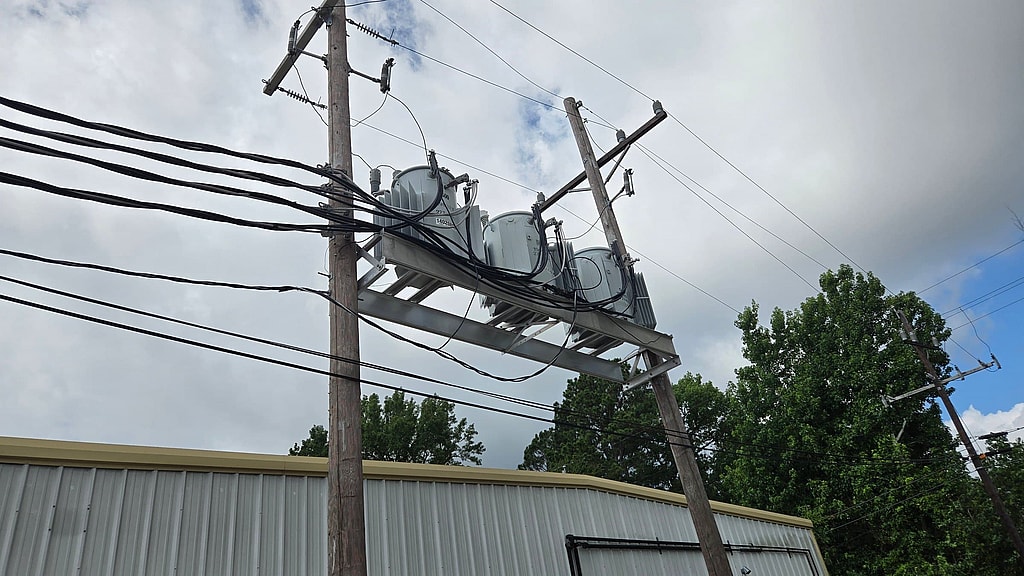
- After the utility changes its transformer or feeder, which can raise your The most current that could flow at a point in the system during a short circuit, set by the utility source, transformers, cables and running motors. Equipment there must be rated to interrupt or withstand it.See the glossary without you touching anything
- After any modification that changes the available fault current at the service, since NEC® 110.24(B) then requires a new calculation and an updated marking
- Before an arc flash study, which can’t be done without fault current data
- If the service equipment has no field marking of available fault current, or the marking isn’t dated
- For a review at least every five years, to stay in step with the NFPA® 70E, Standard for Electrical Safety in the Workplace, 2024 editionThe consensus standard US employers use to protect workers from shock and arc flash. It covers the electrical safety program, risk assessments, approach boundaries, choosing PPE, and when equipment must be put in an electrically safe work condition.Plain-language summary, not the standard’s wording.See the glossary 130.5 review cycle for the arc flash risk assessment
You can see the idea on a small scale in our free circuit solver. Draw a source, the line impedance and a fault path, and watch the impedance set the current. A real study adds the utility’s contribution, transformer impedance, motor contribution and the The ratio of the system’s reactance (X) to its resistance (R) up to the fault. A higher ratio gives a larger, more offset current in the first cycles of a fault, which breakers and fuses must be rated for.See the glossary. Our engineers model all of that in ETAP® or SKM.
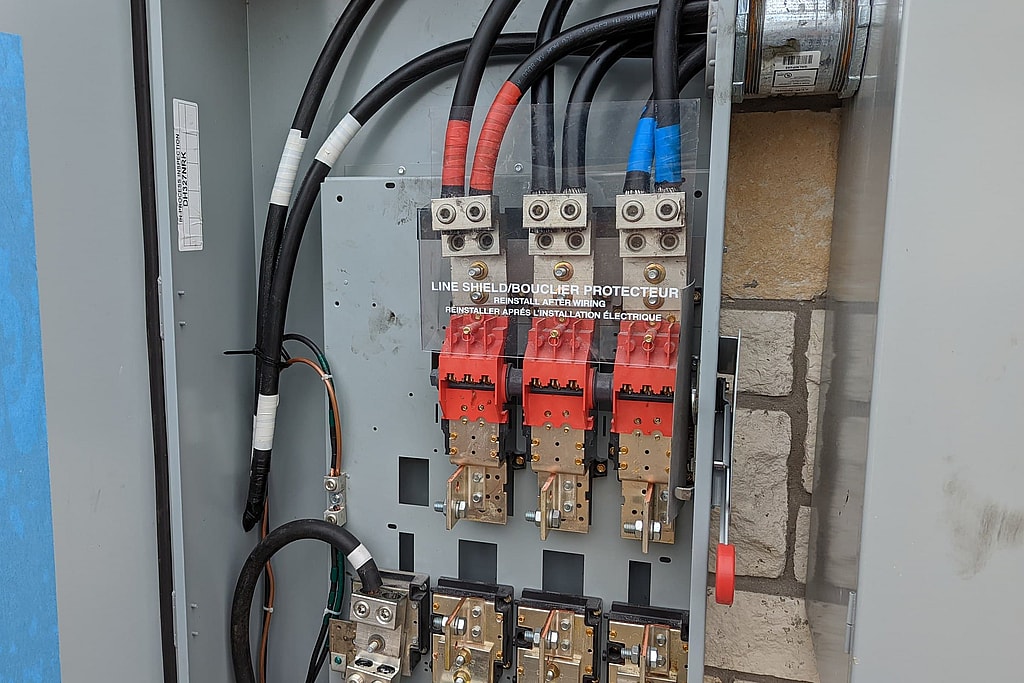
Commercial service switchboard
Things change, however. As your facility ages and you add equipment, generators, offices, people and everything else you need to run your business, the available short circuit current changes. Even if you don’t change a thing, changes made by the utility can raise the fault current at your major equipment. This is where our fault current analysis comes into play.
What a short circuit study includes
We model your distribution from the utility source down through every transformer, cable and protective device, in ETAP® or SKM. The finished study gives you:
- Available fault current at each bus, both symmetrical and asymmetrical
- The calculated fault current at every breaker and fuse, checked against its The highest fault current a breaker or fuse can safely interrupt at its rated voltage, marked in kA or as AIC (amperes interrupting capacity). NEC® 110.9 requires it to be at least the fault current available where the device is installed.See the glossary
- The same check for panelboards, switchboards, MCCs and control panels, against their The fault current an assembly such as a panelboard, switchboard or control panel can be connected to without damage beyond set limits. Like an interrupting rating, it must not be lower than the available fault current where the assembly is installed.See the glossary
- A list of underrated or misapplied equipment that names each device
- The one-line diagram we built the model from, corrected to match what’s in the field
- Field marking data for the service equipment (NEC® 110.24), with the date of the calculation
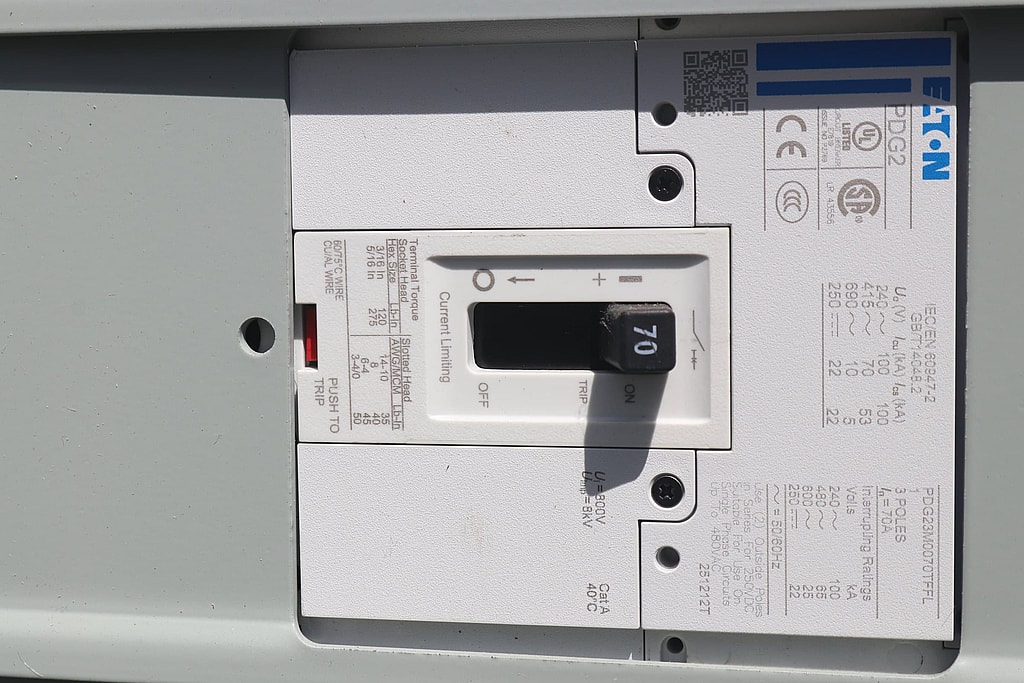
Molded case circuit breaker
Short Circuit Analysis Benefits
When you contract with Dreiym for a fault current analysis, you get a report of the available short circuit current at each point in your facility, compared against the equipment you have on hand.
- The one-line diagram the model was built from.
- The available fault current at each bus, from the utility service down to the panels in scope.
- A comparison of the interrupting rating of each device and the short circuit current rating of each assembly with the fault current available where it is installed (NEC® 110.9 and 110.10).
- A list of any underrated equipment, with options to correct it.
- The maximum available fault current and calculation date for service equipment marking under NEC® 110.24.
- A system model ready for a coordination study and an arc flash study to IEEE® 1584-2018, IEEE® Guide for Performing Arc-Flash Hazard CalculationsThe calculation method behind most arc flash studies. The 2018 edition replaced the 2002 model with one based on many more arc tests. It covers three-phase AC systems from 208 V to 15 kV and accounts for how the conductors are arranged in the enclosure.Plain-language summary, not the standard’s wording.See the glossary.
Dreiym Engineering can perform a fault current analysis for your facility. Ongoing maintenance programs are also available to help you manage issues before they become problems.
Short Circuit Study vs. Coordination Study vs. Arc Flash Study
These three studies are often bought together and often confused. They answer different questions, and each one depends on the one before it.
| Short circuit study | Coordination study | Arc flash study | |
|---|---|---|---|
| Question it answers | How much fault current can flow at each point, and is the equipment rated for it? | When a fault or overload happens, does the nearest device open first and leave the rest of the system on? | If an arc occurs at this equipment, how much energy reaches a worker, and what boundary and PPE apply? |
| Main inputs | Utility fault current and X/R ratio, transformer and cable data, motor contribution | Short circuit results, device types and ratings, trip settings, equipment damage curves | Short circuit results, device clearing times from the coordination study, equipment configuration |
| What you get | Fault current at each bus, equipment rating check, list of underrated equipment, NEC® 110.24 marking data | Time-current curves, recommended device settings, list of coordination problems | Incident energy and arc flash boundary at each location, labels, PPE guidance, mitigation options |
| Order | First | Second, on the same model | Last, using both |
We normally build all three on one system model, so the data is collected once and the results agree with each other.
Codes and Standards That Call for a Short Circuit Analysis
Every electrical design needs a number for available fault current. Several codes and standards require it directly, and others require something that can’t be produced without it. Jurisdictions adopt different code editions, so check which cycle your The organization, office or person who enforces a code and approves equipment and installations, such as a city or county building official, a fire marshal or a state agency.See the glossary enforces.
| Reference | What it says |
|---|---|
| NEC® 110.9 | Equipment intended to interrupt fault current must have an interrupting rating sufficient for the fault current available at its line terminals. |
| NEC® 110.10 | Overcurrent devices, circuit impedance, and equipment short circuit current ratings must be selected and coordinated so a fault is cleared without extensive damage to the equipment. |
| NEC® 110.24(A) | Service equipment at other than dwelling units must be field marked with the maximum available fault current and the date the calculation was performed. Industrial installations are excepted where maintenance and supervision ensure only qualified persons service the equipment. |
| NEC® 110.24(B) | When a modification changes the maximum available fault current at the service, the value must be recalculated and the field marking updated. |
| OSHA 29 CFR 1910.303(b)(4) | Equipment intended to interrupt current at fault levels must have an interrupting rating sufficient for the nominal circuit voltage and the current available at the line terminals. |
| OSHA 29 CFR 1910.303(b)(5) | Overcurrent devices, total impedance, component short circuit current ratings, and other circuit characteristics must be selected and coordinated to clear a fault without extensive damage. |
| NFPA® 70E 130.5 | Requires an arc flash risk assessment, reviewed for accuracy at intervals not exceeding five years. Incident energy cannot be calculated without available fault current and device clearing time. |
| IEEE® 1584-2018 | The arc flash calculation method takes bolted fault current as a primary input, for systems from 208 V through 15 kV. |
| IEEE® 3002.3-2018 | Recommended practice for conducting short circuit studies and analysis of industrial and commercial power systems. |
If you want a screening number before you commission a study, try our free available fault current calculator (point-to-point method). Don’t treat it as a short circuit study, and don’t use its result for the NEC® 110.24 marking or to check equipment ratings.

Short circuit analysis in practice
Since 2018 we’ve run a standing program of arc flash and protection coordination studies for industrial facilities around Greater Houston. Each facility has its own system model, built from one-line diagrams checked in the field and maintained in ETAP® and SKM. The short circuit duty on the equipment comes out of that model first, and the coordination and IEEE® 1584 incident energy calculations are built on it. We ask the serving utility for both its maximum and minimum fault contribution, because the lowest fault current can be the worst case for arc flash. When a plant changes, we restudy it. Client details stay confidential. Read more about the Greater Houston arc flash and coordination study program.
Who does the work
Brian J. Brackensick, M.S., P.E., leads our short circuit studies, and Ruben A. Rodriguez does the field data collection. Our engineers are licensed Professional Engineers with active and past licensure in multiple states, and our studies are PE-stamped where required. Dreiym Engineering was founded in 2014, our team has over 30 years of combined experience, and our memberships include IEEE®, NFPA®, AMPP®, IAAI® and ISNetworld®. More about the team is on our staff page.
Request a short circuit study
We serve Texas, Louisiana, Oklahoma, New Mexico, Colorado and Florida. When you contact us, you won’t spend a lot of time on hold or leaving voicemails. You’ll talk to an engineer who is ready to discuss your project.
Every job starts with a free quote and a scoped proposal, and our rate schedule is available on request. Send us your one-line diagram if you have one, even an old one. Contact us today. We typically respond within one business day.
Before the study
Build a data request for your study
Arc flash, short circuit and coordination studies start from the same system data. Tick what applies, then print the list for whoever gathers it. Anything you cannot find, we can collect on site.
Selective coordination Illustrative
See what fault current does to selectivity
The fault current from a short circuit study decides whether breakers and fuses stay selective. Move a fault along a time-current chart and see which device trips first.
Open the selectivity explorerFrequently asked questions
What is a short circuit study?
It’s an engineering calculation of the current that would flow if a A short circuit with almost no resistance at the fault, as if the conductors were bolted together. It gives the highest fault current, the starting value for equipment ratings and arc flash calculations.See the glossary occurred at each bus in your system, from the utility service through the transformers, feeders and panels. The results are compared with the interrupting ratings and short circuit current ratings of the installed equipment. “Short circuit study,” “short circuit analysis” and “fault current study” generally mean the same work.
When is a short circuit study required?
No code section uses the words “short circuit study,” but several requirements can’t be met without one. NEC® 110.9 and 110.10 require interrupting ratings and short circuit current ratings that are adequate for the fault current available where the equipment is installed, and OSHA 29 CFR 1910.303(b)(4) and (b)(5) say the same for workplaces. NEC® 110.24 requires service equipment, other than in dwelling units, to be field marked with the maximum available fault current and the date of the calculation. In practice, you need a study for new construction and major renovations, service upgrades, added generation or large motors, utility transformer changes, and before any arc flash study.
How is a short circuit analysis different from an arc flash study?
A short circuit analysis tells you how much fault current is available and whether your equipment can interrupt it. An arc flash study starts from that fault current, so the short circuit analysis has to come first. From there it adds how fast each protective device clears and calculates the incident energy, which sets the labels and PPE requirements.
How long is a short circuit analysis good for?
NFPA® 70E 130.5 requires the supporting data to be reviewed for accuracy at intervals not exceeding five years. Five years is the outside limit. If your system changes in year two, the study is already out of date. Equipment changes, added generation, protective device or setting changes, and changes on the utility side all call for an update, wherever you are in the cycle.
What do you need from us to start?
A fault current letter from your utility, your one-line diagram, and nameplate data for the major equipment. If any of that is missing or out of date, we can verify it in the field as part of the study.
Can the utility change your available fault current?
Yes. A transformer or feeder change on the utility side can raise the available fault current at your service even if nothing changed inside your facility. It’s one of the most common reasons equipment that was correctly rated when it went in turns out to be underrated years later.
Related Reading
- Ground Fault vs. Short Circuit: What’s the Difference?
Ground fault vs short circuit: what each fault is, how they differ, why both are dangerous, and how GFCIs, AFCIs and breakers protect people and property.
- The Importance of Short Circuit Analysis in Engineering
The importance of short circuit analysis: it confirms breaker and fuse interrupting ratings and sets up coordination and arc flash studies.
- Causes and Effects of Short Circuits
Learn the causes and effects of short circuits, from inadequate protection to equipment misuse, and how short circuit analysis protects your facility.
- Selective Coordination: What the NEC® Requires and What the AHJ Needs to See
Where the NEC® requires selective coordination (700.32, 701.32, 708.54, 620.62), what counts as selective, and what the AHJ needs in a submittal.
Related Services
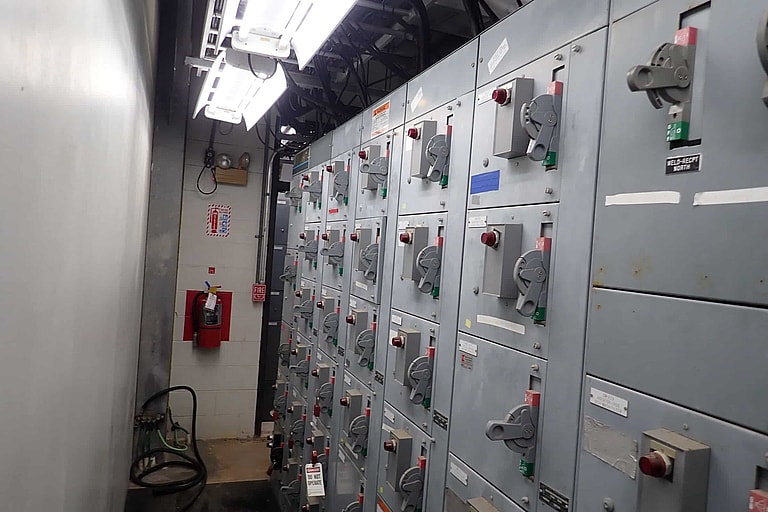
Arc Flash Studies

Electrical Coordination
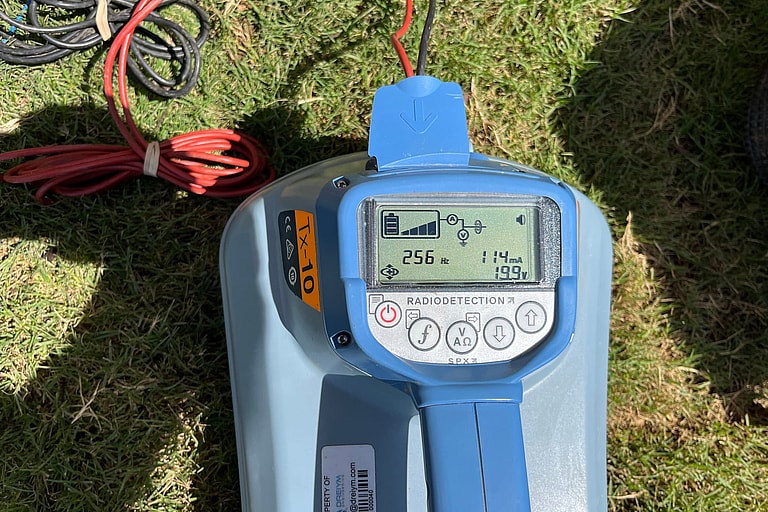
Facility Walkdowns
Project experience
Related projects
Seattle, WA
Arc Flash Studies for a Power Control Unit System, Seattle
Arc flash, short circuit
Grapeland, TX
Four-Area Plant Arc Flash Studies, Grapeland
Arc flash, short circuit
League City, TX
Data Center Arc Flash Study and Walk-Down, League City
Arc flash, coordination, short circuit
Area pages: Arc Flash and Power Studies in the Houston Area
Get your project started
We typically respond within one business day.