Corrosion and Cathodic Protection
What Causes Cathodic Protection Interference?
Learn what causes cathodic protection interference, from stray current and nearby CP systems to power lines, and how testing keeps pipelines protected.
Reach out to Dreiym Engineering for any Corrosion, Electrical or Forensic Questions.
Contents
Where there is growth, there is decay. And where there is metal, inevitably, you will find corrosion. This is especially true of metal that has been buried underground, such as steel piping. Cathodic protection slows that corrosion, but cathodic protection interference can undo it.
Key takeaways
- Cathodic protection interference occurs when an additional electric charge disrupts the flow of current between the anode and the protected metal.
- Most interference comes from human-made sources, such as another cathodic protection system built too close.
- Natural sources such as lightning strikes on or near a pipeline can also interfere with cathodic protection.
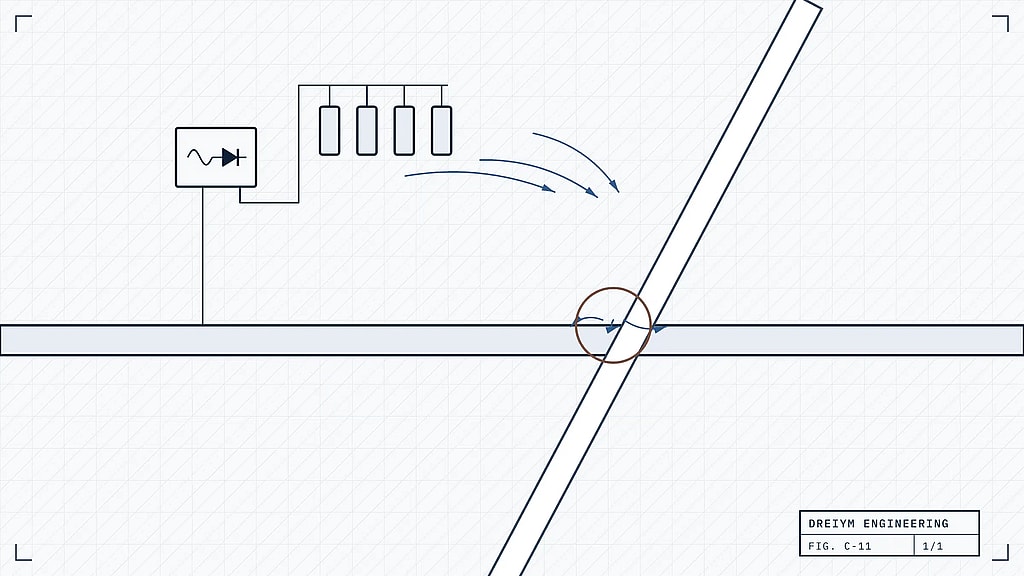
- Interference testing reads structure-to-soil potentials while the interfering rectifier is switched on and off.
- Where current leaves the foreign pipe, its potential shifts positive when the rectifier is on, and that is where corrosion concentrates.
Many companies turn to cathodic protection to help stave off the effects of underground corrosion. While this is typically an effective means of prevention, it isn’t always foolproof. This is evident in the case of cathodic protection interference. Knowing what it is and what causes cathodic protection interference is the key to protecting the longevity of your pipes.
A Review of Cathodic Protection
An explanation of cathodic protection interference would not be complete without a discussion of cathodic protection itself. A galvanic cathodic protection system connects the structure to a more electrochemically active metal (typically magnesium, zinc, or an aluminum alloy) whose native potential is more negative than steel’s, so that it discharges current into the electrolyte and corrodes preferentially while the structure receives that current and is protected. A galvanic anode is therefore not a positively charged metal; it is the more negative of the two. An impressed-current system produces the same protective effect differently, using a rectifier whose positive terminal drives current from an inert or consumable anode through the electrolyte to the structure. Most of the corrosion is transferred to the anode, and the protected surface remains intact. This process can add up to 20 years to your pipe’s lifespan.
What Is Cathodic Interference?
Cathodic Protection interference occurs when an additional electric charge disrupts the flow of electricity between the anode and the protected metal surface. This disruption prevents the cathodic protection from working effectively. Worse, it may potentially worsen the effects of corrosion.
Common Causes of Cathodic Interference
Most causes of cathodic protection interference come from human-made devices that carry an electric charge. In many cases, an additional cathodic system built too close to your cathodic system may cause interference. But the source of the current doesn’t have to come from underground. At times, high-voltage electric utility wires may also potentially cause interference.
For a field example, see the AC interference data logging on Texas pipelines.
Cathodic interference may also come from more natural sources. Lightning strikes on or near pipelines may cause interference with cathodic protection if the system doesn’t have built-in devices to mitigate that kind of damage.
How Interference Is Tested and Mitigated
Interference testing measures structure-to-soil potentials on the affected pipeline while the interfering rectifier is switched on and off. Where current leaves the foreign pipe, its potential shifts in the positive direction when the rectifier is on, and that is where corrosion is concentrated. Typical fixes are a resistance bond between the two structures, galvanic anodes at the discharge area, coating repairs, or adjusting or moving the interfering groundbed. Federal pipeline rules in 49 CFR 192.473 require operators whose pipelines are subject to stray currents to keep a continuing program to minimize their detrimental effects.
Reducing Cathodic Protection Interference
Awareness is key to preventing cathodic protection interference. When you are aware of what causes corrosion (cathodic systems placed too closely together, power lines, etc.), you can design your systems with that in mind. You can also install devices such as cathodic isolators, decouplers, and isolating spark gaps to help direct lightning away from the site.
For pipelines near high-voltage power lines, see our AC interference and mitigation service, which covers touch voltage and AC corrosion checks.
For pipelines in Colorado, see AC interference and mitigation in Colorado.
Another key step is having your site inspected by professionals. These inspections can help identify potential sources of cathodic interference through dedicated interference testing services. That’s why Dreiym Engineering is proud to offer cathodic protection testing to ensure your cathodic systems run as they should.
Discussion
Comments are reviewed before they appear. We cannot give opinions on specific incidents or cases in comments.