Digital PE Stamp and Seal Fraud: Rules in 55 Jurisdictions
What the seal rules of 55 US licensing jurisdictions require of a digital PE stamp, how seal fraud works, and how to verify a sealed PDF.

Contents
- What is a PE stamp, and what is a digital PE stamp?
- How a digital signature works
- What NCEES®, ESIGN and UETA say
- The rules in Texas, Louisiana, Oklahoma, New Mexico, Colorado and Florida
- How the rules compare across licensing boards
- What PEs and engineering firms need for a digital PE stamp
- How seal fraud happens and gets caught
- How building officials, owners, contractors, attorneys and insurers can check a sealed document
- How to report a suspected forged seal
- When a sealed document becomes evidence
- Frequently asked questions
- Professional engineer seal rules in all 55 jurisdictions
- References
Is a digital PE stamp legal? In most places, yes. Of the 52 licensing jurisdictions whose rules we could read, 46 allow an electronic signature in some form, but the stricter boards expect a verifiable digital signature tied to one engineer, not just an image of the seal. Using a seal that belongs to another engineer is a separate matter: in 29 jurisdictions, misusing a seal that belongs to someone else is a crime.
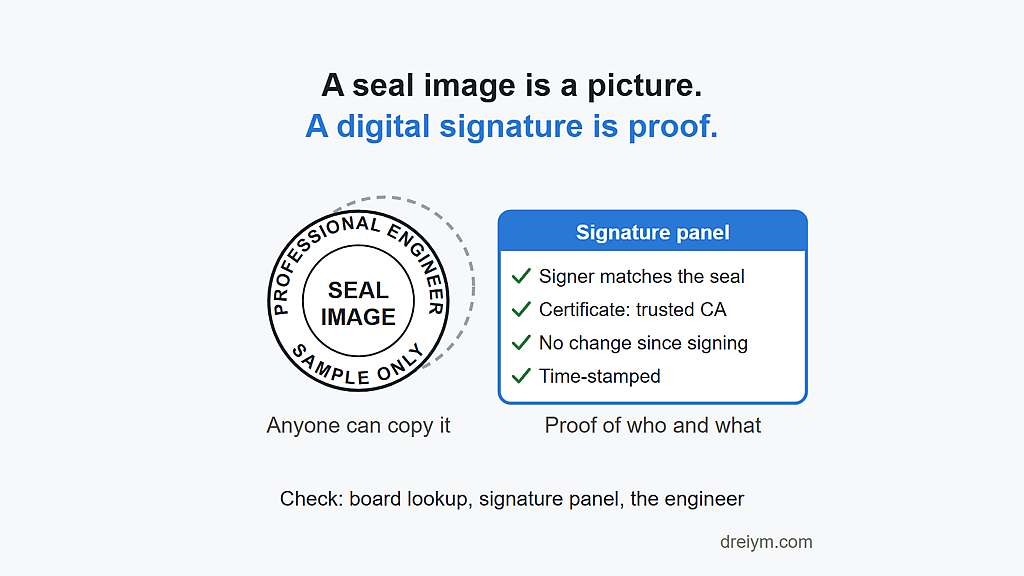
Most of what gets sold as a “digital PE stamp” is just a picture of a seal, and a picture doesn’t prove much. Anyone holding a sealed PDF can copy the image onto another drawing. What the stricter boards care about is the signature behind the seal: a cryptographic signature tied to one engineer’s certificate, which shows who signed the file and whether anyone changed it afterward. A scanned seal can’t do either, and that gap is where seal fraud lives.
Key takeaways
- Most of what is sold as a digital PE stamp is just a picture of a seal, and anyone with a sealed PDF can copy that image.
- A cryptographic digital signature shows who signed the file and whether anyone changed it afterward; a scanned seal cannot.
- Of the 52 jurisdictions whose rules we could read, 46 allow an electronic signature in some form, and 24 set all four NCEES® tests.
- A valid digital signature does not prove the license is active, so check the board lookup for the status on the signing date.
- Before relying on a sealed document, look the engineer up on the board site, validate any digital signature and call the engineer using the board record.
We read the seal and electronic-signature rules for all 55 licensing jurisdictions that belong to NCEES®: the 50 states, the District of Columbia, Guam, the Northern Mariana Islands, Puerto Rico and the U.S. Virgin Islands. (American Samoa doesn’t have a board in that directory.) Below is what they require, where they disagree, how seals get forged and how to check one.
On October 8, 2026, we read every statute, rule and board page we rely on, except the rules published only as PDF or Word files, which we read on October 9. Each rule is cited by section with a link to the text we read. Where we couldn’t open a file, we say so and state nothing from it as fact. This is a technical and regulatory summary, not legal advice.
If you only need part of this:
- Licensing boards: what the rules share, the gaps fraud exploits, measures in use and all 55 rules.
- PEs and firms: what the rules require, how to seal a PDF and how to protect your seal.
- If you’ve been handed a sealed document: how to check the seal and how to report a forgery.
- Background: what a PE stamp is, how digital signatures work, NCEES® and ESIGN, six states, how fraud happens, the FAQ and the references.
What is a PE stamp, and what is a digital PE stamp?
A PE stamp, or professional engineer seal, is what a licensed engineer puts on final plans, specifications and reports. Together with the engineer’s signature and the date, it tells the reader that the engineer either prepared the work or directly supervised it. Each board decides what its seal looks like and how big it can be. In Texas, for instance, a seal of the board’s design can be up to 2 inches across, and decals and seal replicas aren’t allowed (22 TAC § 137.31).
People tend to use four terms interchangeably, and they shouldn’t:
- The seal, or stamp, is the board’s design with the engineer’s name and license number on it. On paper it’s ink or an embossment. In a file, it’s an image.
- The signature is the engineer’s handwritten signature, or an electronic one where the rules allow it.
- Under federal law, an electronic signature is any electronic sound, symbol or process adopted with intent to sign (15 U.S.C. § 7006(5)). A typed name can count.
- A digital signature is an electronic signature made with a private key and a certificate, so software can check who signed and whether the file changed. Florida’s statute defines it in those terms (Fla. Stat. § 668.003).
When a vendor sells a digital PE stamp, it’s usually only the first of these: an image file of the seal. The image is handy for placing the seal on a drawing, but on its own it proves nothing, since anyone with a sealed PDF can lift it. That’s why 24 jurisdictions set four tests for the digital signature itself, and an image alone can’t pass them. Others ask for security measures that keep the file from being changed without anyone noticing.
Digital signature vs electronic signature
Every digital signature is an electronic signature, but most electronic signatures aren’t digital signatures. The federal ESIGN Act and the state-level Uniform Electronic Transactions Act (UETA) protect electronic signatures. Neither one defines a seal; that’s left to each board.
Pennsylvania’s board drew that line in 2020: an electronic signature can be a scanned signature or a typed “/s/” with no authentication, while a digital signature adds authentication of both the signer and the document (50 Pa.B. 4245). The board’s rule allows three ways to seal: a physical seal with an ink signature, a seal image with an ink signature, or a digital seal with a digital signature (49 Pa. Code § 37.59(7)).
How a digital signature works
A digital PE stamp that meets these rules needs four pieces:
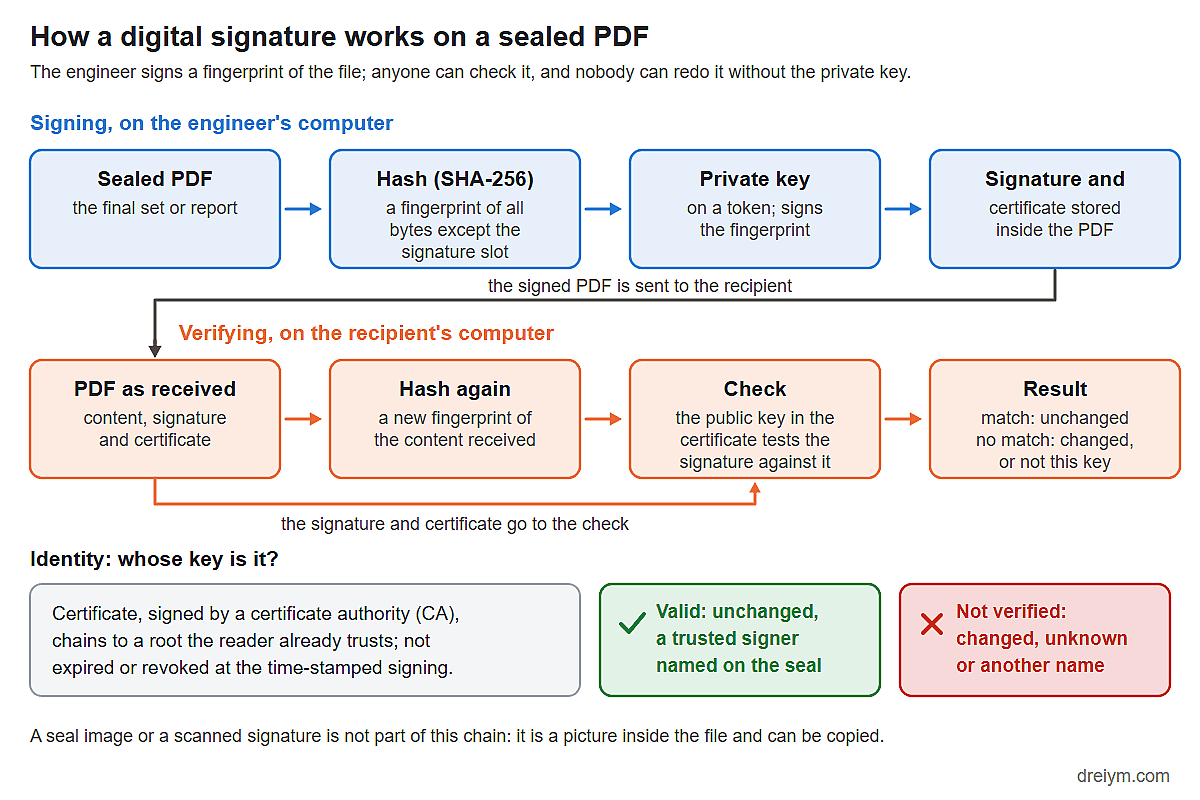
- Software turns the file’s bytes into a fixed-length fingerprint called a hash, using an algorithm such as SHA-256. Change one character and the hash changes completely. In NIST’s words, these digests “are used to detect whether messages have been changed since the digests were generated” (FIPS 180-4).
- The engineer has a key pair. Ideally the private key sits on a token, smart card or hardware module that won’t release it (FIPS 140-3). The public key can go to anyone.
- The signature is the hash transformed with the private key. To verify it, software recomputes the hash and checks it with the public key, and one changed byte fails it. NIST lists what signatures are for: detecting changes, authenticating the signer and supporting non-repudiation (FIPS 186-5).
- An X.509 certificate (RFC 5280) ties the public key to a named person. A certificate authority (CA) signs it and should check the person’s identity first (NIST SP 800-63-4). Certificates expire and can be revoked; software can check their status online (RFC 6960).
Keys, certificates and CAs together make up a public key infrastructure (PKI). Software trusts the CAs listed by the operating system, the PDF reader or government programs such as the U.S. Federal PKI. A self-signed digital ID will pass the math, but nobody vouches for the name in it.
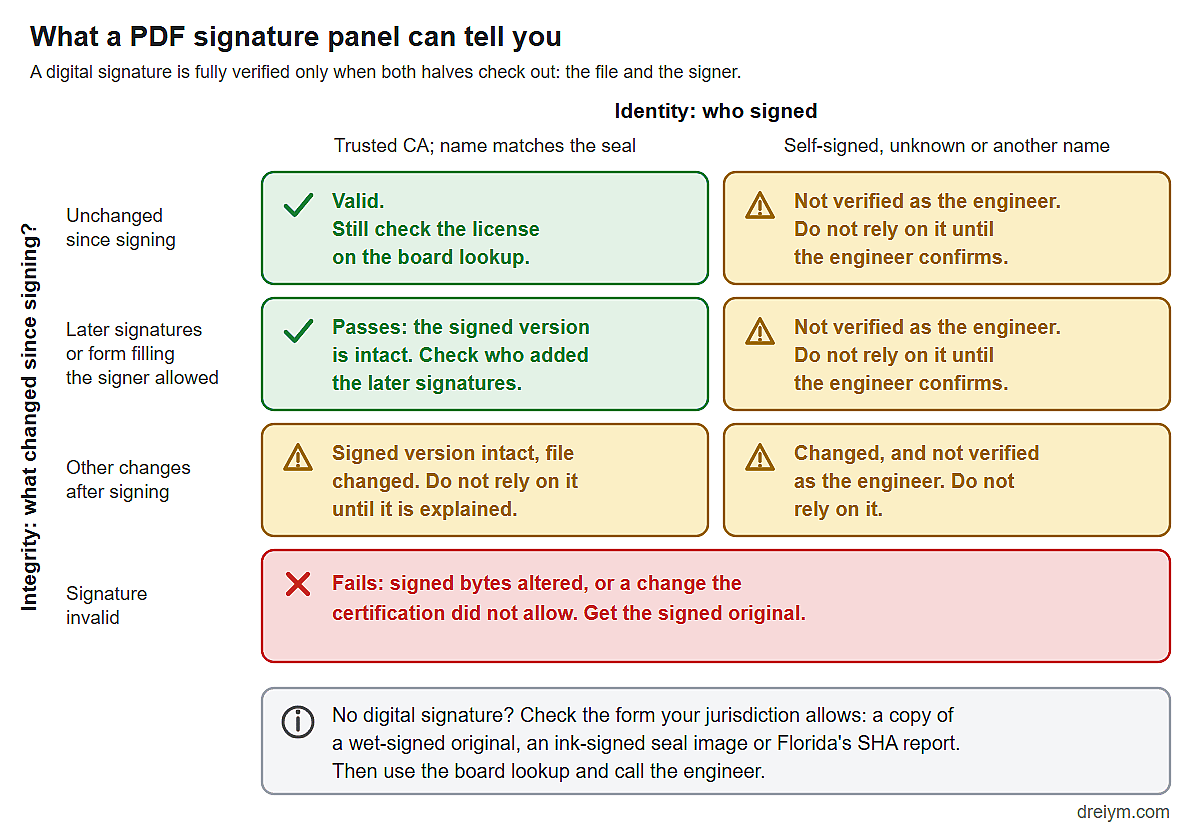
A validator’s “valid” means two things. The file hasn’t changed since signing (integrity). And the certificate comes from a trusted CA, names the engineer on the seal, and wasn’t expired or revoked at signing (identity). Only a trusted time-stamp can prove that last part.
How a signed PDF shows a later change
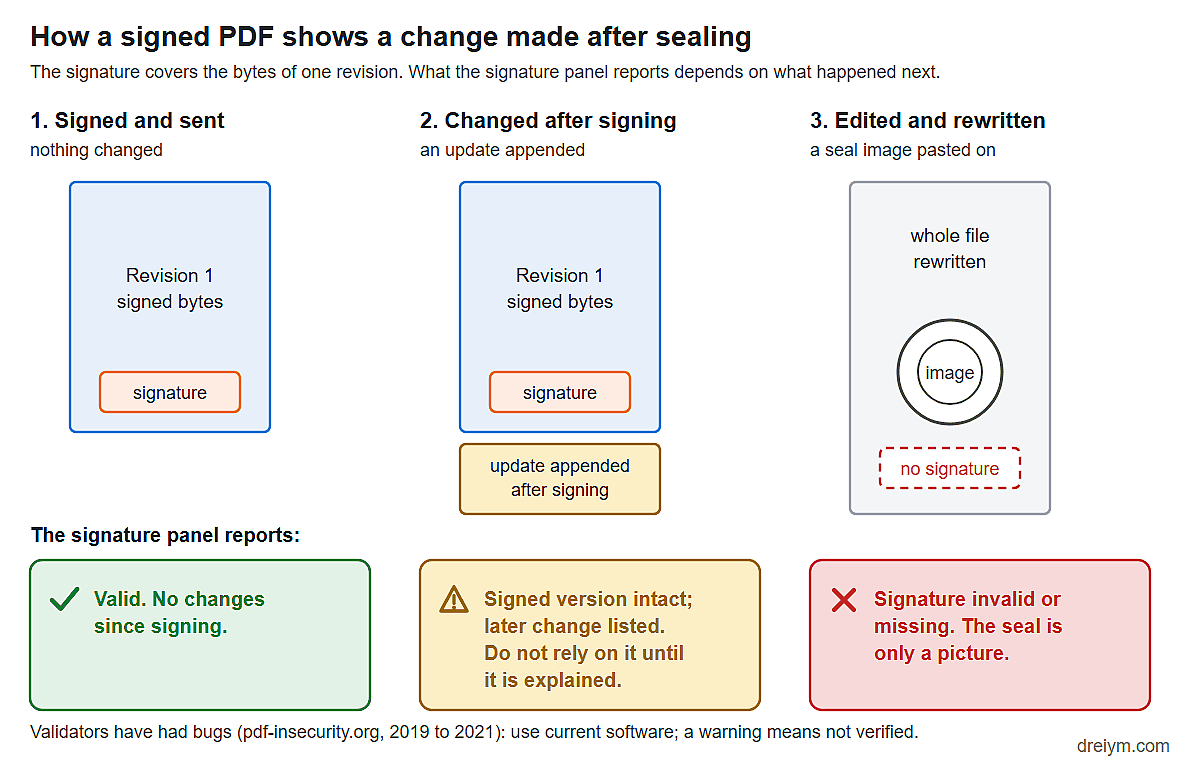
In a PDF, the signature is a container (RFC 5652) stored inside the file. Its hash covers the whole file except the slot where the signature itself sits. Later edits are appended to the end of the file, so each signature covers one revision. A validator that works properly reports any change made after signing and can show you the signed version. A change inside the signed bytes makes the signature invalid.
Say a forger gets hold of a sealed PDF. If they edit and save it, either the change is appended and the signature panel reports it, or the file is rewritten and the signature breaks or disappears. They can paste in a seal image and draw a fake signature box. What they can’t do without the engineer’s private key is make a valid signature in the engineer’s name. They can still sign validly in their own name under the engineer’s seal image, but comparing the signer’s name with the name on the seal catches that. So check the signature panel, not the picture.
Validators are software, and they’ve had bugs. In 2019 the researchers behind pdf-insecurity.org found at least one signature-forgery flaw in 21 of 22 desktop PDF viewers and in 5 of 7 online validation services. Their “shadow attacks” in 2020 worked on 15 of 28 desktop viewers, and attacks on certified documents in 2021 broke 24 of 26 applications. The vendors fixed what was reported, so validate in current software. If you get a warning, treat the signature as not verified and don’t rely on the file until the warning is resolved.
Certification signatures and long-term validation
A certification signature goes on first and sets which later changes are allowed: none at all, form filling and signatures, or those plus comments. Approval signatures can follow, for example from another discipline, a checker or a reviewing official, as long as the certification allows form filling and signatures.
Sealed documents get relied on for decades, but certificates expire after a few years. A trusted time-stamp (RFC 3161) proves when the signature existed. Without one, the signing time is just whatever the signer’s computer clock said. The validation data (the certificate chain and the revocation answers) can be embedded in the file, and PDF 2.0 has structures for that (ISO 32000-2). The European PAdES profiles (ETSI EN 319 142-1) go as far as an archive time-stamp that can be renewed as algorithms age. NIST published a post-quantum signature standard, FIPS 204, in 2024.
Without that validation data in the file, a validator may later warn that the certificate has expired or that revocation can’t be checked. That means the signature can’t be verified now, not that it’s forged. Get the record copy from the agency or the engineer.
What NCEES®, ESIGN and UETA say
The NCEES® Model Law and Model Rules
NCEES® is the national council of engineering and surveying licensing boards. Its Model Law and Model Rules aren’t law anywhere, but boards borrow from them, so many state rules share wording. We read the current editions (revised August 2026) on October 9: the Model Law (PDF) and Model Rules (PDF).
Model Rules 240.20, “Seal on Documents”, sets four tests for a digital signature, in 240.20 H of the 2026 edition. The 2019 and 2021 editions match; we read them in Pennsylvania’s reproductions, 50 Pa.B. 4245 and 52 Pa.B. 7709. The signature must be:
- unique to the licensee;
- capable of verification;
- under the licensee’s sole control; and
- linked to the document so that any change invalidates it.
The 2026 rule gives three ways to seal and sign: an ink signature with a physical or a digital seal, or a digital seal with a digital signature (240.20 G). A board-approved process “will be presumed to meet the criteria” (240.20 I); Pennsylvania left that sentence out. The rule treats a printed copy’s facsimile of the signature and seal as confirming the file wasn’t altered, and any alteration voids it. Paper can’t prove that, so the signed file is the record.
NCEES®’s Licensure Exchange has covered seal fraud since 2025, starting with the June 2025 (PDF) and August 2025 (PDF) issues, both read on October 9. Later issues took up the work-for-hire marketplace and digital fraud (October 2025, October 2026). In June, Texas board staff described seals lifted from earlier work, made with a deceased licensee’s name and number, or invented. They also floated replacing the seal with a project code checked against a central registry. In August, an Alabama board investigator added altered documents and suggested involving the state attorney general or the FTC.
ESIGN and UETA
The federal ESIGN Act (2000) and the state versions of UETA are written for transactions. The basic rule is that an electronic signature or record can’t be denied legal effect just because it’s electronic (15 U.S.C. § 7001(a)). ESIGN doesn’t change any other legal requirement, only the ones about the form that writings and signatures take (§ 7001(b)(1)). Nor does it make anyone accept electronic signatures, except a government agency dealing with records other than its own contracts (§ 7001(b)(2)). State agencies can still set the formats for filings made with them (§ 7004(a)), and court orders and official court documents are carved out (§ 7003(b)(1)).
UETA is the Uniform Law Commission’s 1999 model act, and it’s now law nearly everywhere. Washington’s 2020 bill report counted 47 states, DC and the Virgin Islands that had adopted it before Washington did (ESSB 6028). New York’s board relies on the state’s own Electronic Signatures and Records Act instead. Under UETA, each government agency decides whether, and how far, it will accept electronic signatures (Fla. Stat. § 668.50(18) is one example).
So a typed name can be a legally valid electronic signature and still fail a board’s digital-signature tests. Building departments set their own rules for what they’ll accept, and they differ from one another and from the boards. ESIGN also lets a state law other than UETA override it only if that law is technology-neutral (§ 7002(a)(2)(A)(ii)), while some board rules name a standard or a certificate authority. How those fit together is a legal question, and we don’t try to answer it here.
The rules in Texas, Louisiana, Oklahoma, New Mexico, Colorado and Florida
Most of our work is in these six states, so below we lay out each state’s rule clause by clause. The six also show how much the rules vary. Texas and Louisiana set a security standard, while Oklahoma, Colorado and Florida use the four tests. New Mexico asks only for adequate security.
Texas: 22 TAC chapter 137 and Occupations Code chapter 1001
The Texas Board of Professional Engineers and Land Surveyors (TBPELS) enforces the seal requirement. Texas plans, specifications, plats and reports must carry the seal (Tex. Occ. Code § 1001.401(b)), and nobody can seal on an expired, suspended or revoked license (§ 1001.401(c)). A public official may accept only plans whose seal shows an engineer prepared them (§ 1001.402).
Under 22 TAC § 137.33, engineers may seal only work they prepared or directly supervised (b). They must keep seals and electronic signatures secure and report a lost one in writing within 30 days (d). Before release, the engineer applies the seal and signature (or electronic seal and signature) and the date (f). For electronic delivery it requires “reasonable security measures to make the documents unalterable” (l). A local authority can still require an original seal or signature on reproductions (j).
Section 137.35(a) allows two methods for electronic documents: a secure electronic copy of a sealed paper original, or an electronic seal with an electronic signature. Under § 137.37, it’s misconduct to seal on an inactive, expired, suspended or revoked license (a)(2) or to alter a sealed document without notice (a)(3). So is letting others reach files holding their seal or electronic signature without explicit authorization (a)(4). Nobody may use a fraudulent seal (c), and unlicensed people can’t use or depict a seal without permission (b).
Presenting or using someone else’s license or seal is a Class A misdemeanor (§ 1001.552(a)(3)). The board can also fine up to $5,000 per violation, with each day a separate violation (§ 1001.502). Texas has no four-part test and doesn’t name a certificate authority. We read the rules in Cornell LII’s copy, last amended in 2022 (2008 for § 137.35). The board’s home page warns about sealed work sold on freelance marketplaces.
Louisiana: LAC 46:LXI § 2701
The Louisiana Professional Engineering and Land Surveying Board (LAPELS) puts its seal rule in LAC 46:LXI § 2701. A computer-generated seal of the board’s design is allowed ((A)(2)(e)), but it always goes with the signature and date ((A)(2)(f)). The licensee is personally responsible for the seal’s care, custody, control and use ((A)(3)(a)). If a seal is lost, the licensee reports it right away, and the board may issue a new license number.
Documents can go out electronically in a secure mode that keeps the seal, signature and date from being copied or changed ((A)(5)(a)). A sealed document that no longer needs its seal goes out with the seal removed and the board’s notice added ((A)(5)(b)). Like Texas, Louisiana has no four-part list and names no certificate authority.
A licensee can be fined up to $5,000 per violation (La. R.S. 37:698(B)). The same fine applies to a non-licensee who uses someone else’s seal or a “deceptively similar” one (37:700(A)(2), (6), (B)). If a district court finds a violation, up to three months in jail can follow (37:700(N)). Complaints must be in writing and sworn (37:698(D)(2)). We read the rule in Cornell LII’s copy, whose amendment history ends Jan. 1, 2019. The board’s home page also warns about marketplace fraud.
Oklahoma: OAC 245:15-17-2(g)
Oklahoma’s State Board of Licensure for Professional Engineers and Surveyors publishes its statute and rules on its own site. Licensees may sign electronically under their direct control and personal supervision (59 O.S. § 475.15(C)), and a digitized image of the seal is allowed (OAC 245:15-17-1(b)).
Any electronic or digital signature must be unique, verifiable and under the licensee’s sole responsibility and control (245:15-17-2(g)(1)-(3)). If it relies on an electronic authentication process, it must also be dated and verifiable as unaltered ((g)(3)(B)). A scanned original signature with a handwritten date is an allowed alternative ((g)(3)(A)).
Using someone else’s license or seal is a misdemeanor with a fine of $250 to $2,000 (§ 475.20(A)). The administrative penalty is $500 to $20,000 per violation (§ 475.20(B)). The board processes anonymous complaints. If you cite the clause, use 245:15-17-2(g); in Cornell LII’s older copy it was lettered (l). The rules we read are the version effective Sept. 1, 2026.
New Mexico: 16.39.3.12 NMAC and NMSA § 61-23-19
New Mexico’s State Board of Licensure for Professional Engineers and Professional Surveyors borrows UETA’s definition of an electronic signature (16.39.3.7(E) NMAC). Under 16.39.3.12 NMAC, electronic signatures are acceptable “as provided by law and board’s policy”, but rubber-stamp signatures aren’t (A). Computer-generated seals must be bona fide copies of the seal (B). The licensee must provide adequate security, and when more than one licensee signs, each needs their own electronic signature (H). We couldn’t find an online copy of the board policy that (A) mentions.
The statute was amended by Laws 2019, ch. 220 (SB 447, signed April 3, 2019). It requires the board to provide for the proper authentication of documents and to regulate seals, and it lets the board approve “alternative authentications to physical or electronic seals” (NMSA 1978, § 61-23-19(A), (B)). We found no sign that the board has approved any. The board’s Practice Act book (PDF), effective July 1, 2023, says it can fine a professional engineer up to $7,500 for attempting to use another’s license (§ 61-23-24(A)(2)). We didn’t read the current compiled text on NMOneSource.
Colorado: 4 CCR 730-1, Rules 1.2 and 1.5
Colorado’s board is part of the Department of Regulatory Agencies. A PE there may get a crimp, a rubber stamp or an “electronic type seal” (C.R.S. 12-120-216(1)). We read the statute in an unofficial copy; the official text is CRS 2024, Title 12 (PDF).
Under 4 CCR 730-1 (PDF), Rule 1.2(B)(17), an electronic signature must use PKI or signature dynamics technology and meet all four NCEES® tests ((b)(1)-(4)). Rule 1.5(A) sets the seal size and requires the signature and date to go through the seal ((A)(1), (A)(3)). Normally the seal goes on every drawing sheet ((A)(2)(a)). An engineer can instead put an electronic seal on the cover page(s) alone ((A)(2)(a)(1)), but then every title block has to note that the seals are on the cover page(s), all pages must be numbered, the scope must be stated, and Signature Dynamic Technology, an audited e-signature routing application (Rule 1.2), is required ((a)-(d)). Otherwise, a PKI or signature-dynamics signature that meets Rule 1.2(B)(17)(b) is enough.
It’s unlawful to use a certificate or certificate number that wasn’t issued to you (C.R.S. 12-120-205(4)). Unlawful practice draws $50 to $5,000 per violation (205(7)) and is a class 2 misdemeanor (205(6); 12-20-407). Using an expired, suspended or revoked seal is grounds for discipline (12-120-206(1)(m)). On October 9 we read the official version effective June 30, 2026; its notes date Rules 1.2(B)(17)(b) and 1.5(A) to 2020 (rule history). Colorado’s board accepts anonymous complaints.
Florida: Rule 61G15-23 and Fla. Stat. § 471.025
The Florida Board of Professional Engineers (FBPE) has the most detailed rule of any we read. Documents can be signed, dated and sealed electronically under the state’s Electronic Signature Act, and the signature, date and seal are “evidence of the authenticity” of the document (Fla. Stat. § 471.025(1)). Sealing after a license expires or is revoked or suspended is unlawful. A licensee whose license is revoked or suspended has 30 days to surrender the seal and confirm that the digital signature has been canceled (§ 471.025(2)).
A seal can be wet, embossed or digital, and must be at least 1-7/8 inches across (R. 61G15-23.002). A document signed by hand can’t carry a scanned image of the signature (23.003(1)). For the digital method, the engineer’s identity has to be authenticated by a certification authority, and the four tests apply too (23.004(2)(a)-(d)). Electronic copies carry a legend telling recipients to verify the signature (23.004(3)(d)). There’s also a hash option: each file’s SHA code (FIPS 180-4) is listed on a hand-signed, sealed report (23.005).
Florida and Oregon are the only jurisdictions whose rules require a certificate authority, and Florida alone offers a hash method that doesn’t need certificates. The statute defines a certification authority as “a person who issues a certificate” (§ 668.003(2)). The board’s guidance rules out self-signed IDs but doesn’t list any approved authorities. Passing off someone else’s license as your own is a first-degree misdemeanor (§ 471.031). Sealing work that wasn’t done under your supervision can cost up to $5,000 per count, and repeated unlicensed practice up to $25,000 (§ 471.033(1)(j), (3), (4)). As in Oklahoma and Colorado, anonymous complaints are accepted.
How the rules compare across licensing boards
This section is for board members, board staff and enforcement committees. It describes what the rules say and doesn’t recommend anything. Every count here comes from the 55 jurisdictions in the table below.
The common core
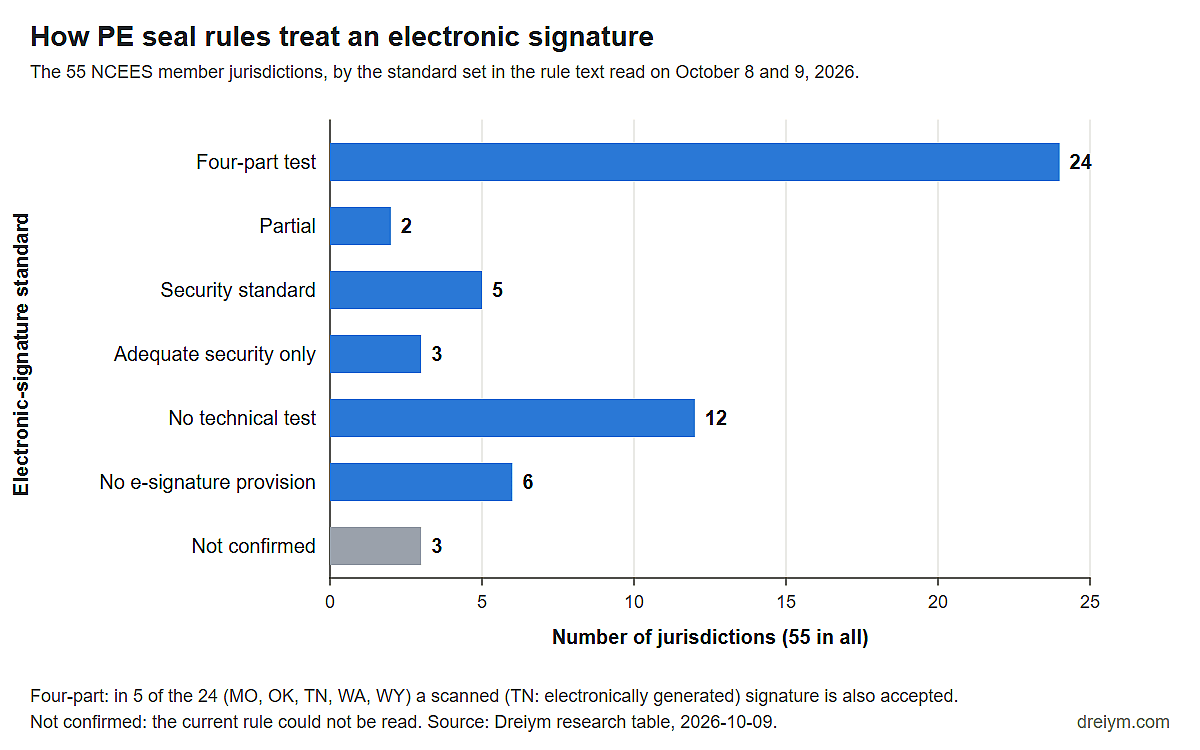
Electronic sealing is the norm. We could read the current electronic-signature text in 52 jurisdictions, and 46 of them allow an electronic signature in some form. Nearly all accept an electronic seal, but six make no provision for electronic signatures. New Hampshire allows only an impression seal or a rubber stamp. West Virginia, the Northern Mariana Islands and Guam accept an electronic seal but require a written signature (22 GCA § 32116(d)(1); NMIAC 125-20.1-805(c)). In South Carolina, the seal comes off transmitted files. Idaho allows a seal image, but its statute doesn’t define “signature”.
The four NCEES® tests are the closest thing to a common standard, and 24 jurisdictions set all four: Alaska, Arkansas, Colorado, Connecticut, Florida, Georgia, Kansas, Kentucky, Maryland, Massachusetts, Mississippi, Missouri, New Jersey, North Carolina, North Dakota, Ohio, Oklahoma, Oregon, Pennsylvania, Puerto Rico, South Dakota, Tennessee, Washington and Wyoming. Virginia sets three (unique, verifiable, direct control), and so does Alabama, whose official text stops there. Setting the tests doesn’t make a digital signature mandatory. In 5 of the 24 (Missouri, Oklahoma, Tennessee, Washington and Wyoming), the tests cover one signing method, and a scanned signature is accepted too (in Tennessee, an electronically generated one). Missouri applies the tests only to native editable files.
Five set a security standard without the four tests (Texas, Louisiana, Iowa, Nevada, Hawaii). Three ask only for adequate security (Arizona, New Mexico, Utah). Another 12 set no technical test: California’s board rule, Delaware, Illinois, Indiana, Maine, Michigan, Minnesota, Nebraska, New York, Rhode Island, Vermont and Wisconsin. In 3 we couldn’t read the current rule: the District of Columbia (a Word file we didn’t open), Montana and the U.S. Virgin Islands.
Where the rules differ
- Only Florida’s and Oregon’s rules require a certificate authority. Connecticut and New Jersey require verification by a trusted third party or another approved process. California’s Secretary of State has a separate rule for digital signatures sent to public entities: where a certificate goes with the signature, it has to come from a CA in a major root program (2 CCR 22003(a)(6)).
- Several boards add requirements of their own. Connecticut requires the NIST Digital Signature Standard, and New Jersey’s rule names FIPS 186-4 “as amended and supplemented”. North Carolina and Georgia want a secure mode plus a record of the hardware and software used. Kentucky wants changes displayed visibly and files sent read-only. Maryland requires non-repudiation, and Oregon’s seal image must include the words “digitally signed”.
- The rules also use different words for the same idea. Most say “sole control”. Washington, Maryland and Alaska use “exclusive control”, and Connecticut, New Jersey and Kentucky “direct and exclusive control”. Virginia has “direct control”; Oklahoma and Wyoming have “sole responsibility and control”. Washington calls for “independent” verification, and Oregon for verification by a third-party certificate authority.
Signature images, legends and lost seals
- A signature image is allowed in Illinois (a scan bearing an original signature), Minnesota (an accurate depiction) and Missouri (PDF only). It’s also allowed in Oklahoma (with a handwritten date), Washington (fixed over the seal), Wyoming (with the date), Tennessee (electronically generated) and Alaska (only with a digital signature). On final or original documents, a scanned or facsimile signature is barred in Oregon (OAR 820-025-0010(2)), Massachusetts, Maryland, West Virginia, North Dakota, North Carolina, Hawaii, Guam and the Northern Mariana Islands. Florida bars one on physically signed documents (23.003(1)). New Mexico, California and Nevada bar rubber-stamp signatures but don’t say anything about scans.
- Some rules say how to mark what isn’t a sealed original. South Carolina strips the seal from transmitted files, and North Carolina and Georgia strip it from editable files unless they’re digitally signed. Connecticut and Kentucky require a statement on unsigned electronic copies. Alabama, Arkansas, Louisiana and Puerto Rico prescribe legends. In Arizona, a label says where the sealed original is, and Idaho marks electronic originals “Original Signed By:”.
- Connecticut requires a lost seal or compromised key to be reported within 15 days, Texas within 30 days, and Louisiana and Alabama at once. In New Jersey, a compromised key is retired, a new key pair is made and clients are told. After a revocation or suspension, Florida requires the seal to be surrendered and the digital signature canceled. Arizona and Wyoming keep a specimen of each engineer’s seal on file.
Using another engineer’s seal
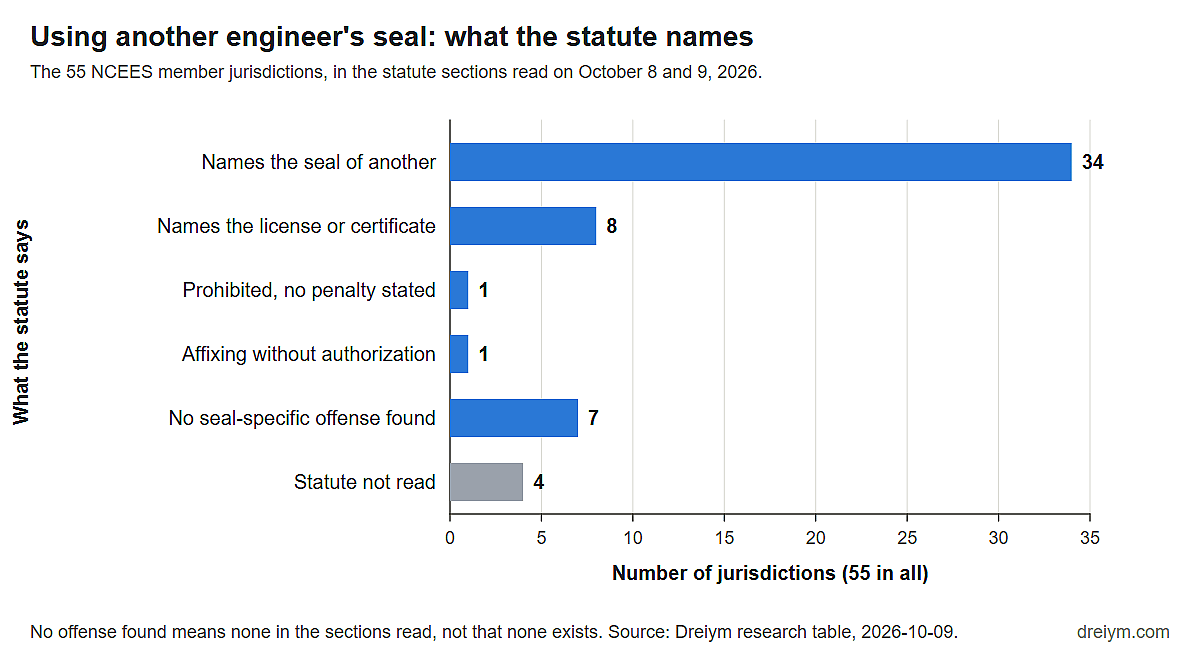
In 34 jurisdictions, the statute specifically mentions using another person’s seal. In 29 of those, misuse is a crime, either directly or through a clause that makes any violation a misdemeanor. Maine treats it as a civil violation, and Missouri and Iowa impose civil penalties. Illinois and Kentucky make it grounds for discipline. In another 8, the offense refers to the license or certificate rather than the seal (Colorado, Florida, New Jersey, New Mexico, Pennsylvania, Rhode Island, Tennessee, Wisconsin). Delaware prohibits it but states no penalty for that clause. Vermont punishes affixing a licensee’s seal without authorization (26 V.S.A. § 1188(c)). In 7, we found no seal-specific offense in the sections we read, and in 4 we didn’t read the statute.
Some go further. Alaska’s rule bars forging the seal holder’s signature, and Louisiana’s statute covers “deceptively similar” seals. Texas bars any fraudulent seal, and Oregon treats a look-alike seal as a false claim of authority. Penalties climb with repeat offenses. At the top end, West Virginia makes a second offense a felony carrying 10 to 20 years (W. Va. Code § 30-13-23). The most common cap on civil penalties is $5,000 per violation. The highest we found were Florida’s $25,000 for repeat unlicensed practice and Virginia’s $25,000 yearly cap.
What the rules expect of the people who receive sealed work
Some statutes put the first check on public officials. In Texas, an official may accept a plan only if an engineer’s seal shows an engineer prepared it, and the official has to report violations (§ 1001.553). Maryland, New York and New Jersey have similar rules (Md. Code, Bus. Occ. & Prof. § 14-4A-02(b); N.Y. Educ. Law § 7209(1); N.J.S.A. 45:8-45). Rhode Island and Wyoming tie electronic seals to whatever the recipient accepts. In Nevada, sealed documents show the license expiration date (NAC 625.610(8)(d)). Nebraska licensees have to report suspected violations within 90 days, according to the board’s summary of its 2025 rules.
The gaps fraud exploits
- Seals are public on purpose. Every permit set shows one, the rules publish the design, and anyone can find the name and number in the license lookup.
- Some jurisdictions still accept a picture of the seal, and a scan or printout carries no cryptographic proof.
- Recipients rarely validate the signature, and validation tools have had bugs. Boards often don’t control filing either. Florida’s board, for one, says filing formats are outside its jurisdiction.
- A CA certificate usually keeps validating after a license lapses. It proves who signed, but it can’t tell you whether that person’s license was active.
- Self-signed IDs and platform signatures make it hard to tell who actually signed. Some e-signature platforms seal the file with their own certificate.
- A board’s authority ends at its state line and doesn’t reach the platforms. Washington’s board notes that most boards can’t act against the websites.
- There are 55 separate license lookups and, as far as we could find, no official national one.
- Rules that name a specific standard can get left behind when it changes. On Feb. 3, 2023, FIPS 186-5 superseded FIPS 186-4, the version New Jersey’s rule names, though the rule does say “as amended and supplemented”. Florida’s rule names the 2015 FIPS 180-4 but no algorithm. That standard includes SHA-1, which NIST plans to retire by 2030 after practical collision attacks (NIST, 2022).
- Once an engineer dies or retires, their seal stays in circulation unless someone checks the license status.
- There’s little data to go on. No board we found posts a count of seal-fraud cases.
What boards and other regulators already do
Each of these is in use somewhere today. Whether one fits is each board’s call.
- Twenty-four jurisdictions set the four tests for a digital signature. Five of those also accept a scanned or electronically generated signature. Florida and Oregon add a certificate authority; Florida also offers a hash method.
- Some boards require a notice on the document: Florida’s legend tells recipients to verify the signature on electronic copies, and Oregon puts “digitally signed” in the seal image.
- Every state board has a public license lookup, linked from the NCEES® directory. In June 2026, Nebraska removed license numbers from its lookup because they were used to create or misuse seals. Staff confirm numbers on request. That costs some transparency but gives forgers less to work with.
- Locally, Miami-Dade County doesn’t accept scans of sealed documents as electronic submittals, and Wellington, Florida explains that scanning removes the digital signature.
- Every board takes complaints on its own terms (see reporting below). Florida’s board also gives building officials an investigator to contact.
- Texas, Louisiana, Washington, Nebraska, Florida and North Carolina (with its Department of Justice) have warned the public. Several tell engineers to guard their seals and keys and watch for misuse of their names.
- Boards point victims to the FBI’s IC3, the FTC and state attorneys general. One Alabama case ended in a guilty plea for identity theft.
In Canada, two regulators tie signing certificates to the license. Engineers Geoscientists Manitoba verifies applications for members’ digital signatures and can revoke them. APEGA in Alberta can revoke a signature instantly once a member’s license ends, and signatures applied before then stay valid. So a valid signature there also shows the engineer was in good standing when signing, provided a trusted time-stamp proves when that was.
The rules themselves are hard to read
The official text is often the hardest version to get to. In 22 of the 55 rows, the only copy of the rule we could read was Cornell LII’s free one; the official code was rendered only by script, blocked our reader or wasn’t among the files we read. For six statutes, the only readable versions were as they stood from 2019 to 2022, and Montana’s readable rule dates from 2006.
What PEs and engineering firms need for a digital PE stamp
Start with your own board’s rule and the rules of every board where the work will be filed. The table links each one. A digital PE stamp that meets the four tests has two parts: the seal image and a digital signature. The signature has to be unique to you, verifiable and under your sole control, and any change made after signing either invalidates it or, in a PDF, gets flagged. Florida and Oregon also require a certificate authority, and Connecticut and New Jersey a NIST standard. North Carolina and Georgia want a record of the hardware and software. The agency you file with can still set its own format.
Pennsylvania’s rule defines sole control as the licensee alone deciding when and where the seal is applied (49 Pa. Code § 37.56a). If someone on your staff applies your signature with your password, that doesn’t fit the definition.
How to apply a digital PE stamp so later changes show up
- Finish the set or report, then flatten it so no layers or form fields can change later.
- Put the seal image and the signature appearance where your board’s rule says they go, and include the date.
- Sign with a certificate from a certificate authority, not a self-signed ID. Keep the key on a token, or in a signing service that asks you to approve every use.
- If you’re the first to sign, certify the file to allow no changes. If others have to sign after you, allow only form filling and signatures.
- Add a trusted time-stamp, which proves when you signed, and embed the validation data so the signature outlives your certificate.
- Open the signed file and check the signature panel. It should show a valid signature, you as a trusted signer, a time-stamp and no changes.
- Keep the signed original, plus a log of what you sealed, for whom and when.
- Send the signed file itself. A printout, a scan or a re-exported copy doesn’t carry the signature.
Signing tools and where the key is kept
PDF software signs with a digital ID, which can be kept in one of three places. One is a password-protected digital ID file on your computer. It holds the private key, and the file can be copied. Another is a USB token or smart card, and the key can’t be copied off it. The third is a remote signing service that keeps the key in a hardware module and asks you to approve each use. The token and the signing service keep the key most clearly under your sole control.
Florida’s board doesn’t accept self-signed IDs. Some e-signature platforms seal the finished PDF with their own certificate, so the signature panel shows the platform’s name instead of yours. Whether that passes a board’s “unique” and “sole control” tests depends on the rule. We don’t recommend any products.
Protecting your seal
- Lock up physical seals, destroy old ones, and protect your digital ID (the private key) with a strong password. That’s what Florida’s board advises, though its guidance talks about password-protected certificates.
- Don’t send editable files with your seal on them. Send the signed PDF that carries your digital PE stamp.
- Every so often, search online for your name and license number, including on freelance marketplaces.
- Know your board’s rule for a lost seal. Texas wants it reported in writing within 30 days, Connecticut within 15 days, and Louisiana right away.
- If your seal turns up on work you didn’t do, tell every board involved. Florida’s and Washington’s boards also point engineers to the FBI’s IC3.
- Watch out for refund scams. Washington’s fraud alert describes fake clients who order stamped PDFs and CAD files, pay, then cancel and demand a refund before their payment clears.
How seal fraud happens and gets caught
Board pages from 2019 to 2026 describe the same few patterns. We don’t name anyone.
- Someone copies the seal and signature from a public sealed PDF onto other plans. Florida’s board described this in wireless-site permits in 2019. In an Alabama case reported in July 2024, one metal-building design was reused on many others. It’s caught when someone spots a seal on a project the engineer never saw, or a signature-panel signer who isn’t the engineer on the seal.
- A real engineer’s identity gets sold online. Marketplace sellers use a real licensee’s name, number, seal and signature, sometimes on copied or AI-generated plans. Washington, Nebraska and North Carolina warned about it in 2026. It’s caught when the engineer hears of it; sellers abroad are hard to pursue.
- The license is made up or doesn’t match: the number belongs to someone else or to nobody, though the seal may look legitimate. The board’s lookup catches it.
- A document is changed after sealing. NSPE®’s ethics column posed a hypothetical about a damage report altered this way. If the document was digitally signed, the signature panel flags the change; if not, only a comparison with the original catches it.
- An unlicensed employee uses the seal without the engineer’s knowledge, or a relative uses a deceased engineer’s seal (Florida, Washington). Audits and status checks catch this.
- The license has lapsed, is inactive or is from another state, which the lookup’s status and dates show. Only a trusted time-stamp proves the signing date. Without one, a lapsed licensee can backdate both the document’s date and the signing time, and the certificate usually still validates.
- The seal is a look-alike. Oregon treats one as a false claim of authority (OAR 820-025-0005(6)). Comparing it with the board’s design exposes it.
How often it happens
We didn’t find any board that publishes a count of seal-fraud cases. Boards describe the trend in words instead. Nebraska calls it a growing trend, and Florida says engineers are reporting more misuse of their seals. Washington calls it an issue growing across the US. We don’t try to estimate a national number.
How building officials, owners, contractors, attorneys and insurers can check a sealed document
Checking a digital PE stamp takes only a PDF reader that validates signatures, and four checks catch most forgeries. First, know what to expect: not every sealed document needs a digital signature. It depends on the jurisdiction and on what the receiving agency accepts. Texas allows a secure electronic copy of a wet-signed paper original (22 TAC § 137.35(a)(1)). Missouri and Oklahoma accept a scanned signature in some cases (20 CSR 2030-3.060(3)(C); OAC 245:15-17-2(g)(3)(A)). Florida allows a signed report listing each file’s SHA code instead of a digital signature (R. 61G15-23.005). A missing digital signature is not, by itself, evidence of forgery.
Four checks before you rely on a digital PE stamp
- Look the engineer up on the board’s own site. Use the lookup in the table, not a link from the document or seller. Check the name, number, discipline, status and expiration date against the seal and the document’s date. Nebraska’s lookup hasn’t shown license numbers since June 2026, so ask that board. This catches fake numbers, lapsed licenses and seals of deceased or retired engineers.
- If there’s a digital signature, validate it. Use a desktop PDF reader that validates signatures, not a web browser’s built-in viewer. If no signatures panel appears, try another reader before deciding the file is unsigned. You want a valid signature, a trusted signer whose name is the engineer on the seal, and no changes since signing except later signatures or form filling the signer allowed. If the panel says the signing time comes from the signer’s computer clock rather than a trusted time-stamp, the date is just the signer’s claim. A warning means not verified.
- If there is no digital signature, check the form the rule allows. If a Florida document was sealed with an SHA authentication code, run it through any standard hash tool and compare the result with the code on the sealed signature report. Compare a scan or an ink-signed copy with the agency’s record copy.
- Call the engineer, using the contact details on the board’s record, not those on the document. Ask whether they sealed this document, for this project, on this date.
Red flags, and what to do next
Nebraska’s board lists red flags: very low prices on freelance marketplaces, a seller who avoids meeting, a seal that looks altered or incomplete, a license that doesn’t verify, and little contact with the licensee. If something doesn’t add up, don’t rely on the document. Ask the engineer for the signed file, or get the agency’s record copy, then report it.
How to report a suspected forged seal
Report a forged digital PE stamp to the board of the state where the seal claims licensure. The table links each board’s complaint page or site. If the seal names an engineer licensed elsewhere, tell that board too. Fraud often crosses state lines.
Not every board takes anonymous complaints. Texas, Florida, Oregon, Colorado, Oklahoma and Wisconsin do; Washington, Maryland, North Carolina and Georgia don’t. Indiana sends complaints to its Attorney General, which doesn’t take anonymous ones, but the Professional Licensing Agency can file one on the complainant’s behalf. Hawaii sends them to its Regulated Industries Complaints Office. Louisiana requires sworn complaints, and North Dakota and West Virginia notarized ones. Alabama sets a two-year limit and Virginia a three-year one. Texas asks for complaint forms by mail, not email.
You can also try the FBI’s Internet Crime Complaint Center (IC3) and the Federal Trade Commission, both listed by Washington’s board. Your state attorney general’s consumer office is another; Nebraska’s board points there. Tell the building department that received the documents, and the marketplace that listed them. Keep the document exactly as received, with the email it came in.
When a sealed document becomes evidence
Questions about a seal often come up after a loss: a fire, an equipment failure or a construction dispute. The questions are whether the engineer named on the document actually sealed it, whether it changed after sealing, whether the license was active that day, and whether the engineering holds up.
We’re forensic and power electrical engineers with active and past licensure in multiple states, and we work in Texas, Louisiana, Oklahoma, New Mexico, Colorado and Florida. We review sealed electrical designs and reports for investigations and litigation. Our forensic electrical engineering team works for attorneys, insurers and adjusters. To retain us, submit a forensic assignment or request an expert CV and rate schedule. We’ve also written a guide to choosing an electrical and corrosion expert witness.
On licensing, see our posts on cathodic protection specialists versus licensed PEs and how to become a licensed electrical engineer.
Frequently asked questions
Is a digital PE stamp the same as a digital signature?
No. What is sold as a digital PE stamp is usually just an image of the seal. A digital signature is cryptographic proof of who signed and whether the file changed. Where a rule sets the NCEES® tests, the signature must meet them, not the image, though five such rules also accept a scanned or electronically generated signature. Many rules still allow a seal image on paper with an ink signature.
Is an electronic PE stamp accepted in every state?
Almost. Among the 52 jurisdictions we could read, 46 allow an electronic signature in some form. Of the six that don’t, New Hampshire has no electronic provision, South Carolina removes the seal from transmitted files, West Virginia requires a written signature (so do Guam and the Northern Mariana Islands), and Idaho allows a seal image without defining “signature”. If by an electronic PE stamp you mean an electronic seal, nearly every jurisdiction accepts one. Agencies can still set their own format.
Does a valid digital signature prove the license is active?
No. A certificate proves who signed, not that they’re licensed, and usually stays valid after a license lapses. Check the board’s lookup for the status on the signing date, which only a trusted time-stamp proves.
Can a building department refuse a digitally signed plan?
Yes, in many places: agencies set their own acceptance rules. Under UETA, each government agency decides whether it accepts electronic signatures, and ESIGN leaves state agencies’ filing formats alone (§ 7004(a)).
Related service
Expert reports for attorneys, insurers and owners. Consulting-only retentions are accepted.
Professional engineer seal rules in all 55 jurisdictions
There’s one row per jurisdiction, in alphabetical order, with the professional engineer seal and electronic-signature rules as we read them. The middle column summarizes the text, clause by clause. The right column links the rules we read, the license lookup and the complaint page, and gives the row’s status. “Four-part” means the rule sets all four NCEES® tests. “LII” is Cornell’s free copy of state rules, which can lag the official code. To link one row, add #rules- and the jurisdiction’s name to this page’s address, as in #rules-ohio.
Confirmed (40 rows): we read the rule, or the statute where there’s no rule. Partly confirmed (14): we couldn’t read some of the governing text. Not confirmed (1: the U.S. Virgin Islands): we couldn’t read the seal rule itself. Rows read from older code releases say so. Links marked “(PDF, not reviewed)”, “(Word file, not reviewed)” or “(not reviewed)” lead to text we didn’t open. If you spot a change, tell us and we’ll update the row.
Jump to a row by postal code: AL, AK, AZ, AR, CA, CO, CT, DE, DC, FL, GA, GU, HI, ID, IL, IN, IA, KS, KY, LA, ME, MD, MA, MI, MN, MS, MO, MT, NE, NV, NH, NJ, NM, NY, NC, ND, MP, OH, OK, OR, PA, PR, RI, SC, SD, TN, TX, VI, UT, VT, VA, WA, WV, WI, WY.
| Jurisdiction and board | What the rules say | Rules read, lookup, reporting and status |
|---|---|---|
| Alabama Alabama State Board of Licensure for Professional Engineers and Land Surveyors | Electronic seal and signature: Yes: digital signature in lieu of a handwritten one (Code § 34-11-7(c); r. 330-X-2-.01(10)) Signature test: Partial: Three of four (unique, verifiable, sole control, (b)1.-3.); the official text has no item (b)4., though (b)5. presumes a board-approved process meets ‘(b)1. through (b)4.’ Certificate authority: Not mentioned; a board-approved process is presumed compliant ((b)5.) A change invalidates the signature: Not stated: the official text lists no item (b)4. Seal or signature image: Computer-generated or facsimile seal only with the signature and date on or adjacent (330-X-11-.03(8)) Using another’s seal: Class A misdemeanor, each day separate (Code § 34-11-15(a)) | Rules read: Ala. Admin. Code r. 330-X-2-.01(10) (PDF); r. 330-X-11-.03 (PDF); Code of Ala. § 34-11-7(c) Lookup: license lookup Report: complaints Status: Confirmed. Statute: official; rules: the official Administrative Code text (PDF, read 2026-10-09; 330-X-2-.01 amended eff. Feb. 14, 2025; chapter 330-X-11 as supplemented Sept. 30, 2015). |
| Alaska State Board of Registration for Architects, Engineers, and Land Surveyors | Electronic seal and signature: Yes: electronic seal; signature image plus a digital signature (12 AAC 36.180(b), 36.185(f)(2)) Signature test: Four-part ((f)(2)(B)(i)-(iv)) Certificate authority: Not stated A change invalidates the signature: Yes, expressly ((f)(2)(B)(iv)) Seal or signature image: A signature image is allowed only together with a qualifying digital signature ((f)(2)) Using another’s seal: Misdemeanor, up to $10,000 and/or 1 year (AS 08.48.291); the rule bars forging the seal holder’s signature (12 AAC 36.185(a)(6)) | Rules read: 12 AAC 36.185; 12 AAC 36.180; AS 08.48.221 Lookup: board site (the lookup page could not be read) Report: board site (the complaint page could not be read) Status: Partly confirmed. Statute and regulation: official (12 AAC 36.185 am. April 18, 2024); board and Division pages could not be read. |
| Arizona Arizona State Board of Technical Registration | Electronic seal and signature: Yes: computer-generated seal matching the one on file; electronic signature per A.R.S. Titles 41 and 44 (R4-30-304(E), (G)) Signature test: Adequate security only (R4-30-304(G)) Certificate authority: Not stated A change invalidates the signature: Not stated Seal or signature image: Seal only by original imprint or a computer-generated match of the seal on file (R4-30-304(E)(1), (F)); specimen filed with the board (R4-30-303(B)) Using another’s seal: Class 2 misdemeanor (A.R.S. 32-125(D), 32-145) | Rules read: A.A.C. R4-30-304; A.A.C. R4-30-303; A.R.S. 32-125 Lookup: board site (the lookup page could not be read) Report: board site (the complaint page could not be read) Status: Partly confirmed. Rules: Cornell LII copy (eff. Aug. 5, 2018); statute: official; board site could not be read. |
| Arkansas Arkansas State Board of Licensure for Professional Engineers and Professional Surveyors | Electronic seal and signature: Yes: sealed electronically and signed or sent electronically in three ways (17 CAR § 285-602(d)(5)) Signature test: Four-part ((d)(5)(A)(i)-(iii)) Certificate authority: Not mentioned A change invalidates the signature: Yes, expressly ((d)(5)(A)(iii)) Seal or signature image: Digital copy of a manually signed and sealed document may be sent ((d)(5)(C)); unsigned copies carry a legend ((B)) Using another’s seal: Presenting or attempting to use the certificate of licensure or the seal of another: Class A misdemeanor, Class D felony for a second or later offense (Ark. Code § 17-30-102(b)(3)); civil penalty up to $5,000 per offense (§ 17-30-305; rule 17 CAR § 285-805) | Rules read: 17 CAR § 285-602; Ark. Code § 17-30-102 (2020 code release) Lookup: board site (the lookup page could not be read) Report: board site (the complaint page could not be read) Status: Partly confirmed. Rules: official Code of Arkansas Rules; statutes: Ark. Code §§ 17-30-102, -203, -303, -305 read in Release 78 (2020) of the official code, and in the board’s 2025 handbook (PDF, read 2026-10-09), which prints them as updated through the 2020 sessions (later amendments not checked). |
| California Board for Professional Engineers, Land Surveyors, and Geologists | Electronic seal and signature: Yes: electronically generated seal; the signature may be applied electronically (16 CCR 411(e)) Signature test: No technical test: None in the board rule; the four-part test is in Gov. Code 16.5 for documents to public entities that elect digital signatures Certificate authority: Not in the board rule; for public-entity digital signatures, a signature accompanied by a certificate must use one from a CA in one of the operating-system or browser root programs the rule names, at signing (2 CCR 22003(a)(6)); signature dynamics is a second accepted technology (22003(b)) A change invalidates the signature: Not in the board rule; Gov. Code 16.5(a)(4) for public entities Seal or signature image: Rubber-stamped signature, decals and preprinted forms prohibited (411(f)); scans not addressed Using another’s seal: Misdemeanor (B&P 6787(d)); enhanced penalties in disaster repair (B&P 6788) | Rules read: 16 CCR 411; Bus. & Prof. Code 6764; Gov. Code 16.5 Lookup: license lookup Report: complaints Status: Confirmed. Rule: Cornell LII copy (last amended 2013, operative Jan. 1, 2014); statutes: read in an unofficial copy (the official site blocked automated reading). |
| Colorado State Board of Licensure for Architects, Professional Engineers and Professional Land Surveyors | Electronic seal and signature: Yes: ‘electronic type seal’ (C.R.S. 12-120-216(1)); electronic signature by PKI or signature dynamics (Rule 1.2(B)(17)(b)) Signature test: Four-part (Rule 1.2(B)(17)(b)(1)-(4)); cover-page-only sealing requires Signature Dynamic Technology (1.5(A)(2)(a)(1)(d)) Certificate authority: Not required by name; the PKI definition refers to trusted parties (Rule 1.2(B)(17)) A change invalidates the signature: Yes, expressly (Rule 1.2(B)(17)(b)(4)) Seal or signature image: Not addressed for signatures; the seal may be crimp, rubber-stamp or computer-generated (Rule 1.5(A)(1)) Using another’s seal: Unlawful to use a certificate or certificate number not issued to one (C.R.S. 12-120-205(4)); unlawful practice: fine $50 to $5,000 per violation (12-120-205(7)) and a class 2 misdemeanor (12-120-205(6), 12-20-407); discipline for using an expired, suspended or revoked seal (12-120-206(1)(m)) | Rules read: 4 CCR 730-1, Rule 1.2(B)(17) (PDF); 4 CCR 730-1, Rule 1.5(A) (PDF); C.R.S. 12-120-216 (PDF) Lookup: license lookup Report: complaints Status: Confirmed. Rule: the official version effective June 30, 2026 (PDF, read 2026-10-09; Rules 1.2 B.17.b and 1.5 A last amended eff. Aug. 14, 2020); statutes: read in an unofficial copy of CRS 2024 (official text PDF). |
| Connecticut State Board of Examiners for Professional Engineers and Land Surveyors | Electronic seal and signature: Yes: digital signature in lieu of handwritten signature and live seal (§ 20-300-10(c)) Signature test: Four-part plus the NIST Digital Signature Standard (§ 20-300-10(c)(1)-(5)) Certificate authority: Trusted third party or other approved process ((c)(3)) A change invalidates the signature: Yes, expressly ((c)(5)) Seal or signature image: Unsigned e-copy must drop the seal and signature images or state it is not a sealed document ((c)(6)) Using another’s seal: No seal-specific offense found; knowing violation of ch. 391: up to $500 and/or 3 months (C.G.S. § 20-310); a lost or compromised key (§ 20-300-10(e)) or a lost seal ((g)) is reported within 15 days | Rules read: Regs. Conn. State Agencies § 20-300-10; C.G.S. § 20-304 Lookup: license lookup Report: complaints Status: Confirmed. Rule: Cornell LII copy (no amendment shown after March 7, 2013); statute: official. |
| Delaware Delaware Association of Professional Engineers | Electronic seal and signature: Yes by statute: seal, signature and date may be created or transmitted electronically (§ 2829(b)(2)) Signature test: No technical test: None in the statute, the DAPE bylaws or the code of ethics Certificate authority: Not mentioned A change invalidates the signature: Not stated Seal or signature image: Not addressed Using another’s seal: Using another’s seal prohibited (§ 2825(d)); § 2825 is headed ‘Unlicensed practice’ and its subsection (m) fines unlicensed practice up to $5,000, but no penalty is stated for (d) itself; licensee discipline, fines up to $5,000 (§ 2824(c)) | Rules read: 24 Del. C. § 2829; 24 Del. C. § 2830 Lookup: license lookup Report: complaints Status: Confirmed. Statute: official; no engineer regulation on the state code site; the DAPE bylaws (ratified Aug. 10, 2022) and code of ethics (amended April 8, 2026), read 2026-10-09 (PDF), add no seal design or electronic-signature condition. |
| District of Columbia Board of Professional Engineering | Electronic seal and signature: Not confirmed: the seal rule is published only as a Word file Signature test: Not confirmed Certificate authority: Not confirmed A change invalidates the signature: Not confirmed Seal or signature image: Not confirmed Using another’s seal: General penalty up to 1 year and $10,000 (D.C. Code § 47-2853.27); board fine up to $5,000; seal rule not read | Rules read: 17 DCMR § 1516 (Word file, not reviewed); D.C. Code § 47-2853.27 Lookup: license lookup Report: complaints Status: Partly confirmed. Statute: official; 17 DCMR §§ 1516, 1517, 1599 exist officially only as Word files and no readable copy was found. |
| Florida Florida Board of Professional Engineers | Electronic seal and signature: Yes: digital signature (23.004) or a SHA authentication code listed on a wet-signed ‘signature report’ (23.005) Signature test: Four-part plus a certification authority (23.004(2)); or a FIPS 180-4 hash on a sealed signature report (23.005) Certificate authority: Required: identity authenticated by a certification authority (23.004(2)) A change invalidates the signature: Yes, expressly (23.004(2)(d)); a changed file no longer matches its hash (23.005(3)(e)) Seal or signature image: Scanned or copied signature image prohibited on physically signed documents (23.003(1)) Using another’s seal: Names the license: first-degree misdemeanor (Fla. Stat. § 471.031); discipline up to $5,000 per count (§ 471.033) | Rules read: Fla. Admin. Code R. 61G15-23.004; Fla. Admin. Code R. 61G15-23.005; Fla. Stat. § 471.025 Lookup: license lookup Report: complaints Status: Confirmed. Rule: Cornell LII copy (effective dates checked against flrules.org); statute: official. |
| Georgia Georgia Professional Engineers and Land Surveyors Board | Electronic seal and signature: Yes: electronic signature meeting r. 180-12-.02(9); otherwise the seal is removed from transmitted editable files (.02(8)) Signature test: Four-part plus a secure mode and a hardware and software list (180-12-.02(9)) Certificate authority: Not mentioned A change invalidates the signature: Yes, expressly ((9)(d)) Seal or signature image: Scans of wet-sealed originals may circulate (.02(8)) Using another’s seal: Presenting or attempting to use as one’s own the certificate, license or seal of another: misdemeanor, each day or occurrence a separate offense (O.C.G.A. § 43-15-30); affixing a seal contrary to § 43-15-22 is a ground for discipline (§ 43-15-19) | Rules read: Ga. Comp. R. & Regs. r. 180-12-.02; O.C.G.A. §§ 43-15-22, -30 (2022 code release) Lookup: license lookup Report: complaints Status: Partly confirmed. Rule: Cornell LII copy (official site could not be read); statute: O.C.G.A. §§ 43-15-19, -22, -30 read in Release 86 (Nov. 2022) of the official code (later amendments not checked). |
| Guam Guam Board of Registration for Professional Engineers, Architects and Land Surveyors | Electronic seal and signature: No: a written signature and date go beside the seal; facsimile signatures and computer-generated signatures and dates are not acceptable (22 GCA § 32116(d)(1)) Signature test: No e-signature provision: None (a written signature is required; computer-generated signatures are not acceptable, § 32116(d)(1)) Certificate authority: Not mentioned A change invalidates the signature: Not addressed Seal or signature image: The seal may be an image, imprint or other medium the board approves and must make a permanent mark (§ 32116(d)(1)-(2); 25 GAR § 1109); facsimile signatures are not acceptable (§ 32116(d)(1)) Using another’s seal: Presenting or attempting to use the certificate of registration or the seal of another: a petty misdemeanor for a first offense, a third-degree felony for a second or later (22 GCA § 32122(b)(1)); the board may also levy a civil penalty on a non-licensee for it, which the compiled text sets at not less than $5,000 per offense (§ 32122(a)(1)(C), (a)(2)) | Rules read: 22 GCA §§ 32116, 32122 (PDF); 25 GAR § 1109 (PDF) Lookup: official roster search Report: board contact page (no complaint page found) Status: Confirmed. Statute and regulations: the Compiler of Laws texts of 22 GCA ch. 32 (latest amendment shown: P.L. 33-028, May 7, 2015) and 25 GAR ch. 1 (PDF, read 2026-10-09); the 1974 Rules of Professional Conduct also read as HTML. |
| Hawaii Board of Professional Engineers, Architects, Surveyors and Landscape Architects | Electronic seal and signature: Yes: an original or a digital signature; rubber signature stamps and other facsimile signatures are prohibited (HAR 16-115-9(e)) Signature test: Security standard: Digital signature generated and authenticated by public encryption, verifying the document’s contents and the sender’s identity (16-115-2); no four-part list Certificate authority: Not named; the definition calls for public encryption (16-115-2) A change invalidates the signature: Not stated as such; the digital signature verifies the document’s contents (16-115-2) Seal or signature image: Rubber signature stamps and other facsimile signatures prohibited (16-115-9(e)); a legible, reproducible seal or stamp (16-115-8(a)) Using another’s seal: A criminal penalty in HRS 464-14(a), read only in a summary (wording not verified) | Rules read: HAR 16-115-9(e) (PDF); HRS 464-11 (read only in a summary) Lookup: license lookup Report: complaints Status: Partly confirmed. Rules: HAR ch. 16-115 as amended and compiled Sept. 22, 2023, read 2026-10-09 in the department’s posted copy (PDF, marked ‘Unofficial Copy’); statutes read only in a summary (wording not verified). |
| Idaho Idaho Board of Licensure of Professional Engineers and Professional Land Surveyors | Electronic seal and signature: Seal: electronically generated image allowed (Idaho Code 54-1215(3)(a)); no electronic-signature provision found Signature test: No e-signature provision: None found in the statute or the current rule (IDAPA 24.32.01.200.01) Certificate authority: Not stated A change invalidates the signature: Not stated Seal or signature image: Not addressed; electronic originals carry ‘Original Signed By:’ and ‘Date Original Signed:’ (54-1215(3)(c)) Using another’s seal: Misdemeanor (Idaho Code 54-1222); administrative penalty up to $5,000 (54-1220) | Rules read: Idaho Code 54-1215(3); IDAPA 24.32.01.200.01 (PDF) Lookup: license lookup Report: complaints Status: Confirmed. Statute: official; rule: the current official IDAPA 24.32.01 (sections dated July 1, 2025), PDF read 2026-10-09; the board’s 2026 guidance documents (PDF) not read. |
| Illinois Illinois Department of Financial and Professional Regulation | Electronic seal and signature: Yes: computer-generated seal and signature at the licensee’s discretion (225 ILCS 325/14) Signature test: No technical test: None Certificate authority: Not mentioned A change invalidates the signature: Not required; the sealing engineer is not responsible for unauthorized later changes (325/15(d)) Seal or signature image: Allowed: a scanned copy bearing an original signature (325/14) Using another’s seal: Discipline, fine up to $10,000 (325/24(a)(16)); a non-licensee violating the Act: Class A misdemeanor, then Class 4 felony (325/20.10(e)) | Rules read: 225 ILCS 325/14; 68 Ill. Adm. Code 1380.295 Lookup: license lookup Report: complaints Status: Confirmed. Statute and rule: ILGA HTML (the site notes it is not the official text). |
| Indiana Indiana State Board of Registration for Professional Engineers | Electronic seal and signature: Yes: electronically applied seal; electronic signature in UETA terms (864 IAC 1.1-7-2(b), 1.1-7-3(b)) Signature test: No technical test: None (intent to sign) Certificate authority: Not mentioned A change invalidates the signature: Not stated Seal or signature image: Not addressed (‘other signature recognized under Indiana law’) Using another’s seal: Statute (IC 25-31-1) not read | Rules read: 864 IAC 1.1-7-2; 864 IAC 1.1-7-3 Lookup: license lookup Report: complaints Status: Partly confirmed. Rules: Cornell LII copy (readopted 2024); Indiana Code not readable as HTML. |
| Iowa Iowa Engineering and Land Surveying Examining Board | Electronic seal and signature: Yes, if protected by a UETA ‘security procedure’ such as digital signature technology (r. 193C-6.1(8)) Signature test: Security standard: Security procedure adequate to verify the signer and to detect later changes (6.1(8)(1)-(2)) Certificate authority: Not named; ‘digital signature technology’ is the example given A change invalidates the signature: Yes, in substance: later changes must be detectable (6.1(8)(2)) Seal or signature image: Computer-generated seals allowed on final original documents (6.1(7)); paper official copies need an original ink signature (6.1(4)); by statute a legible rubber stamp or other facsimile of the seal has the same effect as the seal (§ 542B.16(1)) Using another’s seal: A non-licensee who presents or attempts to use the certificate of licensure or the seal of a licensee faces a board civil penalty of up to $1,000 per offense, each day separate (Iowa Code § 542B.27(1)(c), (2)); presenting another’s certificate as one’s own is a fraudulent practice (§ 542B.25); improper seal use is grounds for discipline (r. 193C-6.1(6)) | Rules read: Iowa Admin. Code r. 193C-6.1; Iowa Code §§ 542B.16, 542B.27 (PDF) Lookup: board site (the lookup page could not be read) Report: board site (the complaint page could not be read) Status: Partly confirmed. Rule: Cornell LII copy (eff. April 10, 2024); statute: Iowa Code 2026 ch. 542B (official PDF, read 2026-10-09); board site could not be read. |
| Kansas Kansas State Board of Technical Professions | Electronic seal and signature: Yes: digital seal and authenticated digital signature (K.A.R. 66-6-1(a), (b)) Signature test: Four-part ((b)(3)(A)-(D)) Certificate authority: Not mentioned A change invalidates the signature: Yes, expressly: an altered document’s signature, date and seal are void ((b)(4)) Seal or signature image: Seal may be a rubber stamp, an embossed seal or a digital seal (K.A.R. 66-6-1(a)); the signature across it is handwritten or an authenticated digital signature ((b)(1)); a scanned signature image is not addressed Using another’s seal: Class A misdemeanor (K.S.A. 74-7029(a)) | Rules read: K.A.R. 66-6-1; K.S.A. 74-7023(d) Lookup: license lookup Report: board site (the complaint page could not be read) Status: Confirmed. Rule: Cornell LII copy (eff. Dec. 4, 2020); statute: official. |
| Kentucky Kentucky State Board of Licensure for Professional Engineers and Land Surveyors | Electronic seal and signature: Yes: digital signature in place of original seal, signature and date (Sec. 3) Signature test: Four-part: Six conditions: four-part plus visible display of changes and read-only transmission (Sec. 3(1)-(6)) Certificate authority: Not mentioned A change invalidates the signature: Yes, expressly (Sec. 3(4)-(5)) Seal or signature image: Computer facsimiles allowed on copies other than the one original (Sec. 2(2)); unsigned e-copies say they are not a certified document (Sec. 4(1)); by statute, reproduction of original signatures is adequate for the certification (KRS 322.340(3)) Using another’s seal: Presenting or attempting to use as one’s own the license, seal or stamp of another, or applying another engineer’s seal, stamp, signature or title block, is a ground for discipline (KRS 322.180); any violation of the chapter: $100 to $1,000 and/or up to 3 months (KRS 322.990) | Rules read: 201 KAR 18:104; KRS 322.180, 322.340, 322.990 (2022 code release); KRS 322.340 (PDF) Lookup: license lookup Report: complaints Status: Partly confirmed. Rule: official HTML; statutes: KRS 322.340 in the official text (PDF, read 2026-10-09; effective July 14, 2000); KRS 322.180 and 322.990 read in Release 87 (Oct. 2022) of the official code (later amendments not checked). |
| Louisiana Louisiana Professional Engineering and Land Surveying Board | Electronic seal and signature: Yes: transmission ‘in a secure mode’; computer-generated seals (LAC 46:LXI § 2701(A)(2)(e), (A)(5)(a)) Signature test: Security standard: Secure mode that precludes the seal, signature and date being reproduced or modified ((A)(5)(a)) Certificate authority: Not mentioned A change invalidates the signature: Not stated as such; the secure mode must preclude modification ((A)(5)(a)) Seal or signature image: Not addressed Using another’s seal: Non-licensee using another’s or a deceptively similar seal: fine up to $5,000; misdemeanor up to 3 months on a court finding (La. R.S. 37:700(A)(2), (6), (B), (N)); licensee fine up to $5,000 (37:698(B)) | Rules read: LAC 46:LXI § 2701; La. R.S. 37:700 Lookup: license lookup Report: complaints Status: Confirmed. Rule: Cornell LII copy (history ends LR 45:77, Jan. 1, 2019); statute: official. |
| Maine State Board of Licensure for Professional Engineers | Electronic seal and signature: Yes: electronically generated seal image; UETA electronic signature (ch. 2 § 9(1), (3)) Signature test: No technical test: None beyond the UETA definition (10 M.R.S. § 9402(8)) Certificate authority: Not mentioned A change invalidates the signature: Not stated; revisions must be described and dated (§ 9(10)) Seal or signature image: Electronically generated seal image is an accepted seal form (§ 9(1)) Using another’s seal: Civil violation, fine up to $10,000 (32 M.R.S. § 1256) | Rules read: 02-322 C.M.R. ch. 2, § 9 (Word file); 32 M.R.S. § 1355 Lookup: license lookup Report: complaints Status: Confirmed. Rule: the official Word file of 02-322 ch. 2 (read 2026-10-09; the seal rule is § 9); statute: official. |
| Maryland State Board for Professional Engineers, Maryland Department of Labor | Electronic seal and signature: Yes: a qualifying digital signature counts as an ‘original signature’ (COMAR 09.23.03.09E(2)); seal facsimile allowed (§ 14-4A-02(a)(2)) Signature test: Four-part variant: unique ID, exclusive control, non-repudiable and independently verifiable, linked (09E(2)(b)) Certificate authority: Not mentioned A change invalidates the signature: Yes, in effect: a later change means the document is no longer the licensee’s (09E(2)(b)(iv)) Seal or signature image: Seal facsimile allowed; the signature must be ink or a qualifying digital signature Using another’s seal: Only a PE may use a seal (§ 14-504); misdemeanor up to $500 and/or 6 months, board fine up to $5,000 (§ 14-508) | Rules read: COMAR 09.23.03.09; COMAR 09.23.03.10; Bus. Occ. & Prof. § 14-4A-02 Lookup: license lookup Report: complaints Status: Confirmed. Rule and statute: official. |
| Massachusetts Board of Registration of Professional Engineers and Land Surveyors | Electronic seal and signature: Yes: digitized seal; ‘properly encrypted digital Signature’ (250 CMR 5.03(2), (6)) Signature test: Four-part variant: uniquely associated, authenticable by the recipient, change invalidates (5.03(11)); key custody duty (5.03(8)-(9)) Certificate authority: Not mentioned A change invalidates the signature: Yes, expressly (5.03(11)) Seal or signature image: A facsimile signature stamp does not comply (c. 112, § 81M) Using another’s seal: $100 to $500 and/or 3 months (c. 112, § 81T) | Rules read: 250 CMR 5.03; M.G.L. c. 112, § 81M Lookup: board site (the lookup page could not be read) Report: board site (the complaint page could not be read) Status: Confirmed. Rule: Cornell LII copy (no effective date shown); statute: official. |
| Michigan Michigan Board of Professional Engineers | Electronic seal and signature: Yes: ‘seal’ and ‘signature’ include electronic ones by statutory definition (MCL 339.2007(3)) Signature test: No technical test: None (intent to sign); the licensee keeps the seal secure (R 339.16032(2)) Certificate authority: Not mentioned A change invalidates the signature: Not stated Seal or signature image: ‘Seal’ and ‘signature’ include ones created by electronic or optical means and affixed electronically (MCL 339.2007(3)); a scanned signature image is not addressed Using another’s seal: No seal-specific offense found; no one may apply a licensee’s seal or signature after the license has expired or been suspended or revoked (MCL 339.2007(2)), under the act’s general penalties (339.602, 339.604): licensee fine up to $10,000; unlicensed practice a misdemeanor (339.601(7)) | Rules read: MCL 339.2007; Mich. Admin. Code R 339.16032 Lookup: license lookup Report: complaints Status: Confirmed. Statute: official; rule: Cornell LII copy (eff. May 2, 2023). |
| Minnesota Minnesota Board of Architecture, Engineering, Land Surveying, Landscape Architecture, Geoscience and Interior Design | Electronic seal and signature: Yes: electronic (UETA), facsimile or digital certification and signature; the seal itself is optional (R. 1800.4200, subp. 1; § 326.12) Signature test: No technical test: None (an accurate depiction of the actual signature, § 326.12, subd. 3) Certificate authority: Not mentioned A change invalidates the signature: Not stated; a certification signature may not be removed (R. 1800.4200, subp. 5) Seal or signature image: Allowed if an accurate depiction of the actual signature (§ 326.12, subd. 3) Using another’s seal: No criminal provision found (§ 326.18 repealed 2001); civil penalty up to $10,000 (§ 326.111, subd. 6) | Rules read: Minn. Stat. § 326.12, subd. 3; Minn. R. 1800.4200 Lookup: board site (the lookup page could not be read) Report: board site (the complaint page could not be read) Status: Confirmed. Statute and rule: official Revisor HTML; board website not read. |
| Mississippi Mississippi Board of Licensure for Professional Engineers and Surveyors | Electronic seal and signature: Yes: drawings, reports, documents and digitally delivered work products may use electronic or digital signatures and seals (Rule 6.2, Seal on Documents (d)); where a rule requires a signature, an electronic or digital one is acceptable (Rule 1.2) Signature test: Four-part, for every electronic or digital signature (Rule 6.2, Seal on Documents (d)(1)-(4)) Certificate authority: Not mentioned A change invalidates the signature: Yes, expressly (Rule 6.2 (d)(4)); any alteration of the file voids the facsimile of the signature on a printout ((d)) Seal or signature image: A printout of the signed file bears a facsimile of the signature and seal and confirms the file was not altered after signing; any alteration voids the facsimile (Rule 6.2 (d)); a seal is ‘a symbol, image, or list of information’ (Rule 1.2) Using another’s seal: Presenting or attempting to use as one’s own the certificate or seal of another: misdemeanor, $100 to $5,000 plus costs and/or up to 3 months (Miss. Code § 73-13-39); only the licensee to whom a seal was issued may stamp with it (§ 73-13-29); board penalty $100 to $5,000 per violation (§ 73-13-37); the rules repeat the bar on using the seal of another (Rule 1.3) and bar letting others possess or use one’s seal (Rule 6.2, Seal Care and Custody) | Rules read: 30 Miss. Admin. Code Pt. 901, R. 6.2 (PDF); Miss. Code §§ 73-13-29, -39 (2019 code release) Lookup: license lookup Report: complaints Status: Partly confirmed. Statute: Miss. Code §§ 73-13-29, 73-13-37, 73-13-39 read in Release 73 (2019) of the official code (later amendments not checked); rules: the official PDF effective Nov. 21, 2025, read 2026-10-09; board guidance read. |
| Missouri Missouri Board for Architects, Professional Engineers, Professional Land Surveyors, and Professional Landscape Architects | Electronic seal and signature: Yes, with criteria by file type (20 CSR 2030-3.060(3)(B)-(C)) Signature test: Four-part for native editable files ((3)(B)); none for PDF, where a scanned signature suffices ((3)(C)) Certificate authority: Not mentioned A change invalidates the signature: Yes for native files ((3)(B)); not for PDF Seal or signature image: Allowed on PDF and similar not-easily-altered files if an accurate depiction ((3)(C)) Using another’s seal: Civil penalty up to $5,000 per offense through the Administrative Hearing Commission (RSMo §§ 327.076(2), 327.077(2)); unlicensed practice a class A misdemeanor (327.076(1)) | Rules read: 20 CSR 2030-3.060; RSMo § 327.411 Lookup: license lookup Report: complaints Status: Confirmed. Statute: official; rule: Cornell LII copy (amended eff. Oct. 1, 2018). |
| Montana Montana Board of Professional Engineers and Professional Land Surveyors | Electronic seal and signature: Yes in the 2006 LII text: electronic reproduction of the seal and a digital signature (ARM 24.183.511(3)-(4)); current official text not read Signature test: Not confirmed: the only readable copy (Cornell LII, 2006 text) sets all four tests ((4)(b)(i)-(iv)); the current official text could not be read Certificate authority: Not stated A change invalidates the signature: Not confirmed (yes in the 2006 text, (4)(b)(iv)) Seal or signature image: Not addressed Using another’s seal: No Montana-specific offense found for using another’s seal; discipline (MCA 37-1-316, 37-67-331) | Rules read: ARM 24.183.511; MCA 37-67-314 Lookup: license lookup Report: complaints Status: Partly confirmed. Statute: official (MCA 2025); rule: Cornell LII copy last amended 2006, probably superseded by a 2016 version. |
| Nebraska Nebraska Board of Engineers and Architects | Electronic seal and signature: Yes (board FAQ); the rule recognizes computer-generated and electronically produced seals and signatures (110 NAC 6.1.3, 6.1.8) Signature test: No technical test: None (legibility and adequate security, 6.1.8) Certificate authority: Not mentioned A change invalidates the signature: Not stated Seal or signature image: Not addressed Using another’s seal: Class I misdemeanor, then Class IV felony (Neb. Rev. Stat. § 81-3442); civil penalty up to $10,000 (§ 81-3444(2)) | Rules read: 110 Neb. Admin. Code ch. 6, § 1; Neb. Rev. Stat. § 81-3437.01 Lookup: license lookup Report: complaints Status: Confirmed. Statute: official (as amended by LB1212, operative July 18, 2026; the board’s notice says effective July 17, 2026); rule: Cornell LII copy (eff. March 16, 2024), and the board’s summary of the rule changes effective Nov. 25, 2025 lists only one chapter 6 change (new 6.1.5.1, sealing large specifications); the official 110 NAC text is PDF. |
| Nevada Nevada State Board of Professional Engineers and Land Surveyors | Electronic seal and signature: Yes, conditionally: electronically prepared seal and digital signature (NAC 625.610(10)) Signature test: Security standard: Encryption that identifies the licensee and tracks later changes; licensee believes protections are adequate ((10)(a)-(b)) Certificate authority: Not stated A change invalidates the signature: Tracks changes after issue; does not say a change invalidates ((10)(a)) Seal or signature image: Not addressed; a stamp may not produce the signature (610(4)) Using another’s seal: Gross misdemeanor (NRS 625.520(1)(c), (5)); civil penalty up to $15,000 (625.590) | Rules read: NAC 625.610; NRS 625.383 Lookup: license lookup Report: complaints Status: Confirmed. Rule and statute: official (NAC rev. Aug. 26, 2026; NRS rev. April 15, 2026). |
| New Hampshire Board of Professional Engineers | Electronic seal and signature: No provision found: impression seal or rubber stamp only Signature test: No e-signature provision: None (no electronic seal or signature provision in RSA 310-A or Eng 100-500) Certificate authority: Not mentioned A change invalidates the signature: Not addressed Seal or signature image: Not addressed Using another’s seal: Class B misdemeanor; felony for a business organization (RSA 310-A:25) | Rules read: Eng 308.02; RSA 310-A:18 Lookup: board site (the lookup page could not be read) Report: board site (the complaint page could not be read) Status: Confirmed. Rule and statute: official (Eng 308.02 eff. June 25, 2024; RSA 310-A:18 as amended through 2025); absence of an e-seal provision confirmed in the texts read. |
| New Jersey State Board of Professional Engineers and Land Surveyors | Electronic seal and signature: Yes: digital signature and seal carry the weight of handwritten signature and impression seal (13:40-8.1A(a)) Signature test: Four-part plus NIST FIPS 186-4, read-only transmission and a retained copy (8.1A(a)-(b)) Certificate authority: Trusted third party or other approved process ((a)1.ii) A change invalidates the signature: Yes, expressly ((a)1.iv, (a)2) Seal or signature image: Rubber-stamp facsimile of the seal not permitted (8.1(a)) Using another’s seal: Names the license: $200 first offense, $500 later (N.J.S.A. 45:8-39); civil penalty up to $10,000 / $20,000 (45:1-25) | Rules read: N.J.A.C. 13:40-8.1A; N.J.A.C. 13:40-8.1; N.J.S.A. 45:8-36 Lookup: board site (the lookup page could not be read) Report: board site (the complaint page could not be read) Status: Confirmed. Rule: Cornell LII copy (13:40-8.1A adopted eff. Nov. 16, 2015, 47 N.J.R. 2874(a); amended eff. Jan. 6, 2020, 52 N.J.R. 46(a)); statute: official. |
| New Mexico New Mexico State Board of Licensure for Professional Engineers and Professional Surveyors | Electronic seal and signature: Yes: electronic signature ‘as provided by law and board’s policy’ (16.39.3.12(A), (H)); computer-generated facsimile seal ((B)) Signature test: Adequate security only ((H)); each licensee needs an independent electronic signature Certificate authority: Not stated A change invalidates the signature: Not stated Seal or signature image: Rubber-stamp signatures not acceptable ((A)); scans not addressed Using another’s seal: A professional engineer who attempted to use the license of another may be fined up to $7,500 and disciplined (NMSA 61-23-24(A)(2)); any violation of the Act is a misdemeanor, up to $7,500 and/or 1 year (61-23-24(I)); the board may fine an unlicensed person up to $7,500 per violation (61-23-23.1(B)); as of July 1, 2023 | Rules read: 16.39.3.12 NMAC; 16.39.3.7(E) NMAC; NMSA 61-23-19, 61-23-24 (2023 Practice Act book) (PDF) Lookup: license lookup Report: complaints Status: Partly confirmed. Rules: official HTML (16.39.3.12 last amended Dec. 16, 2022); statute: NMSA 61-23 as printed in the board’s Practice Act book effective July 1, 2023 (PDF, read 2026-10-09; 61-23-19(B) as amended by Laws 2019, ch. 220); later amendments and the current compiled text not read. |
| New York State Board for Engineering, Land Surveying and Geology, New York State Education Department | Electronic seal and signature: By statute and board guidance, not rule: ‘authorized facsimile’ (§ 7209(1)); Guideline 3 accepts an electronic seal and an ESRA e-signature Signature test: No technical test: None in statute or rule; guidance relies on the state ESRA (not read) Certificate authority: Not mentioned A change invalidates the signature: Not stated for e-signatures; statutory ‘altered by’ procedure for any change (§ 7209(2)(a)) Seal or signature image: Statute speaks of an ‘authorized facsimile of the signature’ (§ 7209(1)) Using another’s seal: No seal-specific offense found; unauthorized practice or a fraudulent license or permit: class E felony (Educ. Law § 6512); misconduct fine up to $10,000 (§ 6511) | Rules read: Educ. Law § 7209; 8 NYCRR § 68.13; NYSED Practice Guideline 3 Lookup: license lookup Report: complaints Status: Confirmed. Statute and rule: NYSED HTML copies; electronic acceptance from board guidance, not a rule. |
| North Carolina North Carolina Board of Examiners for Engineers and Surveyors | Electronic seal and signature: Yes, for files sent beyond the licensee’s control, if digitally signed; otherwise the seal is removed and a ‘not a certified document’ statement added (.1103(d)) Signature test: Four-part plus a secure mode and a hardware and software list (.1103(e)); board may approve a process (.1103(f)) Certificate authority: Not mentioned; the board may approve a process (.1103(f)) A change invalidates the signature: Yes, expressly ((e)(4)) Seal or signature image: Facsimile signature not acceptable on originals (.1103(a)(3), (b)(3)); scans of wet-signed originals may circulate (.1103(d)) Using another’s seal: Class 2 misdemeanor (G.S. 89C-23); civil penalty up to $5,000 (89C-21) | Rules read: 21 NCAC 56 .1103; G.S. 89C-16 Lookup: license lookup Report: complaints Status: Confirmed. Rule: official OAH HTML (last amended Aug. 1, 2011); statute: official; the board’s Notice of Text for .0901 and .1103, dated May 18, 2026, is a PDF (not reviewed). |
| North Dakota North Dakota State Board of Registration for Professional Engineers and Land Surveyors | Electronic seal and signature: Yes: electronic seals and electronic signatures (28-02.1-08-02(2)-(3)) Signature test: Four-part (08-02(3)) Certificate authority: Not mentioned A change invalidates the signature: Yes, expressly (08-02(3)); others may not change sealed final documents (08-03(6)) Seal or signature image: Rubber-stamp or facsimile signature not allowed (08-02(3)) Using another’s seal: Presenting or attempting to use the certificate of registration or the seal of another: class B misdemeanor (N.D.C.C. § 43-19.1-31) | Rules read: N.D. Admin. Code 28-02.1-08-02; N.D. Admin. Code 28-02.1-08-03; N.D.C.C. §§ 43-19.1-21, -31 (PDF) Lookup: license lookup Report: complaints Status: Confirmed. Rules: Cornell LII copy (08-02 eff. Oct. 1, 2021; 08-03 eff. Jan. 1, 2024); statutes: the current official chapter 43-19.1 (PDF, read 2026-10-09). |
| Northern Mariana Islands CNMI Board of Professional Licensing | Electronic seal and signature: No: the seal may be an electronically digitized seal, but the signature must be original; a facsimile or electronically digitized signature is not acceptable (NMIAC 125-20.1-805(a), (c)) Signature test: No e-signature provision: None (an original signature is required; a facsimile or electronically digitized signature is not acceptable, 125-20.1-805(c), -020(hhh)) Certificate authority: Not mentioned A change invalidates the signature: Not addressed Seal or signature image: Rubber-stamp, electronically digitized or metal impression seal (125-20.1-805(a)); a facsimile or electronically digitized signature is not acceptable (805(c)) Using another’s seal: Statute not read; by regulation, using or attempting to use as one’s own the seal, license or certificate of another is a ground for board action (125-20.1-1001(a)(8)), and a licensee may let no one else use the seal (125-20.1-805(e)) | Rules read: 4 CMC 3217 (PDF, not reviewed); NMIAC 125-20.1-805 (PDF) Lookup: board site (the lookup page could not be read) Report: board contact page Status: Partly confirmed. Regulations: NMIAC 125-20.1 as compiled by the Law Revision Commission on July 28, 2018 (the board’s PDF, read 2026-10-09; later amendments not checked, as the Commission’s current PDF did not load); statute PDF only, not read. |
| Ohio Ohio State Board of Registration for Professional Engineers and Surveyors | Electronic seal and signature: Yes by statute: computer-generated seal and electronic signature and date (Ohio Rev. Code § 4733.14) Signature test: Four-part (4733-23-01(D)) Certificate authority: Not mentioned A change invalidates the signature: Yes, expressly (4733-23-01(D)) Seal or signature image: Computer-generated seal with an electronic signature and date (Ohio Rev. Code § 4733.14; Ohio Adm. Code 4733-23-01(A)); a scanned signature image is not addressed Using another’s seal: $100 to $500 and/or up to 90 days (Ohio Rev. Code §§ 4733.22, 4733.99(A)); board fine on an applicant or registrant up to $1,000 per offense (4733.20(F)(2)) | Rules read: Ohio Adm. Code 4733-23-01; Ohio Rev. Code § 4733.14 Lookup: license lookup Report: complaints Status: Confirmed. Statute and rule: official. |
| Oklahoma State Board of Licensure for Professional Engineers and Surveyors | Electronic seal and signature: Yes: electronic or digital signature (OAC 245:15-17-2(g)); digitized seal image (17-1(b)) Signature test: Four-part: unique, verifiable and under the licensee’s sole responsibility and control for every electronic or digital signature (17-2(g)(1)-(3)); the requirement that the document can be verified as unaltered is stated for a signature with an electronic authentication process ((g)(3)(B)); a scanned signature with an original handwritten date is an alternative ((g)(3)(A)) Certificate authority: Not mentioned A change invalidates the signature: Yes, in substance, for a signature with an electronic authentication process ((g)(3)(B)); not for a scanned signature with a handwritten date ((g)(3)(A)) Seal or signature image: Allowed with an original handwritten date (17-2(g)(3)(A)) Using another’s seal: Misdemeanor, $250 to $2,000 (59 O.S. § 475.20(A)); administrative penalty $500 to $20,000 (§ 475.20(B)) | Rules read: OAC 245:15-17-2(g); 59 O.S. § 475.15 Lookup: license lookup Report: complaints Status: Confirmed. Statute and rules: board-hosted HTML (rules eff. Sept. 1, 2026); official OSCN and OAC not read. |
| Oregon Oregon State Board of Examiners for Engineering and Land Surveying | Electronic seal and signature: Yes: ‘Digital Seal and Signature’ (OAR 820-025-0010) Signature test: Four-part plus a third-party certificate authority and ‘digitally signed’ in the seal image (0010(3)) Certificate authority: Required: third-party certificate authority (0005(5)(b), 0010(3)(b)) A change invalidates the signature: Yes, expressly (0010(3)(d)) Seal or signature image: Scanned, photocopied or facsimile seal and signature not allowed on final documents (0010(2)) Using another’s seal: Class A misdemeanor (ORS 672.045(3), 672.991(1)); civil penalty up to $1,000 (672.325) | Rules read: OAR 820-025-0010; OAR 820-025-0005; ORS 672.020 Lookup: license lookup Report: complaints Status: Confirmed. Rule: Cornell LII copy (BEELS 3-2024, eff. Sept. 11, 2024; official site could not be read); statute: official. |
| Pennsylvania State Registration Board for Professional Engineers, Land Surveyors and Geologists | Electronic seal and signature: Yes: three methods, including a digital seal with a digital signature (37.59(7)) Signature test: Four-part, for the signature and the seal separately (37.60(a)-(b)); per the rule, a printout confirms no alteration (37.60(c)) Certificate authority: Not mentioned A change invalidates the signature: Yes, expressly: alterations void the signature and seal (37.60(c)) Seal or signature image: Computer-image seal facsimile with an ink signature allowed (37.58(d), 37.59(7)(ii)) Using another’s seal: Names the license or certificate: summary offense, up to $1,000 and/or 3 months; a second or later offense is a felony, $2,000 to $5,000 and/or 1 to 2 years (Act 367 § 11(a), as amended 2024); board civil penalty up to $1,000 (§ 11(b)) | Rules read: 49 Pa. Code § 37.59; 49 Pa. Code § 37.60; Act 367 § 7 (63 P.S. § 154) Lookup: license lookup Report: complaints Status: Confirmed. Rule and statute: official. |
| Puerto Rico Junta Examinadora de Ingenieros y Agrimensores de Puerto Rico | Electronic seal and signature: Yes: a signature may be handwritten or digital (Reglamento 9274, art. XIII(B), note 2); a digitally signed document states its authentication procedure and lists the equipment, programs and parameters used (art. XIII(B), the second item numbered 6); the statute leaves digital seals and signatures to the Junta (Ley 173, Art. 16) Signature test: Four-part, in the definition of a digital signature (art. XIII(B), note 2) Certificate authority: Not mentioned A change invalidates the signature: Yes, expressly: the digital signature is invalidated if any data or the document itself is changed (art. XIII(B), note 2) Seal or signature image: Computer-generated seals with electronically generated signatures only if signed by hand beside or over the seal, with the date below it; uncertified files sent electronically have the seal and signature removed and carry a legend (art. XIII(B)(7)) Using another’s seal: Up to $10,000 or 6 months; 1 year if aggravated (Ley 173, Art. 35) | Rules read: Ley 173-1988, Art. 16 (PDF); Reglamento 9274, art. XIII (PDF) Lookup: CIAPR member directory (no license search by the Junta was found) Report: CIAPR ethics tribunal Status: Confirmed. Statute: read in two unofficial copies, which agree (official text PDF); Junta rules: Reglamento 9274 (filed April 27, 2021), official PDF read 2026-10-09. |
| Rhode Island Board of Registration for Professional Engineers | Electronic seal and signature: Yes where the receiving agency accepts them, under the state UETA (1.3.1(E)(3)) Signature test: No technical test: None beyond ‘properly encoded to avoid unauthorized use’ (1.3.1(E)(3)) Certificate authority: Not mentioned A change invalidates the signature: Not stated Seal or signature image: Seal facsimile permitted (1.3.1(E)(2); § 5-8-14(c)) Using another’s seal: Names the certificate: misdemeanor, up to $1,000 first offense, $1,000 to $2,000 later, or up to 1 year (§ 5-8-20(c)) | Rules read: 430-RICR-00-00-1.3.1(E); R.I. Gen. Laws § 5-8-14 Lookup: board site (the lookup page could not be read) Report: board site (the complaint page could not be read) Status: Confirmed. Rule: official SOS HTML; statute: official. |
| South Carolina South Carolina Board of Registration for Professional Engineers and Surveyors | Electronic seal and signature: No digital-signature provision; transmitted files must have the seal removed and say they are not a certified document (49-207(C)(5)) Signature test: No e-signature provision: None (no digital-signature provision; UETA linked on the board page without comment) Certificate authority: Not mentioned A change invalidates the signature: Not addressed for e-files; revisions must be resealed by the reviser (49-207(C)(4)) Seal or signature image: Computer-generated seal allowed on documents; removed from transmitted files Using another’s seal: Misdemeanor, up to 6 months or $500 to $2,000 per violation, total not over $10,000 (§ 40-22-200) | Rules read: S.C. Code Regs. 49-207; S.C. Code § 40-22-200 Lookup: license lookup Report: complaints Status: Confirmed. Rule: Cornell LII copy; statute: official. |
| South Dakota South Dakota Board of Technical Professions | Electronic seal and signature: Yes: computer-generated seal; optional digital signature (SDCL §§ 36-18A-44, 36-18A-45.1) Signature test: Four-part (§ 36-18A-45.1(1)-(4)); board-approved process presumed Certificate authority: Not mentioned; a board-approved process is presumed compliant (§ 36-18A-45.1) A change invalidates the signature: Yes, expressly; an alteration voids the printed facsimile of the signature (§ 36-18A-45.1) Seal or signature image: Computer-generated seal or other facsimile acceptable to the board (SDCL § 36-18A-44); a printout of a digitally signed file bears a facsimile of the signature and seal, and any change to the file voids the facsimile of the signature (§ 36-18A-45.1); a scanned signature image is not addressed Using another’s seal: Class 2 misdemeanor (SDCL § 36-18A-65(4), (8)) | Rules read: SDCL § 36-18A-45.1; SDCL § 36-18A-44 Lookup: contact the board Report: complaints Status: Confirmed. Statute and rule: official. |
| Tennessee Tennessee Board of Architectural and Engineering Examiners | Electronic seal and signature: Yes: electronically generated seal ((8)(a)); an electronically generated signature and date, across or beside the seal, and a digital signature that meets four tests ((8)(b)) Signature test: Four-part, for a digital signature ((8)(b)1.-4.); an electronically generated signature and date, across or beside the seal, is an accepted alternative ((8)(b)) Certificate authority: Not mentioned A change invalidates the signature: Yes, expressly ((8)(b)4.); others may not change sealed final documents ((6)(b)) Seal or signature image: Signature, not a rubber stamp, and date across the seal ((3)); an electronically generated signature and date may be placed across or beside the seal ((8)(b)); seals may be rubber-stamp, embossed, self-adhesive or electronically generated but may not include the signature or date ((8)(a)) Using another’s seal: Presenting or attempting to file as one’s own the certificate of registration of another: Class B misdemeanor (T.C.A. § 62-2-105(a)); the section does not name the seal; unlawful to seal after expiry or revocation (§ 62-2-306); by rule, a registrant may not use another registrant’s seal without that registrant’s knowledge and consent (0120-02-.07(6)) | Rules read: Tenn. Comp. R. & Regs. 0120-02-.08 (PDF); T.C.A. §§ 62-2-105, 62-2-306 (2021 code release) Lookup: license lookup Report: complaints Status: Partly confirmed. Rule: the official chapter 0120-02 revised June 3, 2026 (PDF, read 2026-10-09; rule .08 last amended eff. Oct. 23, 2018, so the LII text is current); statute: T.C.A. §§ 62-2-105, 62-2-306 read in Release 76 (May 2021) of the official code (later amendments not checked). |
| Texas Texas Board of Professional Engineers and Land Surveyors | Electronic seal and signature: Yes: electronic seal and electronic signature, or a secure electronic copy of a sealed paper original (22 TAC §§ 137.33(f), 137.35(a)) Signature test: Security standard: Security of seal files and ‘reasonable security measures to make the documents unalterable’ (§§ 137.33(d), (l), 137.35(a)); no four-part list Certificate authority: Not mentioned A change invalidates the signature: Not stated as a test; altering a sealed document without notice is misconduct (§ 137.37(a)(3)) Seal or signature image: Not addressed; a secure electronic copy of a sealed paper original may be sent (§ 137.35(a)(1)) Using another’s seal: Class A misdemeanor (Tex. Occ. Code § 1001.552(a)(3), (b)); administrative penalty up to $5,000 per violation (§ 1001.502); no fraudulent seal (22 TAC § 137.37(c)) | Rules read: 22 TAC § 137.35; 22 TAC § 137.33; 22 TAC § 137.37; Occ. Code § 1001.401 Lookup: license lookup Report: complaints Status: Confirmed. Statute: official; rules: Cornell LII copy (§§ 137.31, .33, .37 eff. July 3, 2022; § 137.35 eff. April 27, 2008); Jan. 2026 Texas Register shows no sealing-rule change. |
| U.S. Virgin Islands Virgin Islands Board of Architects, Engineers and Land Surveyors | Electronic seal and signature: Not found: no rule or guidance found; statute not read Signature test: Not confirmed Certificate authority: Not confirmed A change invalidates the signature: Not confirmed Seal or signature image: Not confirmed Using another’s seal: Not confirmed (statute not read) | Rules read: 27 V.I.C. § 286 (not reviewed) Lookup: license lookup Report: complaints Status: Not confirmed. Only the DLCA board page and a news report were read; 27 V.I.C. ch. 8 not readable. |
| Utah Utah Division of Professional Licensing | Electronic seal and signature: Yes: electronically produced seal; electronically generated signatures (R156-22-601(1)(e)-(f)) Signature test: Adequate security only ((1)(g)) Certificate authority: Not stated A change invalidates the signature: Not stated Seal or signature image: Not addressed; copies fine if seal, signature and date are recognizable ((1)(h)) Using another’s seal: No seal-specific offense found; citations and fines up to $1,000 / $2,000 (Utah Code 58-22-503) | Rules read: Utah Admin. Code R156-22-601 Lookup: license lookup Report: complaints Status: Confirmed. Rule: Cornell LII copy (eff. Aug. 21, 2017; official site could not be read); statute: official. |
| Vermont Board of Professional Engineering | Electronic seal and signature: Yes: the seal may be wet, embossed or electronic, and manual or electronic forms of the seal and signature are acceptable (Rules 2.6, 2.7(a)) Signature test: No technical test: None; each licensee is responsible for managing the use and security of the seal and signature (Rule 2.6) Certificate authority: Not mentioned A change invalidates the signature: Not stated Seal or signature image: Electronic seal format allowed (Rule 2.6); signature images not addressed Using another’s seal: Affixing a licensee’s seal without authorization: up to $1,000 and/or 30 days (26 V.S.A. § 1188(c)) | Rules read: 26 V.S.A. § 1188; Vt. board rules 2.6, 2.7 (PDF) Lookup: license lookup Report: complaints Status: Confirmed. Statute: official; board rules: the official PDF (eff. Aug. 1, 2017), read 2026-10-09. |
| Virginia Board for Architects, Professional Engineers, Land Surveyors, Certified Interior Designers and Landscape Architects | Electronic seal and signature: Yes: electronic seal, signature and date in lieu of originals (760 C) Signature test: Partial: Three of four: unique, verifiable, under direct control (760 C 1-3); no tamper-evidence element Certificate authority: Not mentioned A change invalidates the signature: Not stated Seal or signature image: Not addressed Using another’s seal: No seal-specific offense found; willful unlicensed practice: Class 1 misdemeanor, a third conviction within 36 months a Class 6 felony; civil $200 to $5,000 per violation, capped at $25,000 a year per person (Va. Code § 54.1-111) | Rules read: 18VAC10-20-760 Lookup: license lookup Report: complaints Status: Confirmed. Rule and statute: official. |
| Washington Washington State Board of Registration for Professional Engineers and Land Surveyors | Electronic seal and signature: Yes: digital identification (WAC 196-23-070(2)); seal ‘or facsimile’ (RCW 18.43.070) Signature test: Four-part ((2)(a)-(d)): independent verification, exclusive control Certificate authority: Not stated A change invalidates the signature: Yes, expressly ((2)(d)) Seal or signature image: A scanned image of the handwritten signature counts if permanently affixed over the seal ((1)(a)) Using another’s seal: Gross misdemeanor (RCW 18.43.120) | Rules read: WAC 196-23-070; WAC 196-23-010; RCW 18.43.070 Lookup: license lookup Report: complaints Status: Confirmed. Rule and statute: official (WAC 196-23-070 eff. Dec. 3, 2018). |
| West Virginia West Virginia State Board of Registration for Professional Engineers | Electronic seal and signature: Partly: electronic reproduction of the seal allowed (7CSR1 § 7.3.g); a written signature is required (§ 30-13-16(c)) Signature test: No e-signature provision: None (no digital-signature provision) Certificate authority: Not mentioned A change invalidates the signature: Not addressed Seal or signature image: Facsimile signature not acceptable (§ 30-13-16(c)) Using another’s seal: Misdemeanor, up to $500 and/or 6 months; a second offense is a felony, 10 to 20 years (§ 30-13-23); civil ‘misuse of seal’ up to $5,000 (7CSR1 § 15) | Rules read: W. Va. Code § 30-13-16; 7CSR1 § 7 Lookup: license lookup Report: complaints Status: Confirmed. Rule: Cornell LII copy (7CSR1 eff. Aug. 1, 2022); statute: official. |
| Wisconsin Wisconsin Examining Board of Architects, Landscape Architects, Professional Engineers, Designers, Professional Land Surveyors, and Registered Interior Designers | Electronic seal and signature: Yes: digitally embedded seal; electronic signature with name and date (A-E 2.02(3), (7)(b)3.) Signature test: No technical test: None (the signature must show the name and date) Certificate authority: Not mentioned A change invalidates the signature: Not stated Seal or signature image: Digital seal with a handwritten ink signature is one accepted method ((7)(b)2.) Using another’s seal: Names the certificate: $100 to $500 and/or 3 months (Wis. Stat. § 443.18(1)(a)); a registrant who knowingly lets another use his or her seal violates § 443.17(1): up to $500 and/or 3 months (443.18(3)) and discipline (443.11(1)(b)) | Rules read: Wis. Admin. Code § A-E 2.02 Lookup: board site (the lookup page could not be read) Report: complaints Status: Confirmed. Rule and statute: official (A-E 2.02 rev. eff. June 1, 2025). |
| Wyoming Wyoming State Board of Registration for Professional Engineers and Professional Land Surveyors | Electronic seal and signature: Yes: electronically generated seal; UETA image on electronic submittals; digital signature (ch. 5 sec. 1(c)-(e)) Signature test: Four-part (1(e)(i)-(iv)); board-approved process presumed for (i)-(iii) Certificate authority: Not mentioned; a board-approved process is presumed compliant (1(e)) A change invalidates the signature: Yes, expressly; an alteration voids the facsimile signature (1(e)) Seal or signature image: A scanned image of the original signature may be used with the date (1(f)); seal impression filed with the board (1(h)) Using another’s seal: A licensee may not permit another to use the seal, and an unlicensed individual may not use a licensee’s seal (W.S. 33-29-601(e)(i), (f)); any violation of the act is a misdemeanor, up to $1,000 and/or 1 year, each violation separate (33-29-708); civil penalty up to $2,000 per violation (33-29-707) | Rules read: Board Rules ch. 5, sec. 1; W.S. 33-29-601, -707, -708 (2022 code release) Lookup: license lookup Report: complaints Status: Confirmed. Rule: Cornell LII copy (amendments through Sept. 3, 2021); statutes: W.S. 33-29-601, 702, 707, 708 read verbatim in Release 84 (2022) of the official code (later amendments not checked). |
References
We read every source below on October 8, 2026, or on October 9 where its entry says so. The exceptions are marked “(PDF, not reviewed)”, “(Word file, not reviewed)” or “(not reviewed)”: we cite those by section only and don’t rely on them. Links go to official pages or to Cornell LII. Where we read a statute in an unofficial copy or an older code release, the link still goes to the official code, and the entry says what we read.
NCEES®, federal law and UETA
- NCEES®, Member licensing board directory (read 2026-10-08).
- NCEES®, Publications (read 2026-10-08), linking the Model Law, 2026 edition (PDF, read 2026-10-09) and the Model Rules, 2026 edition (PDF, read 2026-10-09), both revised August 2026, including Model Rules 240.20 G to I, Seal on Documents.
- 50 Pa.B. 4245 (Aug. 22, 2020), proposed rulemaking on digital signatures and seals, Pennsylvania Bulletin (read 2026-10-08).
- 52 Pa.B. 7709 (Dec. 17, 2022), final-form rulemaking, Pennsylvania Bulletin, quoting Model Rules 240.20 (2021 edition) (read 2026-10-08).
- NCEES® Licensure Exchange issue pages: June 2025, August 2025, October 2025, October 2026 (titles read 2026-10-08; the October articles are PDFs, not opened).
- NCEES® Licensure Exchange, June 2025 (PDF, read 2026-10-09), Member Board Brief, “Addressing sealing fraud: Alternatives for authentication and verification”, pages 8 to 10; and August 2025 (PDF, read 2026-10-09), Enforcement Beat, “The serious issue of fraudulent use of engineering and surveying seals”, pages 14 to 15.
- Electronic Signatures in Global and National Commerce Act (ESIGN), Cornell LII: 15 U.S.C. § 7001, § 7002, § 7003, § 7004 and § 7006 (read 2026-10-08).
- Fla. Stat. § 668.50, Uniform Electronic Transaction Act, 2025 statutes (read 2026-10-08).
- Washington House bill report, ESSB 6028 (2020), Uniform Electronic Transactions Act (read 2026-10-08).
Standards
- NIST: FIPS 186-5, Digital Signature Standard (Feb. 3, 2023); FIPS 180-4, Secure Hash Standard (Aug. 2015); FIPS 140-3, Security Requirements for Cryptographic Modules; FIPS 204, ML-DSA (2024); SP 800-63-4, Digital Identity Guidelines (July 2025); NIST retires SHA-1 cryptographic algorithm (Dec. 15, 2022) (pages read 2026-10-08).
- IETF: RFC 5280, X.509 certificate and CRL profile; RFC 6960, OCSP; RFC 5652, Cryptographic Message Syntax; RFC 3161, Time-Stamp Protocol (read 2026-10-08).
- Library of Congress, PDF 2.0 (ISO 32000-2) format description (read 2026-10-08); the ISO standard itself was not obtained.
- ETSI EN 319 142-1, PAdES, version directory (listing read 2026-10-08; the standard is a PDF, not opened).
- U.S. Federal PKI overview, idmanagement.gov (read 2026-10-08).
- PDF Insecurity, research on PDF signature validation (2019 to 2021) (read 2026-10-08).
Board notices, guidance and agency pages
- Texas Board of Professional Engineers and Land Surveyors, home page notice on marketplace fraud; Louisiana Professional Engineering and Land Surveying Board, home page notice (read 2026-10-08).
- Florida Board of Professional Engineers: Wireless site project plans with stolen PE stamps (2019); Look out for engineering-related forgeries (July 2024); Protecting your PE seal as misuse continues (April 2026); Signing and sealing engineering documents (read 2026-10-08).
- Washington Board of Registration for Professional Engineers and Land Surveyors: Engineer ID theft and fraud (June 11, 2026); Low-cost engineering plans fraud alert (read 2026-10-08).
- Nebraska Board of Engineers and Architects: Board sees increase in fraudulent seal use (posted April 7, 2026); Individual license numbers removed from licensee lookup (posted June 29, 2026); Board rules updated, effective Nov. 25, 2025 (read 2026-10-08).
- North Carolina Department of Justice, Consumer alert: be cautious when hiring freelancers online (July 17, 2026) (read 2026-10-08).
- Miami-Dade County, Digital signing and sealing; Village of Wellington, Florida, Digital signature guide (read 2026-10-08).
- NSPE®, PE magazine, March/April 2019, ethics case (hypothetical) (read 2026-10-08).
- Engineers Geoscientists Manitoba, Signatures and seals; APEGA, Digital signatures: common questions (read 2026-10-08).
- FBI, Internet Crime Complaint Center; Federal Trade Commission, ReportFraud (as listed on Washington’s fraud alert, read 2026-10-08).
Statutes and board rules, by jurisdiction
- Alabama: Code of Ala. 1975, § 34-11-7(c), Issuance of certificate; seal (official, read 2026-10-08); Code of Ala. 1975, § 34-11-11(a)(4), (11), (12), (b), (d), Disciplinary action (official, read 2026-10-08); Code of Ala. 1975, § 34-11-15(a), (b), (e), Violations; penalties (official, read 2026-10-08); Ala. Admin. Code r. 330-X-2-.01(10), Definitions of terms: ‘Signature’ (Cornell LII copy, read 2026-10-08); Ala. Admin. Code r. 330-X-11-.02, Seal of the licensee (Cornell LII copy, read 2026-10-08); Ala. Admin. Code r. 330-X-11-.03, Seal on documents (Cornell LII copy, read 2026-10-08); Ala. Admin. Code r. 330-X-11-.04, Seal, signature, and date on certifications (Cornell LII copy, read 2026-10-08); Ala. Admin. Code r. 330-X-14-.06(a)6., (a)12., (b), Rules of professional conduct (licensee’s obligation to other licensees and the profession) (Cornell LII copy, read 2026-10-08); Ala. Admin. Code r. 330-X-16-.01, Complaints (Cornell LII copy, read 2026-10-08); Ala. Admin. Code r. 330-X-2-.01(10) (official text, eff. Feb. 14, 2025), Definitions: ‘Signature’ (handwritten or digital) (official PDF, read 2026-10-09); Ala. Admin. Code ch. 330-X-11 (official text, Supp. 9/30/15), Seals: seal of the licensee; seal on documents; certifications (official PDF, read 2026-10-09).
- Alaska: AS 08.48.221 (official, read 2026-10-08); AS 08.48.291 (official, read 2026-10-08); AS 08.48.295, Civil penalty up to $5,000 per offense for unregistered practice (official, read 2026-10-08); 12 AAC 36.180 (official, read 2026-10-08); 12 AAC 36.185 (official, read 2026-10-08).
- Arizona: A.R.S. 32-125 (official, read 2026-10-08); A.R.S. 32-145 (official, read 2026-10-08); A.R.S. 32-128 (official, read 2026-10-08); A.A.C. R4-30-303 (Cornell LII copy, read 2026-10-08); A.A.C. R4-30-304 (Cornell LII copy, read 2026-10-08); A.A.C. R4-30-301(16) (Cornell LII copy, read 2026-10-08); A.R.S. 44-7002(8), Electronic transactions: definitions (‘Electronic signature’) (official, read 2026-10-09); A.R.S. 44-7031, Secure electronic signatures (official, read 2026-10-09).
- Arkansas: 17 CAR § 285-602(a), (c), (d), Seals (official, read 2026-10-08); 17 CAR § 285-801, Disciplinary action (official, read 2026-10-08); 17 CAR § 285-802, Complaints (official, read 2026-10-08); 17 CAR § 285-805(a)(3), (c), Violations and penalties (official, read 2026-10-08); Ark. Code §§ 17-30-102, 17-30-305 (Release 78, 2020), Penalties; administrative violations (official code (public access); text read in Release 78 (2020) of the official code; later amendments not checked, read 2026-10-08); Arkansas board rules and laws handbook (2025): 17 CAR § 285-602; Ark. Code §§ 17-30-102, 17-30-305, Seals rule; penalties; administrative violations and penalties (official PDF, read 2026-10-09).
- California: Bus. & Prof. Code 6764 (official; text read in an unofficial copy (the official site blocked automated reading), read 2026-10-08); Bus. & Prof. Code 6735(a), 6735.3(a), 6735.4(a) (official; text read in an unofficial copy (the official site blocked automated reading), read 2026-10-08); Bus. & Prof. Code 6787(b), (d), (f), (k) (official; text read in an unofficial copy (the official site blocked automated reading), read 2026-10-08); Bus. & Prof. Code 6788, Enhanced penalties for 6787(a)-(j) violations in disaster-repair work (official; text read in an unofficial copy (the official site blocked automated reading), read 2026-10-08); Bus. & Prof. Code 6775 (official; text read in an unofficial copy (the official site blocked automated reading), read 2026-10-08); 16 CCR 411 (Cornell LII copy, read 2026-10-08); Gov. Code 16.5 (official; text read in an unofficial copy (the official site blocked automated reading), read 2026-10-08); 2 CCR 22003 (Cornell LII copy, read 2026-10-08); BPELSG expiration-date notice (AB 645), Since 1/1/2010 the license expiration date is not required on the seal or on sealed documents (official, read 2026-10-08).
- Colorado: C.R.S. 12-120-216 (PDF; text read in an unofficial copy of CRS 2024); C.R.S. 12-120-205(4)-(7) (PDF; text read in an unofficial copy of CRS 2024); C.R.S. 12-120-206(1)(m), (1)(g), (3) (PDF; text read in an unofficial copy of CRS 2024); C.R.S. 12-20-407(1)(a)(V)(C), Practising professional engineering without an active license is a class 2 misdemeanor (PDF; text read in an unofficial copy of CRS 2024); 4 CCR 730-1, Rule 1.2(17), Definitions of manual and electronic signature; PKI; Signature Dynamics Technology (Cornell LII copy, read 2026-10-08); 4 CCR 730-1, Rule 1.5(A) (Cornell LII copy, read 2026-10-08); 4 CCR 730-1, Rule 1.3(2)-(3), Seal and sign only documents under responsible charge or control; sealing is certification (Cornell LII copy, read 2026-10-08; 2022 text; the official 2026 text, read 2026-10-09, has the same clauses as Rule 1.3(B)(2)-(3) (the 2026 rulemaking revised 1.3(A)(7))); 4 CCR 730-1 rule history (Secretary of State) (official, read 2026-10-08); 4 CCR 730-1, Rules 1.2(B)(17), 1.3(A)(3), 1.3(B)(2)-(3), 1.5(A) (eff. June 30, 2026) (official PDF, read 2026-10-09).
- Connecticut: Conn. Gen. Stat. § 20-304 (official, read 2026-10-08); Conn. Gen. Stat. § 20-306a, Practice of engineering or land surveying by a corporation or limited liability company (official, read 2026-10-08); Conn. Gen. Stat. § 20-307a, Investigation of violations. Hearing. Issuance of order (official, read 2026-10-08); Conn. Gen. Stat. § 20-310, Penalty (official, read 2026-10-08); Regs. Conn. State Agencies § 20-300-10, License seals and stamps (Cornell LII copy, read 2026-10-08); Regs. Conn. State Agencies § 20-300-12(4), Code of ethics (Cornell LII copy, read 2026-10-08).
- Delaware: 24 Del. C. § 2829, Seals, stamps, and signature (official, read 2026-10-08); 24 Del. C. § 2830, Dating, signing and sealing (official, read 2026-10-08); 24 Del. C. § 2803(31), Definitions: successor professional engineer (official, read 2026-10-08); 24 Del. C. § 2823(a)(8), Grounds for discipline; appeals (official, read 2026-10-08); 24 Del. C. § 2824(c), Disciplinary action; procedure: disciplinary penalties and guidelines (official, read 2026-10-08); 24 Del. C. § 2825(d), (f), (g), (m), Unlicensed practice (official, read 2026-10-08); DAPE By-Laws (ratified Aug. 10, 2022), Association by-laws (administration; the Association’s own seal) (official PDF, read 2026-10-09); DAPE Code of Ethics (amended April 8, 2026), Code of ethics: seal only safe documents and work under supervisory control (official PDF, read 2026-10-09).
- District of Columbia: 17 DCMR § 1516 (Word file, not reviewed); 17 DCMR § 1517, Professional Conduct (Word file, not reviewed); 17 DCMR § 1599, Definitions (effective 2/14/2014) (Word file, not reviewed); D.C. Code § 47-2853.133(b), Certain representations prohibited (official, read 2026-10-08); D.C. Code § 47-2853.17(a)(3), (9), (c), Revocation, suspension, or denial of license or privilege; civil penalty; reprimand (official, read 2026-10-08); D.C. Code § 47-2853.26, False representation of authority to practice (official, read 2026-10-08); D.C. Code § 47-2853.27, Fines and penalties; criminal violations (official, read 2026-10-08).
- Florida: Fla. Stat. § 471.025, Seals (official, read 2026-10-08); Fla. Stat. § 471.031, Prohibitions; penalties (official, read 2026-10-08); Fla. Stat. § 471.033(1)(j), (3), Disciplinary proceedings (official, read 2026-10-08); Fla. Stat. §§ 668.003, 668.004, 668.006, Electronic Signature Act: definitions; force and effect; control procedures (official, read 2026-10-08); Fla. Admin. Code R. 61G15-23.001, Signature, Date and Seal Shall Be Affixed (eff. 11/15/2021) (Cornell LII copy, read 2026-10-08); Fla. Admin. Code R. 61G15-23.002, Seals Acceptable to the Board (eff. 11/16/2020) (Cornell LII copy, read 2026-10-08); Fla. Admin. Code R. 61G15-23.003, Procedures for Physically Signing and Sealing … (eff. 11/3/2015) (Cornell LII copy, read 2026-10-08); Fla. Admin. Code R. 61G15-23.004 (Cornell LII copy, read 2026-10-08); Fla. Admin. Code R. 61G15-23.005 (Cornell LII copy, read 2026-10-08).
- Georgia: Ga. Comp. R. & Regs. r. 180-12-.01, Description (adopted eff. May 8, 2001) (Cornell LII copy, read 2026-10-08); Ga. Comp. R. & Regs. r. 180-12-.02, Sealing of Documents (last amended eff. Sep. 13, 2022) (Cornell LII copy, read 2026-10-08); Ga. Comp. R. & Regs. r. 180-6-.09(3), Rules of Professional Conduct: certifications (Cornell LII copy, read 2026-10-08); O.C.G.A. §§ 43-15-22, 43-15-30 (Release 86, 2022), Seal; fraudulent use of seal; unlawful acts (official code (public access); text read in Release 86 (2022) of the official code; later amendments not checked, read 2026-10-08).
- Guam: 22 GCA Chapter 32 (Professional Engineers, Architects and Land Surveyors Law), Certificates and seals (§ 32116); discipline (§ 32120); violations and penalties (§ 32122) (official PDF, read 2026-10-09); 25 GAR Chapter 1 (PEALS Board regulations), Board regulations: seals (§ 1109); Rules of Professional Conduct (§§ 1201-1210) (official PDF, read 2026-10-09); PEALS Rules of Professional Conduct (adopted April 5, 1974) (official, read 2026-10-08).
- Hawaii: HRS 464-11 (official; read only in a summary; wording not verified, read 2026-10-08); HRS 464-14(a) (official; read only in a summary; wording not verified, read 2026-10-08); HRS 464-10 (official; read only in a summary; wording not verified, read 2026-10-08); HAR 16-115-8 (Cornell LII copy, read 2026-10-08; 2013 text, superseded Sept. 22, 2023; the 2023 text is cited below from the department’s PDF); HAR 16-115-9 (Cornell LII copy, read 2026-10-08; 2013 text, superseded Sept. 22, 2023; the 2023 text is cited below from the department’s PDF); HAR 16-115-2, 16-115-8, 16-115-9 (am. and comp. Sept. 22, 2023), Definitions (digital signature); seal or stamp; authentication, (e) original or digital signatures (the department’s posted copy, a PDF marked ‘Unofficial Copy’, read 2026-10-09).
- Idaho: Idaho Code 54-1215(3) (official, read 2026-10-08); Idaho Code 54-1222 (official, read 2026-10-08); Idaho Code 54-1220, Administrative penalty up to $5,000 after hearing (official, read 2026-10-08); IDAPA 24.32.01.012, Seals: board adopts standard seals per 54-1215; seals approved before July 1, 2008 remain valid (Cornell LII copy, read 2026-10-08); IDAPA 24.32.01.010(05), 24.32.01.105.01, Misconduct includes fraud or deceit; licensee may not permit use of name by a fraudulent enterprise (Cornell LII copy, read 2026-10-08); Idaho Board of Licensure of Professional Engineers and Professional Land Surveyors, FAQ, Original signature on permit plan sets (official, read 2026-10-08); IDAPA 24.32.01.200.01 (current rule, sections dated July 1, 2025), Seals: board seal; seals prepared and approved before July 1, 2008 remain valid (official PDF, read 2026-10-09).
- Illinois: 225 ILCS 325/14, Seal (Professional Engineering Practice Act of 1989) (official, read 2026-10-08); 225 ILCS 325/15(a), (c), (d), (e), Technical submissions (official, read 2026-10-08); 225 ILCS 325/20.10(a), (e), Unlicensed practice; violation; civil penalty (official, read 2026-10-08); 225 ILCS 325/24(a)(16), (18), Grounds for disciplinary action (official, read 2026-10-08); 225 ILCS 325/25, Injunction; cease and desist order (official, read 2026-10-08); 68 Ill. Adm. Code 1380.295, Seal and Signature Requirements (official, read 2026-10-08); 68 Ill. Adm. Code 1380.300(b)(2), Standards of Professional Conduct (official, read 2026-10-08).
- Indiana: 864 IAC 1.1-7-2, Design and contents of seal (Cornell LII copy, read 2026-10-08); 864 IAC 1.1-7-3, Application of seal; signature (Cornell LII copy, read 2026-10-08); 864 IAC 1.1-7-4, Use of seal and signature; acceptance of full responsibility (Cornell LII copy, read 2026-10-08); 864 IAC 1.1-11-7, Use of seal restricted (Cornell LII copy, read 2026-10-08); 864 IAC 1.1-11-23, Reporting violations (Cornell LII copy, read 2026-10-08); 864 IAC 1.1-17-1, Fines and civil penalties (Cornell LII copy, read 2026-10-08); IC 25-31-1 (Professional Engineers) and IC 25-1-11 (standards of practice), Indiana Code, professional engineers article (not reviewed); IC 25-1-7-4, 25-1-7-10, Complaints to the Attorney General; confidentiality (official, read 2026-10-08).
- Iowa: Iowa Admin. Code r. 193C-6.1, Seal and certificate of responsibility (Cornell LII copy, read 2026-10-08); Iowa Admin. Code r. 193C-8.2(b)(4), Code of professional conduct (Cornell LII copy, read 2026-10-08); Iowa Admin. Code r. 193C-9.1, Complaints and investigations (Cornell LII copy, read 2026-10-08); Iowa Code ch. 554D; § 554D.103(14), Uniform Electronic Transactions Act; ‘security procedure’ (not reviewed); Iowa Code §§ 542B.16, 542B.21, 542B.25, 542B.27 (Iowa Code 2026) (official PDF, read 2026-10-09).
- Kansas: K.S.A. 74-7023(d), Examinations …; license …; seal, purchase and use, conditions (official, read 2026-10-08); K.S.A. 74-7026(a)(4), (a)(5), Discipline of licensees (official, read 2026-10-08); K.S.A. 74-7029(a)(2), (a)(5), (a)(8), (c), Unlawful acts; prosecution (official, read 2026-10-08); K.S.A. 74-7030, Civil enforcement of act (official, read 2026-10-08); K.A.R. 66-6-1, Seals and signatures (Cornell LII copy, read 2026-10-08); K.A.R. 66-6-4(d), Professional conduct (Cornell LII copy, read 2026-10-08).
- Kentucky: 201 KAR 18:104, Seals and signatures (official, read 2026-10-08); 201 KAR 18:142, Sec. 6 and Sec. 8, Code of professional practice and conduct (official, read 2026-10-08); KRS 322.340, Licensee to obtain seal or stamp: Use of seal or stamp (official PDF, read 2026-10-09); KRS 322.180; KRS 322.990, Grounds for denial of licensure and for disciplinary action; Penalties (PDF, not reviewed); KRS 322.180, 322.340, 322.990 (Release 87, 2022), Grounds for discipline; seal; penalties (official chapter index (section texts are PDF); text read in Release 87 (2022) of the official code; later amendments not checked, read 2026-10-08).
- Louisiana: La. R.S. 37:693(A)(2), Requirements for licensure as a professional engineer … (official, read 2026-10-08); La. R.S. 37:696, Certificates and licenses; seals and stamps (official, read 2026-10-08); La. R.S. 37:698(A)(9), (15), (16), (17), (B), (C), (D), Disciplinary proceedings against licensees and certificate holders; procedure (official, read 2026-10-08); La. R.S. 37:700(A)(2), (A)(6), (B), (N), Enforcement proceedings against other persons; procedure (official, read 2026-10-08); La. Admin. Code tit. 46, pt. LXI, § 2701, Seal and Signature (Cornell LII copy, read 2026-10-08).
- Maine: 32 M.R.S. § 1355, Licenses; seals (official, read 2026-10-08); 32 M.R.S. § 1356, Revocation and reissuance (official, read 2026-10-08); 32 M.R.S. § 1256, Violations; penalties; injunction (official, read 2026-10-08); 02-322 C.M.R. ch. 2, § 11 (the board cites it as Ch. 2(9)), Application of the Professional Engineer Seal (Cornell LII copy, read 2026-10-08; the official text, read 2026-10-09, numbers this section 9); 10 M.R.S. § 9402(8), Uniform Electronic Transactions Act: definitions (‘Electronic signature’) (official, read 2026-10-08); 02-322 C.M.R. ch. 4, § 14(2), Code of Ethics: Obligation to Society (Cornell LII copy, read 2026-10-08); 02-322 C.M.R. ch. 2, § 9 (official text), Application of the Professional Engineer Seal (official Word file, read 2026-10-09).
- Maryland: Md. Code, Bus. Occ. & Prof. § 14-4A-01, Seal (official, read 2026-10-08); Md. Code, Bus. Occ. & Prof. § 14-4A-02, Endorsement of documents (official, read 2026-10-08); Md. Code, Bus. Occ. & Prof. § 14-503, Use of another’s license; impersonation (official, read 2026-10-08); Md. Code, Bus. Occ. & Prof. § 14-504, Use of seal (official, read 2026-10-08); Md. Code, Bus. Occ. & Prof. § 14-508, Penalties (official, read 2026-10-08); Md. Code, Bus. Occ. & Prof. § 14-317, Denials, reprimands, suspensions, and revocations (official, read 2026-10-08); COMAR 09.23.03.09, Signing and Sealing Requirements (amended eff. Sept. 1, 2014; .09E amended eff. July 16, 2018) (official, read 2026-10-08); COMAR 09.23.03.10, Titleblock Rules (official, read 2026-10-08).
- Massachusetts: M.G.L. c. 112, § 81M, Certificate of registration; prima facie evidence; seal of registrant (official, read 2026-10-08); M.G.L. c. 112, § 81P, Reprimand and suspension … revocation (official, read 2026-10-08); M.G.L. c. 112, § 81T, Unauthorized practice of engineering or land surveying; penalties (official, read 2026-10-08); 250 CMR 5.03, Professional Seal (Cornell LII copy, read 2026-10-08); 250 CMR 2.09, Definitions (‘Signature’) (Cornell LII copy, read 2026-10-08); 250 CMR 7.02, Basis for Discipline (Cornell LII copy, read 2026-10-08).
- Michigan: MCL 339.2007, Seal; signature (Occupational Code, Act 299 of 1980) (official, read 2026-10-08); MCL 339.2008(1), (3) (official, read 2026-10-08); MCL 339.601(1), (3), (7), Practicing regulated occupation without license … penalties (official, read 2026-10-08); MCL 339.602; 339.604, Penalties; violations by licensees (official, read 2026-10-08); Mich. Admin. Code R 339.16032, Professional engineer seal (Cornell LII copy, read 2026-10-08); Mich. Admin. Code R 339.16031(2)(e), (3)(k), Professional conduct; requirements; restrictions (Cornell LII copy, read 2026-10-08).
- Minnesota: Minn. Stat. § 326.12, subd. 2, License or certificate as evidence; seal: Seal (official, read 2026-10-08); Minn. Stat. § 326.12, subd. 3, Certified signature (official, read 2026-10-08); Minn. Stat. § 326.111, subds. 1-4, 6, Unauthorized practice; disciplinary action (official, read 2026-10-08); Minn. Stat. § 325L.02(h), Uniform Electronic Transactions Act: definition of ‘electronic signature’ (official, read 2026-10-08); Minn. R. 1800.4200, Certification and signature (official, read 2026-10-08); Minn. R. 1800.4300, Seal (official, read 2026-10-08).
- Mississippi: 30 Miss. Code R. 901-14.2, 14.3, 14.6 (former numbering), Seals; Seal on Documents; care of seal (Cornell LII copy, read 2026-10-08); Miss. Code Ann. Title 73, Chapter 13 (Professional Engineers and Surveyors), incl. § 73-13-15, Licensure law (PDF, not reviewed); Miss. Code §§ 73-13-29, 73-13-37, 73-13-39 (Release 73, 2019), Certificate of registration (seal); disciplinary actions; unlawful acts and penalties (official code (public access); text read in Release 73 (2019) of the official code; later amendments not checked, read 2026-10-08); 30 Miss. Admin. Code Pt. 901, Rules 1.2, 1.3, 6.2 (eff. Nov. 21, 2025) (official PDF, read 2026-10-09).
- Missouri: RSMo § 327.411, Personal seal, how used, effect of (official, read 2026-10-08); RSMo § 327.076(1), (2)(3), (2)(5), (2)(6), (4), Licensure required, penalty for violation; complaint procedure (official, read 2026-10-08); RSMo § 327.077(2), Civil penalties (official, read 2026-10-08); RSMo § 327.441, Denial, revocation, or suspension of license or certificate, grounds for (official, read 2026-10-08); 20 CSR 2030-3.060, Professional Seals (personal seal format and use) (Cornell LII copy, read 2026-10-08).
- Montana: MCA 37-67-314(2), (4) (official, read 2026-10-08); MCA 37-67-331 (official, read 2026-10-08); MCA 37-1-316, General unprofessional conduct (fraud, misrepresentation, deception; misleading representations) (official, read 2026-10-08); ARM 24.183.511 (Cornell LII copy, read 2026-10-08; 2006 text; the current official text could not be read); ARM 24.183.303(13), ‘Signature’ means original manual signature or digital equivalent (Cornell LII copy, read 2026-10-08); ARM 24.183.2207(1)(i)-(k) (Cornell LII copy, read 2026-10-08); Board FAQ, ‘What makes for a valid Seal or Stamp in Montana?’ (official, read 2026-10-08).
- Nebraska: Neb. Rev. Stat. § 81-3437.01, Seal; contents; use; prohibited acts (official, read 2026-10-08); Neb. Rev. Stat. § 81-3454, Technical submissions by professional engineer; affix seal and signature; conditions (official, read 2026-10-08); Neb. Rev. Stat. § 81-3442(1)(e)-(h), (2), Prohibited acts; penalties (official, read 2026-10-08); Neb. Rev. Stat. § 81-3444(2), Disciplinary actions authorized; civil penalties (official, read 2026-10-08); 110 Neb. Admin. Code ch. 6, § 1 (6.1.1-6.1.9), Use of the Seal (Cornell LII copy, read 2026-10-08); Nebraska Board of Engineers and Architects, ‘Board Rules Updated; Effective November 25, 2025’, Summary of Title 110 changes (official, read 2026-10-08).
- Nevada: NRS 625.383 (official, read 2026-10-08); NRS 625.520(1)(c)-(f), (5) (official, read 2026-10-08); NRS 625.565(3)-(7) (official, read 2026-10-08); NRS 625.410, 625.510, 625.590, Discipline grounds; board must investigate complaints; civil penalty up to $15,000 per violation (official, read 2026-10-08); NAC 625.610 (official, read 2026-10-08); NVBPELS, Electronic Submittals and Digital Signatures (read only in a summary; wording not verified, read 2026-10-08).
- New Hampshire: RSA 310-A:18, Certificates; Seals (official, read 2026-10-08); RSA 310-A:18-a, Seals for Temporary Permits (official, read 2026-10-08); RSA 310-A:25, Violations (official, read 2026-10-08); RSA 310-A:6, I(i), Rulemaking Authority (official, read 2026-10-08); RSA 310:12, Sanctions (official, read 2026-10-08); N.H. Admin. Rules Eng 308.02, Licensed Engineer Seal or Stamp (eff. 6-25-24, #13942) (official, read 2026-10-08); N.H. Admin. Rules Eng 501.03(a)(8), (12), Standards of conduct (official, read 2026-10-08).
- New Jersey: N.J.S.A. 45:8-36, Certificates (official, read 2026-10-08); N.J.S.A. 45:8-45, Certificate and seal of licensed engineer … on plans and specifications on public work (official, read 2026-10-08); N.J.S.A. 45:8-39, Practice without license and other violations; penalties (official, read 2026-10-08); N.J.S.A. 45:1-21(b), (e), (h), (n), Refusal to license or renew, grounds (Uniform Enforcement Act) (official, read 2026-10-08); N.J.S.A. 45:1-25, Violations, penalties (official, read 2026-10-08); N.J.A.C. 13:40-8.1, Signing and sealing of documents (amended 47 N.J.R. 2874(a), eff. 11/16/2015) (Cornell LII copy, read 2026-10-08); N.J.A.C. 13:40-8.1A, Digital signatures and seals (adopted eff. 11/16/2015; amended 52 N.J.R. 46(a), eff. 1/6/2020) (Cornell LII copy, read 2026-10-08); N.J.A.C. 13:40-8.2(e), Title block on drawings; forms; removal (Cornell LII copy, read 2026-10-08).
- New Mexico: 16.39.3.7(E), (L) NMAC (official, read 2026-10-08); 16.39.3.12 NMAC (official, read 2026-10-08); 16.39.8.9(A)(3), (B)(2) NMAC (official, read 2026-10-08); NMSA 1978, 61-23-19(B), as amended by Laws 2019, ch. 220 (SB 447, § 4), Engineering; licenses; seals (official bill text as enacted (Laws 2019, ch. 220), read 2026-10-08); NMSA 1978, 61-23-19, 61-23-23.1, 61-23-24 (Practice Act book, eff. July 1, 2023) (official PDF, read 2026-10-09).
- New York: N.Y. Educ. Law § 7209(1), Special provisions (official, read 2026-10-08); N.Y. Educ. Law § 7209(2)(a), Special provisions: alteration stamp (official, read 2026-10-08); 8 NYCRR § 68.13, Seals (Regulations of the Commissioner) (official, read 2026-10-08); 8 NYCRR § 29.3(a)(3), (4), General provisions for design professions (Rules of the Board of Regents) (official, read 2026-10-08); N.Y. Educ. Law § 6509, Definitions of professional misconduct (official, read 2026-10-08); N.Y. Educ. Law § 6511, Penalties for professional misconduct (official, read 2026-10-08); N.Y. Educ. Law §§ 6512, 6513, 6514, Unauthorized practice a crime; unauthorized use of a professional title; criminal proceedings (official, read 2026-10-08); NYSED Practice Guideline 3, Professional Seals and Signatures (board guidance, not a rule) (official, read 2026-10-08).
- North Carolina: N.C. Gen. Stat. § 89C-16(c), Certificates of licensure; effect; seals (official, read 2026-10-08); N.C. Gen. Stat. § 89C-21, Disciplinary action; civil penalty (official, read 2026-10-08); N.C. Gen. Stat. § 89C-22(a), Disciplinary action; charges; procedure (official, read 2026-10-08); N.C. Gen. Stat. § 89C-23, Unlawful to practice … without licensure; penalties (official, read 2026-10-08); 21 NCAC 56 .1101, Seal: General (Cornell LII copy, read 2026-10-08); 21 NCAC 56 .1102, Seal: Design (Cornell LII copy, read 2026-10-08); 21 NCAC 56 .1103 (official, read 2026-10-09).
- North Dakota: N.D. Admin. Code 28-02.1-08-02, Seals (Cornell LII copy, read 2026-10-08); N.D. Admin. Code 28-02.1-08-03, Use of seals (Cornell LII copy, read 2026-10-08); N.D.C.C. §§ 43-19.1-21, 43-19.1-31 (Release 81, 2022), Seals; violation and penalties (official chapter index (section texts are PDF); text read in Release 81 (2022) of the official code; later amendments not checked, read 2026-10-08); N.D.C.C. §§ 43-19.1-21, 43-19.1-25, 43-19.1-26, 43-19.1-31 (current official text), Seals; disciplinary action and procedure; violation and penalties (official PDF, read 2026-10-09).
- Northern Mariana Islands: 4 CMC 3217 (Licenses, Certificates, Seals) (PDF, not reviewed); 4 CMC 3218-3220 (Disciplinary action) (PDF, not reviewed); NMIAC 125-20.1, Part 800 (Seals), incl. 125-20.1-805 and -810 (PDF, not reviewed); NMIAC 125-20.1-020(hhh), -805, -810, -1001 (compiled July 28, 2018), Definitions (signature); seal of licensure; seal on documents; disciplinary action (official PDF, read 2026-10-09).
- Ohio: Ohio Rev. Code § 4733.14, Certificate of registration, seals (official, read 2026-10-08); Ohio Rev. Code § 4733.20(A), (C), (F)(2), Disciplinary actions (official, read 2026-10-08); Ohio Rev. Code § 4733.22, Prohibited acts (official, read 2026-10-08); Ohio Rev. Code § 4733.99(A), Penalty (official, read 2026-10-08); Ohio Adm. Code 4733-23-01, Registrant’s seal (official, read 2026-10-08); Ohio Adm. Code 4733-35-07(A)-(C), Improper conduct (official, read 2026-10-08).
- Oklahoma: 59 O.S. § 475.15(C), (D), License, Issuance, Seal, Intern Enrollment Card (official, read 2026-10-08); 59 O.S. § 475.18(9), (10), Disciplinary actions, Rules of Professional Conduct (official, read 2026-10-08); 59 O.S. § 475.19, Allegations of violations, Notice and hearing, Appeal (official, read 2026-10-08); 59 O.S. § 475.20(A), (B), Criminal and administrative penalties, Legal counsel (official, read 2026-10-08); OAC 245:15-17-1, Licensee’s seal (official, read 2026-10-08); OAC 245:15-17-2(a)-(g), Use of seal (official, read 2026-10-08); OAC 245:15-9-3(c)(1), Professional Conduct of Licensees: responsible charge (official, read 2026-10-08).
- Oregon: ORS 672.020(2) (official, read 2026-10-08); ORS 672.045(3)-(5), (10) (official, read 2026-10-08); ORS 672.991 (official, read 2026-10-08); ORS 672.325, Civil penalty up to $1,000 per offense for any violation of ORS 672.002 to 672.325 or rules (official, read 2026-10-08); ORS 672.200, 672.300, 672.310 (official, read 2026-10-08); OAR 820-025-0001 (Cornell LII copy, read 2026-10-08); OAR 820-025-0005 (Cornell LII copy, read 2026-10-08); OAR 820-025-0010 (Cornell LII copy, read 2026-10-08); OAR 820-025-0015, 820-025-0020, 820-025-0025 (Cornell LII copy, read 2026-10-08); OAR 820-020-0015(2), (9), (10) (Cornell LII copy, read 2026-10-08); OSBEELS board-member article, ‘The Difference Between Electronic and Digital Signing’, Self-signed certificates do not satisfy OAR 820-025-0010; the third-party CA acts like a notary (PDF; text read in a copy republished by a surveyors’ association).
- Pennsylvania: Engineer, Land Surveyor and Geologist Registration Law, Act of May 23, 1945, P.L. 913, No. 367, § 7 (63 P.S. § 154), Seal of Registrants (official, read 2026-10-08); Act 367, § 4(g)(9) (63 P.S. § 151(g)), Suspension and Revocation … code of ethics (official, read 2026-10-08); Act 367, § 11, Penalties (§ 11(a) amended June 28, 2024, P.L. 421, No. 32) (official, read 2026-10-08); 49 Pa. Code § 37.56a, Definitions (added eff. Dec. 17, 2022, 52 Pa.B. 7709) (official, read 2026-10-08); 49 Pa. Code § 37.58, Seal (amended eff. Dec. 17, 2022) (official, read 2026-10-08); 49 Pa. Code § 37.59, Use of seal (amended eff. Dec. 17, 2022) (official, read 2026-10-08); 49 Pa. Code § 37.60, Digital signature and seal (added eff. Dec. 17, 2022) (official, read 2026-10-08).
- Puerto Rico: Ley Núm. 173 de 12 de agosto de 1988, Art. 16 (20 L.P.R.A. § 711k), Sellos (renumbered and amended by Ley 185 of Dec. 26, 1997) (PDF; text read in two unofficial copies, which agree; in Spanish); Ley 173, Art. 19(e), (g) (20 L.P.R.A. § 711n), Denegación, Suspensión, Revocación, o Cancelación de Certificados o Licencias (PDF; text read in two unofficial copies, which agree; in Spanish); Ley 173, Art. 21 (20 L.P.R.A. § 711q), Formulación de Querellas (PDF; text read in two unofficial copies, which agree; in Spanish); Ley 173, Art. 35 (20 L.P.R.A. § 711y), Violaciones y sanciones penales (PDF; text read in two unofficial copies, which agree; in Spanish); Ley Núm. 319 de 15 de mayo de 1938, Sec. 11 (10 L.P.R.A. § 741), Estampillas (CIAPR stamps) (no official online text found; text read in an unofficial copy; in Spanish, read 2026-10-08); Reglamento Núm. 9274 (2021), art. XIII (Sellos) and note 2 (official PDF, read 2026-10-09).
- Rhode Island: R.I. Gen. Laws § 5-8-14(c), Certificates of registration; Enrollment cards; Seals (official, read 2026-10-08); R.I. Gen. Laws § 5-8-18, Suspension and revocation of certificates; Complaints; Hearings (official, read 2026-10-08); R.I. Gen. Laws § 5-8-20(c), Violations and penalties; Enforcement; Injunctions (official, read 2026-10-08); 430-RICR-00-00-1.3.1(E), Rules and Regulations for Professional Engineering: Stamps/Seals (part effective 03/07/2024) (official, read 2026-10-08); 430-RICR-00-00-1.6(A)(1)(b), (d), Disciplinary Actions (official, read 2026-10-08); 430-RICR-00-00-1.7(C)(3), (4), Rules of Professional Conduct, Code of Ethics: Obligations to Society (official, read 2026-10-08).
- South Carolina: S.C. Code Regs. 49-207, Seals: Individuals and Firms (amended State Register Vol. 46, No. 5, eff. 5/27/2022) (Cornell LII copy, read 2026-10-08); S.C. Code § 40-22-200, Violation of chapter; penalty (official, read 2026-10-08); S.C. Code § 40-22-60(A), Rules and regulations; seal (official, read 2026-10-08); S.C. Code § 26-6-70(D), Uniform Electronic Transactions Act: legality of electronic signatures (official, read 2026-10-08).
- South Dakota: SDCL § 36-18A-44, Seal of licensees, Contents, Signature, Certain persons prohibited from using seal (official, read 2026-10-08); SDCL § 36-18A-45 (official, read 2026-10-08); SDCL § 36-18A-45.1, Digital signatures (official, read 2026-10-08); SDCL § 36-18A-56(8), (10), Proof of injury not necessary for board action on certain violations (official, read 2026-10-08); SDCL § 36-18A-57, Disciplinary remedies available to board (official, read 2026-10-08); SDCL § 36-18A-65(4), (8), Prohibited acts, Violation as Class 2 misdemeanor (official, read 2026-10-08); ARSD 20:38:37:01, Seals (official, read 2026-10-08); ARSD 20:38:36:01(11), Professional conduct (official, read 2026-10-08).
- Tennessee: Tenn. Comp. R. & Regs. 0120-02-.08, Seals (Cornell LII copy, read 2026-10-08); T.C.A. §§ 62-2-105, 62-2-306 (Release 76, 2021), Violations; penalties; seal (official code (public access); text read in Release 76 (2021) of the official code; later amendments not checked, read 2026-10-08); Tenn. Comp. R. & Regs. 0120-02-.07(6), 0120-02-.08, 0120-02-.09 (chapter revised June 3, 2026), Misconduct (seal of another); seals; civil penalties (official PDF, read 2026-10-09).
- Texas: Tex. Occ. Code § 1001.401, Use of seal (official, read 2026-10-08); Tex. Occ. Code § 1001.402, Enforcement by certain public officials (official, read 2026-10-08); Tex. Occ. Code §§ 1001.451, 1001.452, Disciplinary powers; grounds for disciplinary action (official, read 2026-10-08); Tex. Occ. Code §§ 1001.501, 1001.502, Administrative penalty; amount (official, read 2026-10-08); Tex. Occ. Code § 1001.5511, Cease and desist order (official, read 2026-10-08); Tex. Occ. Code § 1001.552(a)(3), (b), Criminal penalty (official, read 2026-10-08); Tex. Occ. Code § 1001.553, Report of violation (official, read 2026-10-08); 22 Tex. Admin. Code § 137.31, Seal Specifications (Cornell LII copy, read 2026-10-08); 22 Tex. Admin. Code § 137.33, Sealing Procedures (Cornell LII copy, read 2026-10-08); 22 Tex. Admin. Code § 137.35, Electronic Seals and Electronic Signatures (Cornell LII copy, read 2026-10-08); 22 Tex. Admin. Code § 137.37, Sealing Misconduct (Cornell LII copy, read 2026-10-08).
- U.S. Virgin Islands: 27 V.I.C. § 286, Licenses; seals (not reviewed); 27 V.I.C. § 282a, Virgin Islands Board of Architects, Engineers and Land Surveyors (not reviewed).
- Utah: Utah Code 58-22-601, Seal design and implementation set by DOPL rule in collaboration with the board (official, read 2026-10-08); Utah Code 58-22-602 (official, read 2026-10-08); Utah Code 58-22-603 (official, read 2026-10-08); Utah Code 58-22-503 (official, read 2026-10-08); Utah Code 58-1-501(1)(e) (official, read 2026-10-08); Utah Admin. Code R156-22-601 (Cornell LII copy, read 2026-10-08); Utah Admin. Code R156-22-502(6) (Cornell LII copy, read 2026-10-08).
- Vermont: 26 V.S.A. § 1188, Seal (official, read 2026-10-08); 26 V.S.A. § 1191(c)(2), (5), (11), Unprofessional conduct (official, read 2026-10-08); 26 V.S.A. § 1162, Prohibition; enforcement (official, read 2026-10-08); 3 V.S.A. § 127(c), Unauthorized practice (official, read 2026-10-08); 3 V.S.A. § 129a(a)(1), (7), Unprofessional conduct (all OPR professions) (official, read 2026-10-08); Code Vt. R. 04-030-100, Rules 2.6, 2.7 (eff. Aug. 1, 2017), Seals; sealing of instruments of service (official PDF, read 2026-10-09).
- Virginia: 18VAC10-20-760, Use of seal (official, read 2026-10-08); 18VAC10-20-740, Professional responsibility (official, read 2026-10-08); 18VAC10-20-790, Prohibited acts (official, read 2026-10-08); Va. Code § 54.1-111, Unlawful acts; prosecution; proceedings in equity; civil penalty (official, read 2026-10-08); Va. Code § 54.1-202, Monetary penalty (official, read 2026-10-08).
- Washington: RCW 18.43.070 (official, read 2026-10-08); RCW 18.43.105 (official, read 2026-10-08); RCW 18.43.120 (official, read 2026-10-08); WAC 196-23-010, Seals: required content and design; licensee responsible to maintain control over the seal (official, read 2026-10-08); WAC 196-23-020 (official, read 2026-10-08); WAC 196-23-070 (official, read 2026-10-08); WAC 196-27A-020(2)(c) and (4)(c) (official, read 2026-10-08); WAC 196-27A-030(9) (official, read 2026-10-08); BRPELS fraud alert (official, read 2026-10-08).
- West Virginia: W. Va. Code § 30-13-16(c), (d), Certificates and seals (official, read 2026-10-08); W. Va. Code § 30-13-21(a)(9), (10), Disciplinary action (official, read 2026-10-08); W. Va. Code § 30-13-23, Criminal offenses (official, read 2026-10-08); W. Va. Code R. § 7-1-7 (7CSR1, eff. Aug. 1, 2022), Seals (Cornell LII copy, read 2026-10-08); W. Va. Code R. § 7-1-15, Civil Penalties (Cornell LII copy, read 2026-10-08); W. Va. Code R. § 7-1-12.3.b, Professional Responsibility (Cornell LII copy, read 2026-10-08); W. Va. Code R. §§ 7-3-1, 7-3-2 (7CSR3, eff. July 10, 2011), Application of Engineering Seal (interpretive rule) (Cornell LII copy, read 2026-10-08).
- Wisconsin: Wis. Admin. Code § A-E 2.02, Registration seals (official, read 2026-10-08); Wis. Stat. § 443.17(1), Seal or stamp; aiding unauthorized practice (official, read 2026-10-08); Wis. Stat. § 443.11(1)(b), Disciplinary proceedings against … engineers (official, read 2026-10-08); Wis. Stat. § 443.18(1)-(3), Penalties; law enforcement (official, read 2026-10-08).
- Wyoming: W.S. 33-29-701, 33-29-702(a)(ii)-(iii) (official statutes page; text read in Release 84 (2022) of the official code; later amendments not checked, read 2026-10-08); Board Rules ch. 5, sec. 1 (037-5 Wyo. Code R. 5-1) (Cornell LII copy, read 2026-10-08); W.S. 33-29-601(e), (f); 33-29-707; 33-29-708 (Release 84, 2022), Professional seal; civil penalties; criminal penalties (official statutes page; text read in Release 84 (2022) of the official code; later amendments not checked, read 2026-10-08).
Discussion
Comments are reviewed before they appear. We cannot give opinions on specific incidents or cases in comments.