Corrosion and Cathodic Protection
Atmospheric Corrosion: What It Is and How To Mitigate It
What atmospheric corrosion is, what speeds it up, and how to prevent it with coatings, galvanizing and humidity control. From an engineering firm.
Reach out to Dreiym Engineering for any Corrosion, Electrical or Forensic Questions.
Contents
From the beginning of humankind, humans have fought against Mother Nature’s destructive ways. One of these modern hindrances is the oxidation of metal objects, specifically metal buildings, tools, and electrical systems. This problem is more commonly known as corrosion. When untreated, it can threaten a construction project’s structural integrity and the health and safety of other individuals. Atmospheric corrosion, caused by air and moisture, is one of the most common forms.
Key takeaways
- Atmospheric corrosion is the oxidation of metal exposed to the air, such as metal buildings, tools and electrical equipment.
- Trapped moisture between electrical contacts causes electrolytic corrosion in electrical equipment.
- Cathodic and anodic protection need a continuous electrolyte, so neither can protect atmospherically exposed steel or electrical enclosures.
- Protective coatings seal the metal surface away from oxygen and moisture, and keeping them intact stops rust from taking hold.
- Galvanizing bonds a zinc layer to steel, and the zinc corrodes first, so the steel stays protected even at small breaks.
We at Dreiym Engineering want to ensure your business has the protection it needs from the impact of oxidation and corrosion. Read on to learn more about atmospheric corrosion, what it is, and how to mitigate it effectively. It also covers the cathodic protection services we provide that further reduce the effects of corrosive reactions.
Basics of Atmospheric Corrosion
Before we dive into mitigating this hazardous issue, it’s important to understand the basics of corrosion. Corrosion affects nearly any substance or material it interacts with. The most recognizable form of corrosion (metal oxidation) occurs when metal resources are exposed to oxygen, creating metal oxide (rust) development on the surface. In essence, nothing is safe from the chemical reactions caused by Mother Nature, making structural corrosion all too common for many businesses.
There are many forms of corrosion that impact different materials and equipment. Trapped moisture between electrical contacts causes electrolytic corrosion and affects electrical equipment, while galvanic corrosion refers to reduction and oxidation between different kinds of contacting metals. However, we’re here to focus on atmospheric corrosion, which is perhaps the most problematic for business. Atmospheric corrosion is an electrochemical process dependent on electrolytes found in moisture, specifically in humid climates. Atmospheric corrosion becomes significant once relative humidity rises above the critical value at which a continuous electrolyte film forms on the surface: roughly 60 percent for clean steel, and considerably lower where hygroscopic contaminants such as chlorides or sulfates are present, because those salts deliquesce and hold moisture against the metal.
For a field example, see the corrosion control design for family housing on Kwajalein Atoll.
But that definition sounds similar to other forms of corrosion, albeit more technical. It is common, dangerous and expensive for a simple reason. Since the air causes atmospheric degradation, pollutants within the atmosphere also damage metal structures. This damage makes atmospheric corrosion quite progressive, effective, and present in wet, damp, and dry corrosion.
History and Background
Unfortunately, society has battled the scourge of corrosion from our very first construction projects involving iron. Before using iron, most metal resources were native or in elementary states, reducing the natural corrosion process. Since iron is a combined state, it is more corrosive by nature. As such, many early iron structures and items wore down due to weather exposure. Even still, atmospheric corrosion was significantly less severe before the invention of coal fuel and the introduction of widespread global pollution. Carbon emissions were a huge catalyst for increased atmospheric corrosion, but we didn’t know that at the time.
Humans didn’t recognize that this process was the result of microscopic, electrochemical reactions until 1819. The theory was anonymously published in a French paper and later supported in 1830 by Swiss physicist Auguste de la Rive. This discovery is vital as it highlighted the reactions between acids and metals. In a post-coal world, atmospheric corrosion is more dangerous, thanks to higher atmospheric acidity, especially in humid environments. Luckily, society has many preventative methods for structural degradation, such as atmospheric corrosion.
Early civilizations from 412B.C. used antifouling paints and coatings to preserve papyrus scrolls and documents. Antifouling paints, which often consisted of chain oil, arsenic, and sulfur, were used for widespread applications throughout human history. Early battleships reinforced their wooden hulls with the mixture to slow organism growth and prevent salt damage. We still use antifouling paints today to protect commercial and recreational boats. Other anti-corrosion inventions include powder coatings, which were invented in 1945 by an American named Daniel Gustin. These special paints were environmentally friendly, easy to apply, and extremely anti-corrosive. Like antifouling paints, powder coatings are in common use today.
How Atmospheric Corrosion Is Controlled Today
Cathodic protection and anodic protection both require the metal to be buried in or immersed in a continuous electrolyte, so neither can be applied to atmospherically exposed steel or electrical enclosures. Atmospheric corrosion is controlled with barrier coatings, metallic sacrificial coatings such as hot-dip galvanizing and zinc-rich primers, corrosion inhibitors, and control of humidity, time of wetness and surface contaminants.
How To Prevent Atmospheric Corrosion at Your Worksite
Fortunately, there are effective methods to prevent atmospheric corrosion and avoid costly repairs or replacements. Because atmospherically exposed metal isn’t buried or immersed in an electrolyte, cathodic protection isn’t the right tool here; it protects the buried and submerged portions of a structure. For surfaces exposed to the air, the following methods are the most consistent ways to protect your equipment from corrosion.
- Protective Coatings: Paints and specialty barrier coatings seal the metal surface away from oxygen and moisture. Keeping coatings intact and repairing damage promptly stops rust from taking hold on the infrastructure.
- Galvanizing: A zinc layer is bonded to the steel surface. Because zinc is more active than steel, it corrodes preferentially (much like a sacrificial anode), so the underlying metal stays protected even at small breaks in the coating.
- Environmental Control: Controlling humidity and washing away salts and other contaminants that hold moisture against the metal adds another layer of defense.
How Corrosive Is the Air? ISO 9223 Categories
ISO 9223 sorts atmospheres into corrosivity categories from C1, very low, through C2, C3, C4 and C5 to CX, extreme. The category is based on the first year corrosion of standard metal samples, or it is estimated from the climate, the sulfur dioxide level and the airborne salt at the site. Dry, heated interiors fall in the lowest categories, while coastal and industrial sites with frequent wetting fall in the highest. Coating systems for steel are then chosen for the category, for example under ISO 12944.
If you have a first-year coupon result, our ISO 9223 corrosivity category tool places it in the categories C1 to CX.
Why Cathodic Protection Cannot Stop Atmospheric Corrosion
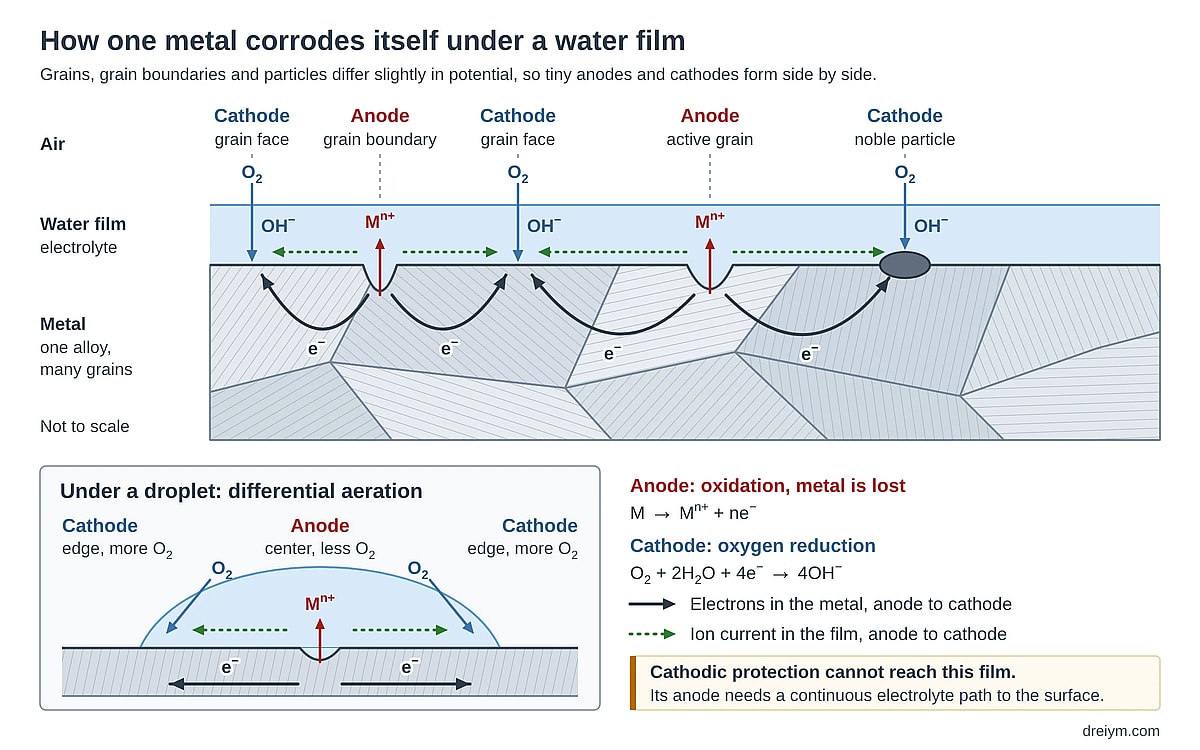
A single piece of metal can corrode on its own as soon as a film of water or condensation sits on it, because its surface is not uniform. Grains with different orientations, the boundaries between grains, inclusions and impurities, second phases, and areas that were cold worked or stressed all sit at slightly different electrical potentials. They act as many tiny anodes and cathodes, often called local action or microgalvanic cells, and the water film is the electrolyte that connects them. The anodic spots are consumed while the cathodic spots are not. A drop of water also creates an oxygen difference between its edge and its center, which concentrates the attack under the drop.
Cathodic protection cannot reach these cells. It works only where the metal sits in a continuous electrolyte, such as soil or water, that connects it to an anode or groundbed, and a thin, broken film of moisture on an exposed surface makes no such connection. Above ground, atmospheric corrosion is controlled with coatings, material selection, drainage and design details that shed water and avoid crevices, and control of humidity and contaminants such as salts. How corrosive the air is at the site sets how robust these measures must be. Cathodic protection belongs to the buried and submerged parts of the same structure, where it is checked with cathodic protection testing equipment.
Anodic protection is a specialized method for a few chemical services, such as tanks of concentrated sulfuric acid, and it does not control atmospheric corrosion either. For where cathodic protection does work, see how cathodic protection prevents corrosion.
Ensuring Proper Cathodic Protection
Chances are your metal structures, and electrical equipment utilize cathodic protection. While effective, this corrosion prevention method isn’t guaranteed. In fact, many businesses require regular cathodic protection testing services to ensure their structures are safe from corrosion.
Federal rule 40 CFR 280.31 requires that cathodic protection on an underground storage tank system be tested for proper operation by a qualified cathodic protection tester within 6 months of installation and at least every 3 years thereafter, and that impressed current systems additionally be inspected every 60 days to confirm the rectifier is operating. State implementing agencies may impose more frequent intervals, and the adequacy criteria must follow a recognized code of practice: AMPP®/NACE SP0285 for underground storage tanks or SP0169 for underground piping. Specifically, these individuals ensure your UST system has proper safeguards in place to prevent corrosion and other atmospheric-related problems. You can make adjustments and corrections to your cathodic protection by working with these professionals, effectively benefiting the well-being of others and the success of your business.
When Signs of Corrosion Appear
You may require services more frequently when signs of corrosion arise. For instance, it’s crucial that you pursue assistance if you notice oxidation and degradation across your metal structures. These issues are often easy to spot as corrosion presents as recognizable rust patches and surface discoloration. Consider consulting with a third party for better protection techniques for your structures if cathodic reactions continue. You may need anodic protection and other measures, such as powder coatings and more.
Understanding atmospheric corrosion, what it is, and how to mitigate it is essential when managing a building and protecting the people and businesses within. We at Dreiym Engineering proudly provide cathodic protection testing services to ensure your structures and equipment are safe and functioning. Contact our friendly team today for additional information on the various corrosion engineering services we provide or if you have any anti-corrosion concerns.
