About
Engineering for Utility Companies
We typically respond within one business day.
Engineering support for gas, water and electric utilities
Utilities own long runs of buried and overhead assets, answer to regulators and often run lean field crews. Dreiym Engineering supports gas, water and electric utilities with cathodic protection programs and designs, grounding tests and forensic investigations of failed equipment. Our engineers are licensed Professional Engineers, our corrosion team includes a NACE CP Specialist (CP4), and our work is PE-stamped where required.
Gas utilities
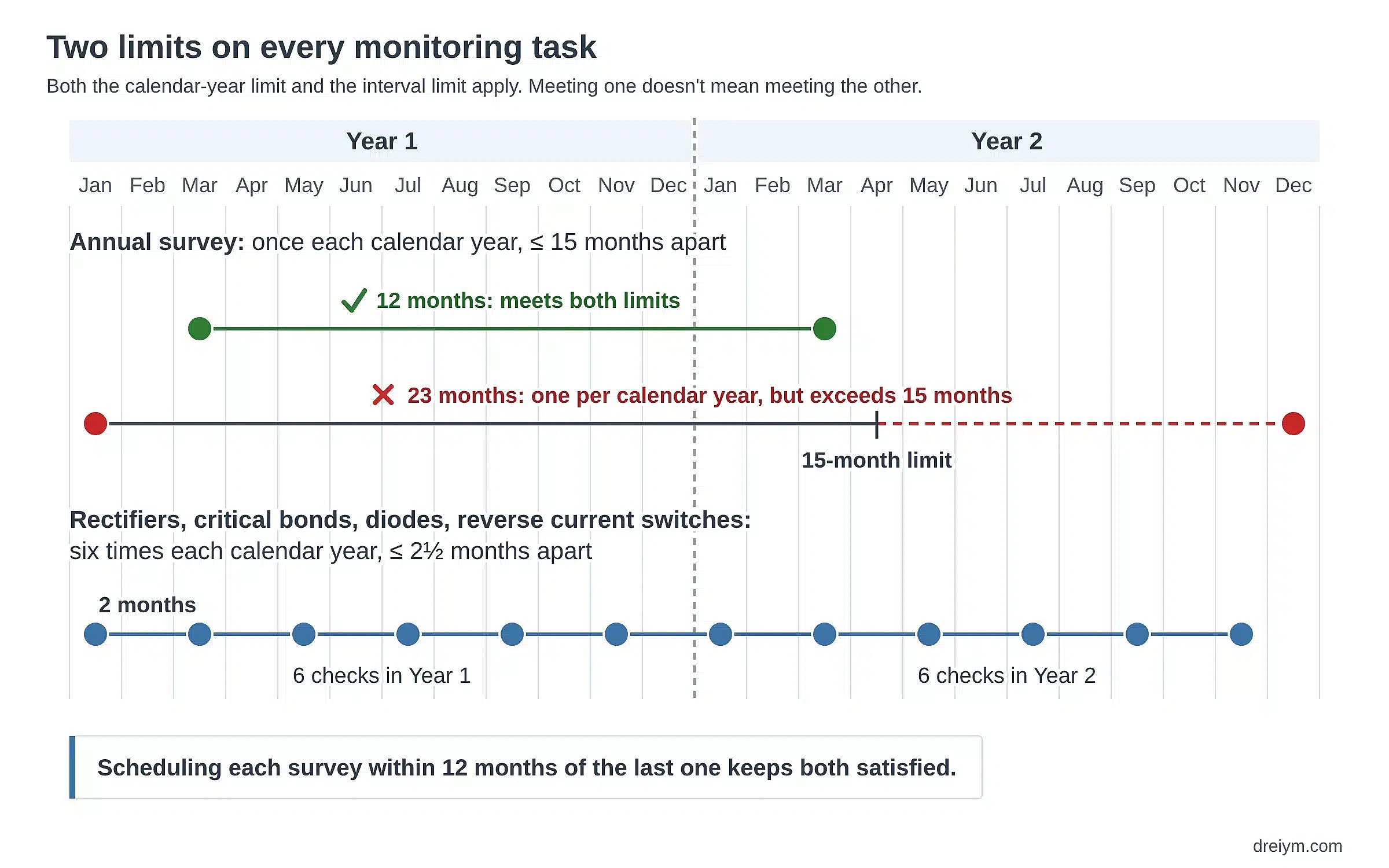
Gas systems answer to federal corrosion control rules whatever their size. Under 49 CFR 192.465, a cathodically protected system needs a survey at least once each calendar year at intervals not exceeding 15 months, and rectifiers are inspected six times each calendar year at intervals not exceeding two and a half months. Records have to be kept, some for as long as the pipe stays in service. We run that program for operators who would rather not build it in house; see cathodic protection for municipal gas systems. PHMSA counts corrosion and excavation damage among the causes of pipeline incidents it tracks, which is why the annual survey, interference checks and good line locations all matter.
A gas operator’s corrosion calendar
The federal corrosion rules set a calendar that every gas operator has to keep, whatever its size:
- Each calendar year, at intervals not exceeding 15 months: test each cathodically protected pipeline against the CP criteria. Short, separately protected sections of main and separately protected service lines may be surveyed on a sampling basis instead, at least 10 percent each year, so that the whole system is tested in each 10-year period (49 CFR 192.465(a)).
- Six times each calendar year, at intervals not exceeding 2 1/2 months: inspect each rectifier, on site or by remote monitoring, and check each reverse current switch, diode and interference bond whose failure would jeopardize protection. A remotely monitored rectifier also needs a physical inspection once each calendar year (192.465(b) and (c)).
- Once each calendar year: check every other interference bond (192.465(c)).
- Every 3 calendar years, at intervals not exceeding 39 months: inspect pipe exposed to the atmosphere for atmospheric corrosion; for service lines, every 5 calendar years at intervals not exceeding 63 months (192.481).
- Promptly: correct any deficiency that the inspections and tests find (192.465(d)).
Our article on the annual cathodic protection survey under 49 CFR 192.465 explains what the yearly survey involves and what to expect.
Water utilities
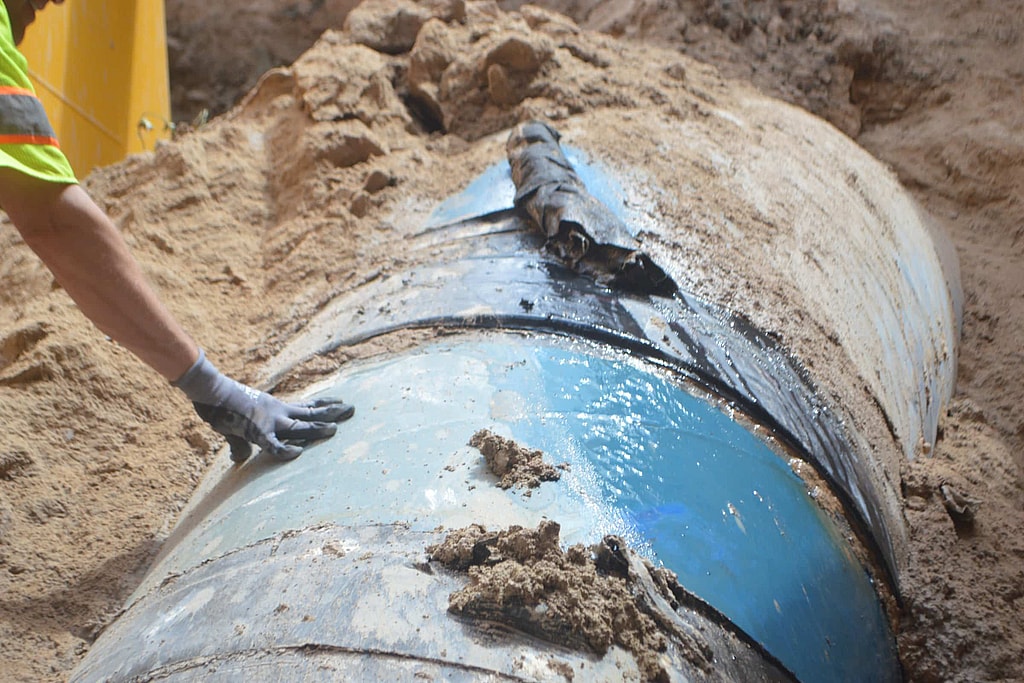
Steel and ductile iron water mains, storage tanks and pump station piping corrode in aggressive soils just as gas lines do. We test soil corrosivity along new routes, then design and install cathodic protection and commission it. Recent water system work includes CP designs for water transmission lines in San Antonio, the Fort Worth area and Mansfield, a galvanic CP design for a water storage tank near Austin, and pump station yard piping in San Antonio. Our cathodic protection design page explains how a design is built.
Related projects
- CP Design for Four Water Transmission Lines, San Antonio
- Water Line CP Designs, Fort Worth Area and Mansfield
- Galvanic CP Design for a Water Storage Tank, Austin Area
- Pump Station Yard Piping CP Design and Testing, San Antonio
From soil test to working CP on a water line
On a new main the work runs in a set order: soil corrosivity testing along the route, a cathodic protection design matched to the pipe and the soil, inspection while the system is installed, and commissioning once the anodes are connected or the rectifier is energized. Our soil corrosivity analysis and start-up and commissioning pages cover the first and last steps. On a water line in McKinney, one team took the work from the soil study through the CP design to commissioning.
Electric utilities and generating stations
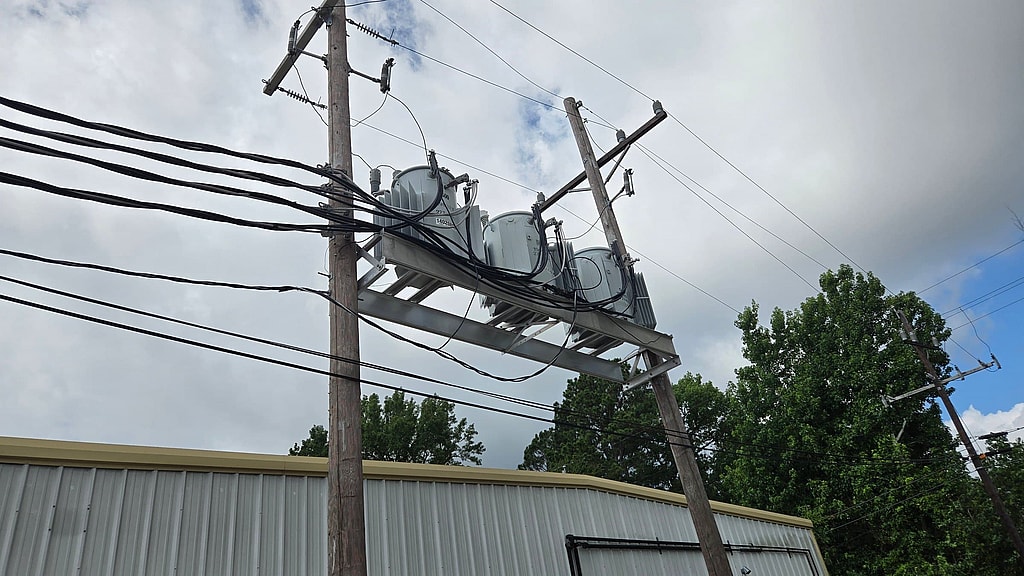
- Equipment failure investigations. Reclosers, transformers and other distribution equipment, where each party needs to know whether a failure started inside the equipment or was caused from outside. See our recloser and transformer investigations in Alabama.
- Transformer oil results. Where you already sample transformer oil, the transformer DGA calculator on our site screens the dissolved gas results under IEEE® C57.104-2019 and shows the history from sample to sample.
- Grounding and CP at plants. Ground grid surveys, grounding tests and cathodic protection surveys of buried gas and fire water piping at power stations.
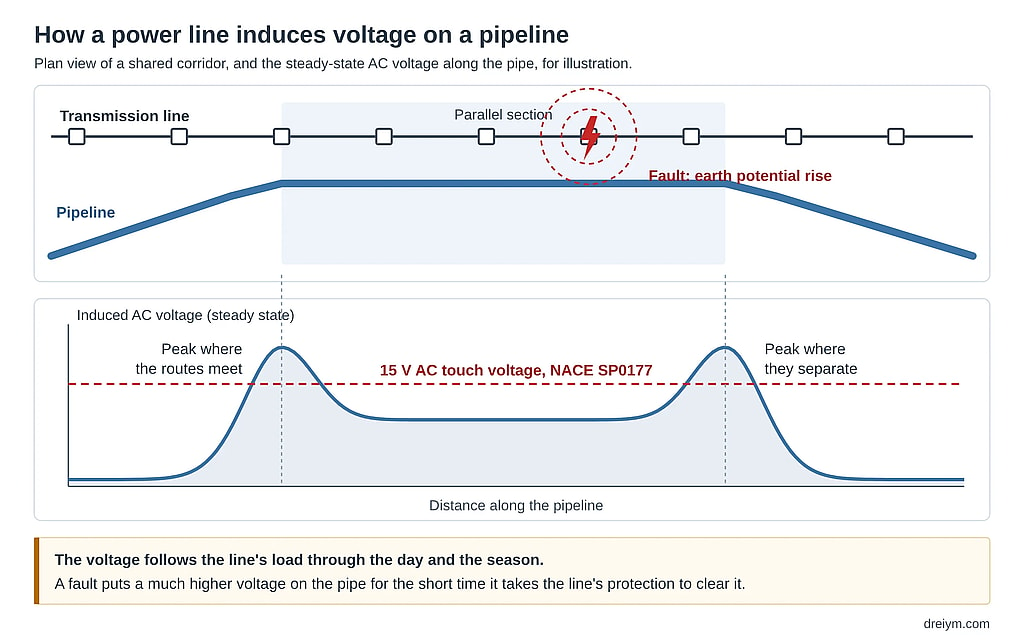
- Shared corridors. Where pipelines run beside power lines, AC interference testing and mitigation addresses touch voltage and AC corrosion.
Have a compliance date coming up, or a failed unit to explain? Request a free quote. We typically respond within one business day.
Working with us
When you call, you talk with an engineer. We provide a scoped proposal before work begins, and our offices are in Coldspring, Texas and Westcliffe, Colorado.
What a utility receives from us
- Survey data for every test point, compared with the CP criteria, with readings that fall short flagged
- Rectifier inspection records with output, settings and condition
- A list of deficiencies with the likely cause of each and the repair we recommend, so they can be corrected promptly
- Records organized for retention and for an audit
- Designs, test reports and failure investigation reports reviewed by a licensed Professional Engineer and PE-stamped where required
For grounding at substations and plants, see our ground testing; for failed equipment, our electrical failure analysis; and where a new rectifier or another operator’s line may be affecting yours, our interference testing.
Frequently asked questions
How often must a gas utility test its cathodic protection?
At least once each calendar year, at intervals not exceeding 15 months, under 49 CFR 192.465. Short, separately protected sections of main and separately protected service lines may be sampled instead, at least 10 percent a year, so the whole system is tested every 10 years.
How often are CP rectifiers inspected?
Six times each calendar year, at intervals not exceeding 2 1/2 months, on site or by remote monitoring. A remotely monitored rectifier also needs a physical inspection at least once each calendar year.
Do water mains need cathodic protection?
It depends on the pipe material and the soil. Steel and ductile iron mains can corrode in aggressive soils, so testing soil corrosivity along the route is the first step in deciding, and the design follows from it.
Can you investigate a failed recloser or transformer?
Yes. We investigate failed distribution equipment, such as reclosers and transformers, to find whether the failure started inside the equipment or was caused from outside it.
How long must a gas operator keep corrosion records?
Records of each required test, survey and inspection must be kept at least 5 years. Maps or records of protected piping, CP facilities and anodes, the annual CP survey records, and inspections of removed pipe must be kept for as long as the pipeline remains in service (49 CFR 192.491).
Talk to an engineer
Have a compliance date coming up, or a failure to explain? Request a free quote. We typically respond within one business day.
Get your project started
We typically respond within one business day.